Transcriber's note: Unusual and inconsistent spelling is as printed.
BY
RUTH LAMB
AUTHOR OF "HER OWN CHOICE," "SERVANTS AND SERVICE,"
"OF NO ACCOUNT," ETC.

LONDON
THE RELIGIOUS TRACT SOCIETY
56 PATERNOSTER ROW AND 65 ST. PAUL'S CHURCHYARD
CONTENTS.
CHAP.
ONLY A GIRL-WIFE
—————♦—————
EVERY inhabitant of Shelverton and its neighbourhood admitted that Dr. Fereday's house and grounds were the prettiest to be seen for many a mile. Larger and grander dwellings there were, but none of these could compare with Steynes-Cote for picturesqueness.
The house was a smaller copy of a fine old half-timbered mansion belonging to his wife's father, in which Mrs. Fereday had spent her girlish days.
At her father's death, it went to a male cousin along with a large portion of the property, but the doctor's wife had a life interest in a compact estate, which brought in a handsome income.
If there had been any young Feredays, this property, and more, would have descended to them. But unfortunately, the doctor and his wife were childless, so Mrs. Fereday's fortune would return to the Steynes at her death. In the meanwhile, the master of Steynes-Cote was an exceptionally well-to-do medical man.
He possessed some private income, was "the doctor" of Shelverton and a wide outlying district, physicked the majority of the poor folk without fee or reward, and had plenty of patients of a class both able and willing to pay him. He was not over-worked, for, though the practice was wholly in his hands, two thoroughly qualified assistants bore the greater share of the burden, and resided under his roof.
Dr. Fereday had built Steynes-Cote in order that when Grace Steyne left her old home to become his wife she might miss no comfort or even luxury to which she had been accustomed. As to Shelverton folk, it was hard to tell whether the doctor, or the sweet gentlewoman who was so liberal with the kitchen physic which supplemented her husband's doses, was more popular amongst them.
It was commonly reported that the village children rejoiced in any ailment which brought Mrs. Fereday to their sick-beds with inquiries and good things, for the childless lady was very tender towards the little people round about Steynes-Cote.
There was one puny pensioner of hers who answered, when Mrs. Fereday wished she might soon be better, "I don't want to, thank you. I like being poorly, 'cause everybody's so good to you when you're ill. Mother's not half so cross, and you come and see me and bring nice things. I'll stop ill a long while, please."
The child looked up with a wan but confiding smile, and wondered that Mrs. Fereday's eyes were wet with tears. The home was a wretched one, and overcrowded with children, who were but little valued in it. As the childless lady turned away, she thought, "What a treasure would even that one little creature be to me, if I could call her my very own!"
Mrs. Fereday was not to be enriched after such a fashion, but she was soon to possess the next best gift, in the shape of an adopted son, though not one of her own kith and kin.
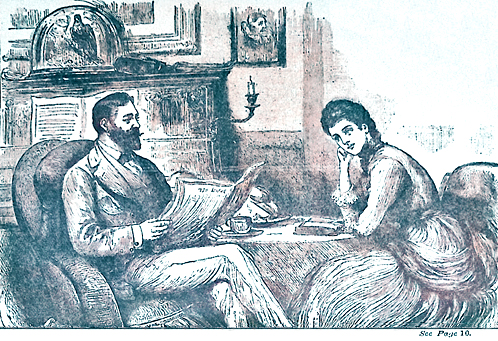
The doctor was a model husband, but during a certain portion of each twenty-four hours, he was accustomed to try his wife's patience rather seriously. This was at breakfast, when he invariably thought fit to absorb his tea, toast, and the "Times" at irregular intervals, during at least an hour.
Like most gentlemen, Dr. Fereday laboured under the delusion that, by taking in supplies of mental and bodily food simultaneously, he economized time.
He was mistaken, for he spent twice as long over his breakfast as anybody else did.
The assistants finished their meal, begged to be excused, and departed, the one to pay a round of visits, the other to await patients in the surgery.
Left alone with her husband, Mrs. Fereday would take a book and prepare to bear him company until he had finished the double process already described.
Not that the doctor needed company, in one sense. If Mrs. Fereday made an allusion to village affairs, she would receive a response relative to doings in Russia. If she asked a question about domestic supplies, she would probably obtain some valuable but totally irrelevant information with regard to the mode by which the national expenditure was to be met—and so on.
Nevertheless, Mrs. Fereday made a point of sitting at table so long as her husband chose to do so, unless summoned away to meet some special domestic difficulty. She knew very well that were her seat left vacant, he would know of and be affected by her absence.
The mere consciousness that his wife was beside him imparted a double relish both to Dr. Fereday's food and the latest intelligence. So Mrs. Fereday sat on until her husband chose to move, though doubtless her chair was occasionally rendered uneasy by the imaginary pins which are said to fill the cushions of those who feel that their presence is needed elsewhere.
Like a true wife, Mrs. Fereday placed her husband's pleasure and convenience first of all, and rejoiced to know that her mere presence added something to the sum of his happiness. Occasionally she would be rewarded by hearing her husband's voice as he read aloud some tit-bit of information for her benefit—a doubtful advantage, under the circumstances. A paragraph from a newspaper, however admirable in itself, mingles with the page of an interesting volume on a totally different subject about as appropriately as would a spoonful of mustard with a dish of strawberries and cream.
When Mrs. Fereday—not having heard a single word—turned to her husband with the face of a person who has been suddenly roused from sleep, and a vague, "Yes, dear," at the moment when he expected a prompt negative, the doctor would smile benevolently, and say, "I see you were not listening, Grace. Never mind, my love; I ought not to have interrupted you."
Dr. Fereday had a way of looking forgivingly at his wife under such circumstances, and making her feel quite guilty and ashamed of herself because she had not sat ready to listen and totally unoccupied, in case he should speak once in a quarter of an hour.
But she never grumbled or accused her husband of being unreasonable. She loved him too well to nag or squabble about trifles. So she would laugh cheerily, and say, "You should have jogged my elbow, Abel. I was almost as deep in my book as you were in your paper."
There was, however, one morning on which Mrs. Fereday did feel unusually anxious for half an hour's quiet talk with her husband before he set out on a professional round. She listened eagerly as the surgery bell sounded from time to time, lest its tone should convey a summons which "the doctor" must answer in person. Were he called away early, she might have no chance of a quiet chat until nightfall.
Dr. Fereday's sister, Agnes, had married a Scotch minister, the Rev. Archibald Crawford, and her already populous nursery had just been further enriched by the arrival of twin boys.
"Actually eight of them now, Grace," the doctor had said, as he laid down his brother-in-law's letter with an expression on his face which hardly gave the idea that he looked upon the new arrivals with approval. "Crawford's income is but small. It is wonderful how Agnes and he make ends meet."
Probably the ends would not have met, but for certain additions quietly made by Mrs. Fereday from her own private income, and other helps by the way, for which the doctor was responsible.
His wife's musings on the morning alluded to were all concerning that overflowing nursery. "More than enough of children at the Manse, more than enough of everything else at Steynes-Cote. Would it not be possible to render matters more equal?"
Mrs. Fereday asked herself this question many times daily, and she now waited the opportunity to put it to the doctor. At last he came to the end of his paper, and leaned back in his chair with a look of satisfaction—always the result of an uninterrupted perusal of the latest news.
"And now, Grace, my dear, have you anything to say before I go out, or any commission that I can execute?"
"Something to say, Abel, if you can spare a few minutes to listen. I have been thinking so much about Agnes and her new babies, and wondering whether we might not take—"
Dr. Fereday started with an air of consternation.
"Not the twins, dear! Don't say you have set your mind on them. If it were one of the elder children that you would like to invite here for an indefinite time, you have only to say the word and take your choice, provided Crawford and Agnes are willing. Better not say 'adopt' in the first instance."
Mrs. Fereday laughed cheerily. "It is not the twins I am hankering after, Abel," she said. "They, poor little tender things, will need a real mother. But I have often thought how nice it would be to have the second boy. He is about twelve years old, a bright, intelligent lad, and I have heard Agnes say that he wants to be a doctor when he is old enough."
"Much he knows what he wants before he is in his teens. But that is of little consequence. If you know what you want, you shall have it, if possible."
"If we do adopt one of your sister's boys, I should like to have Andrew Fereday Crawford. He is called after you. He has a leaning towards your profession, and I doubt whether his parents could bear the expense of educating him for it. He might learn it here, and, should he turn out all that we hope, take a son's place, and become your assistant or partner."
"Do as you like, dear Grace. The lad will be something to enliven you, and, should he come under your care, will be a very fortunate fellow. I should have thought you would prefer a younger to train. He would have seemed more your own if you had started with, say, a three-year-old."
But Mrs. Fereday, while thinking of herself in part, was also planning for others yet more. She would have preferred a "three-year-old," or one younger still, but with sweet unselfishness she proposed to ask for Andrew, because she knew about the lad's longings, and because she wanted her husband to have in him a son who would soon become a bright, intelligent companion for him in his rounds, and be associated with him in his professional pursuits.
So, in due time, Andrew Fereday Crawford came from the overstocked Scotch home to be cared for by his uncle and aunt at Steynes-Cote. He was bright, affectionate, true-hearted, diligent. He made rapid progress in his studies, cheered the once too silent home by his presence, was the means of introducing more young life into the house in the shape of boy companions, and, by his devoted affection to his adopted parents, made them often thank God that they had been moved to take him under their roof and to their hearts.
Years passed on, and Andrew Crawford, having studied diligently, passed his various examinations brilliantly, and stood before his uncle and aunt a fully-fledged doctor, of whose attainments they had cause to be proud.
But who that has done well is satisfied without striving to do more and better? Who that has learned something about a subject which interests him, but wants to increase his knowledge and enlarge his experience?
Andrew Crawford was an enthusiast in his profession, and truly as he loved the dear relatives to whom he owed the position he had attained, he longed for wider experiences than Shelverton would furnish, and to see more of the world beyond, before finally settling down as his uncle's right-hand man.
Dr. Fereday being still in the prime of life and equally kind and reasonable, thought Andrew's desire a very natural one, and resolved to gratify it.
"It will be the better for you, my boy," he said. "I am only forty-eight, and hope to fill my own shoes for a few more years, before slipping them off for you to step into. I should like to keep you here, and so would your aunt, but we will not be selfish. Besides, it seems only the other day since you were a boy, and Shelverton folk cannot all at once forget to call you 'Master Andrew.' As my partner now, you would not take the same position as you would after a few years' absence and practice elsewhere. At Shelverton, you are still a doctor in the bud. You shall go away for a time and return fully blown."
Thus encouraged, Andrew Crawford elected to win his experience in the position of an army doctor, and had only just gone through the necessary preliminaries and received his appointment when the regiment was ordered to India. Then there was a rapid leave-taking, and the young man turned his back upon Steynes-Cote and the dear relatives who had loved him as a son.
This departure was perhaps hardly what Mrs. Fereday calculated upon when she sent for the bright lad from the overcrowded northern manse, and gave him the affection of a mother. But she took care that her last look should be a bright one, her last farewell mingled with a blessing and a prayer for Andrew's happiness. He did not see the after-tears which were shed for him in the quiet of his aunt's chamber, but he judged rightly that many prayers would thence go up to God on his behalf.
A few months after Dr. Crawford's arrival in India the Mutiny broke out, and he went through many experiences which had never entered into his calculations. However, through all that troubled time, he so conducted himself as to win golden opinions, not merely for professional skill, but as a man who was equally gifted and modest, tender-hearted and brave.
The colonel of Crawford's regiment was Viscount Carnelly, and the two were on terms of warm friendship. Thus it happened that when the young orphan sister of the colonel came out to join her only brother and guardian, and to reside under his roof, Dr. Crawford was one of the first to meet and be introduced to the new arrival.
Ida Carnelly was just eighteen when, having completed her education in England, the restoration of order in India enabled her to join her brother and his family. Indeed, through all the time of trouble the colonel's wife and children were in a place of safety, and knew nothing, except by hearsay, of what passed in the disturbed districts, or the horrors which cost the lives of many as delicately nurtured as themselves.
Viscount Carnelly was very anxious to do his duty by the pretty young creature, who looked to him to fill the places both of parents and brother, and from him Ida received a truly affectionate welcome on her arrival. This was, however, scarcely seconded with equal warmth by his wife, a vain and selfish woman, to whom the prospect of chaperoning a beautiful young sister-in-law was anything but agreeable.
Lady Carnelly had various reasons for regretting that Ida would be thrown wholly on her hands. Perhaps the chief of these was that, having been deemed a beauty in her own girlish days, she was still unwilling to yield her claims to admiration in favour of another. And yet she was the mother of six children.
Is there on earth a more pitiable spectacle than that of a young wife and mother, who, with a kind husband and a troop of bright children around her, is still possessed with a craze for admiration; who, not content with the large meed of affection and influence which home ties furnish, sighs at the memories of girlish triumphs, envies her young acquaintances, and is ever hungering after flattery, and striving to attract attention and meaningless compliments to herself?
Yet such a picture is not an uncommon one, and such a character was that of Lady Carnelly. She had been a very beautiful girl, and now, after ten years of married life, she chose to talk and act as if she were still eighteen, instead of being wife, mother, and thirty years of age.
It is needful to tell this much in order to show why Lady Carnelly looked with disfavour on the coming of a sister-in-law, beside whose fresh young loveliness she could only appear what she was—a very handsome matron. So the girl, new from school and ignorant of the world, had to endure many unexpected annoyances, of which her brother little dreamed, at the hands of his vain and foolish wife.
VISCOUNT CARNELLY was by no means a rich man, and his wife's extravagant tastes made him a poor one. The arrival of his sister was, however, no disadvantage, for the interest of Ida's little fortune amply sufficed to cover all her expenses, and was really of service to her brother.
It suited Lady Carnelly to give a different impression with regard to the girl's coming. She did not say in so many words that Ida was dependent on her brother, whose family, and most of all, his wife, had to exercise self-denial in order to meet this additional claim. But she succeeded in conveying this impression to the minds of many of her acquaintances, partly by what she said, still more by what she left unsaid. No remark of the kind was made in Ida's presence, but the insinuations of her sister-in-law could not be persistently repeated, even under promise of secrecy, without at length coming to the girl's knowledge. Grieved and indignant, she scarcely knew what course to take. She felt inclined to deny that her residence under her brother's roof was at his cost, or that it necessitated self-denial on the part of Lady Carnelly.
"Lindsay has told me more than once," thought she, "that my being here was rather a benefit than otherwise, and said that I almost spent too little on dress and other minor personal matters."
She was about to say this to the gossip who had made her acquainted with her sister-in-law's insinuations, when, catching sight of the eager, curious expression on her face, she restrained herself. With quiet dignity she said,—
"I cannot understand why my private affairs should be discussed in such a manner, even by my brother's wife—if she has indeed spoken of them as you say. I think you must have misunderstood her; but in order to remove the false impression, I will ask my brother—"
Ida could not finish her sentence, for her visitor warmly protested against Lord Carnelly being made acquainted with the matter at all.
"It would perhaps cause some unpleasantness, and one should never do that between husband and wife, my dear Miss Carnelly. Besides, Lady Carnelly did not exactly say you were dependent on your brother, and it was hard on him and herself, but she gave me to understand as much. Perhaps I have gone too far. And, you know, I said you must not repeat what I was going to tell you. It was rather a breach of confidence on my part, but I felt for you, and thought you ought to know."
"I made no promise of secrecy," said Ida.
"No; but you allowed me to go on, and so, I think, it was implied. I would not make mischief amongst members of the same family for the world."
"As if you had not done it already!" thought the girl. But she answered coldly, "Since you took my silence as equivalent to a promise, I will say nothing either to my brother or his wife on the subject. You will excuse me now, please. I am a good deal troubled by what you have told me."
Glad enough to escape, the visitor departed, and Ida was left to grieve and chafe under the knowledge of Lady Carnelly's unkindness and want of straightforwardness, without daring to appeal to her brother.
"Poor Lindsay!" thought she. "I will never be the one to disturb his domestic quiet by any act of mine. He is very fond of his wife, and it is right he should be. But it is hard for me. I was so reckoning on coming, after being so long without a real home, just staying on at school from year to year. I thought Beatrice would be as glad to have me as I should be to come, and that I should find a true sister in her. What can I have done to make her treat me so strangely? And to speak of me amongst these gossiping people as if I were a pensioner on Lindsay's bounty, and robbing his wife! It is too bad, and it is shamefully untrue. Ought I to sit down quietly and bear it?"
Such were Ida's mental cogitations, and as they were drawing to a close she caught sight of her brother and his handsome wife, he looking proud and pleased, she evidently amusing him with some lively talk, whilst two of the little ones played at their feet.
"I will bear as long as I can," was the girl's decision. "I am almost a stranger to Beatrice yet, and I daresay she does not care for having a third person—even Lindsay's sister—so much with them. I will study her likings, and be careful not to intrude too much upon the privacy of husband and wife. I daresay I shall win her affection in time, and when we understand each other better, this matter which has troubled me will, no doubt, be easily cleared up."
Not for a moment did the girl guess that Lady Carnelly could be jealous of her. Ida had not been accustomed to flattery or compliments, living in the quiet atmosphere of a boarding-school, where only a dozen pupils were received. She thought very humbly of herself in comparison with her brilliant sister-in-law, who might have had in this innocent-minded girl a sweet companion and great admirer.
Perhaps, had Lady Carnelly understood the feelings of her young guest, she might have been flattered by Ida's admiration, which was equally simple and genuine. But she never troubled herself to study Ida's character. She judged it by her own, and, long before the girl came from England, made up her mind that in her she would have a rival, whom it would be her business to humiliate. It would, however, be easy enough for her to hold her own against a mere schoolgirl, she thought, and from the very first, whilst preserving an appearance of smiling good humour, this clever woman of the world succeeded in trying Miss Carnelly's patience almost beyond endurance.
Sometimes Lady Carnelly would contrive to make Ida appear ridiculous, at others to sting her to the quick by some trifling remark which had none the less been carefully studied, though seemingly carelessly uttered.
Then, when the girl, whose temper was naturally quick, was driven to retort, or, while remaining silent, had hard work to restrain her tears, Lady Carnelly would profess to soothe her like a petted child. Or, if Ida left the apartment, she would lament the hasty temper which rendered her poor sister-in-law unable to bear the least bit of raillery without flying into a passion.
"I am positively afraid to speak to the child," she would say. "First she flies up in this absurd way, and then makes herself ill by fretting. I am pretty even-tempered myself, or I could not bear with Ida. Being Lord Carnelly's sister, I am naturally most anxious for her to be comfortable, and feel a great delicacy in dealing with her. If she were my own—" And then the speaker would shrug her shoulders, and leave her hearers to guess the rest.
Looking, as she did, indulgence and good humour personified, she always left the impression that she was the injured, worried individual, and Ida the one who was always meeting grievances half-way, and destroying the peace of the household by her childish petulance.
What could her hearers do but condole with her on having such a wilful charge? And then Lady Carnelly would wax pitiful over herself, and sigh and bemoan her responsibility.
"If I were older it would be different, you know. But it is a very serious matter to have the guardianship of a sister-in-law so near one's own age, so ignorant of the ways of society, and yet so self-willed."
Somebody ventured to say, "I thought the colonel was his sister's guardian?"
"In the eye of the law he is, of course. But who does not know that where a girl is question, the lady who has charge of her is the real guardian, on whom rests the great weight of responsibility?"
Lady Carnelly's hearers could hardly help assenting. Did she, however, deceive them? Probably she scarcely expected to do so. Certainly there was one who saw through her actions and divined her motive. This was Dr. Andrew Crawford, who, from the first, had deeply regretted that this innocent, tender young creature should have no more sympathetic female friend about her than Lady Carnelly.
"She can sway most of her immediate intimates," thought Dr. Crawford. "Her position as the wife of a man of title and colonel of the regiment gives her so much influence, of a sort. Both men and women are afraid of offending her, for she is clever into the bargain. I pity the girl, poor thing! Her brother will never see what is going on, and, if I judge Miss Carnelly rightly, she will not be the one to tell."
Lady Carnelly's plan succeeded perfectly, and Ida gradually withdrew herself more and more out of her sister's little world.
Happily for the girl, she was fond of children. A loving nature must have some object on which to lavish its wealth. It cannot even be contented without some measure of self-sacrifice, so Ida made the nursery her frequent refuge. Her brother's two eldest children had been sent to England before she left it, but there were four still at home. In the little ones she found objects to occupy and interest her, and she was more really happy with them than when under the chaperonage of their mother.
Lord Carnelly often urged Ida to accept invitations, but the moment his wife professed to second him, the girl would shrink away, and say, with truth, that she preferred remaining at home. Then Lady Carnelly would laugh, and in a playful tone accuse her of obstinacy.
"She will have her own way, Lindsay," she would say. "If I ask Ida to do a thing, that is quite enough to make her choose the opposite course. You are apt to fancy that it is my fault your sister stays so much at home, but I hope you now see for yourself that such is not the case."
Before the sentence was finished, Ida would be out of hearing.
On one of these occasions Lord Carnelly looked regretfully after her retreating figure, and said, "How much the child is altered! She used to be considered so very sweet-tempered. In fact, if anything, too easily swayed, particularly by those whom she loved, or any one who was kind to her. School life and discipline often alter girls, especially if those in authority do not study the dispositions of their pupils. Ida always seemed happy at school, and whilst she reckoned on being with us here, she left her teachers with great regret."
"Girls may be changed during their school-days, but I presume they are sent to school in order that they may alter for the better. You seem to insinuate that if Ida has changed, it must be for the worse, seeing she was so very amiable before," replied Lady Carnelly, with ill-concealed scorn.
"I did not mean to convey such an idea, Beatrice; I only tried to recall to mind what my sister was as a child, and to account for the great difference you seem to find in her. I am sorry, dear, that she should be a cause of annoyance and anxiety to you."
"I suppose it must be because I have not been kind enough to Ida, or else that I have not yet had time to make myself sufficiently acquainted with her disposition to manage her properly. But she is the first grown-up baby with whom I have had to do."
"Are you not rather hard on Ida?" asked Lord Carnelly, his face showing how much he was pained by his wife's words.
"Hard! I think few girls have so much freedom as your sister enjoys, and probably that is one reason why she appreciates her position so little. Coming here straight from school life, she cannot complain of undue restraint. She is invited wherever I am, and has the option of refusing or accepting, as she may think proper. She has the position of an independent woman, though only a girl. And on the other hand, if the least thing puts her out, she acts like a perfect child. The fact is, she has too much indulgence, too many good things."
"I do not think she avails herself of her opportunities to any unreasonable extent. On the contrary, she refuses two out of every three invitations."
"Precisely so. Like a child again, Ida scarcely knows what she wants. Too many sweets spoil the appetite, and the provoking part is, that the girl refuses most of the invitations which any on but herself would consider it a privilege to accept. She will offend the very people who are inclined for our sakes to show her special kindness. Ida never thinks of yielding to my advice in such matters. But it is only what might be expected. I always told you, Lindsay, that I was not old enough to take charge of a grown-up girl like Ida. It is a pity you did not place her in the hands of some family connection, and let her remain in England."
There was no near relative to whom Ida could have been entrusted, and Lady Carnelly knew it. A loving woman would never have uttered such a suggestion when there were but the brother and sister near of kin, truly attached to each other, and wishing to be together.
Her husband, however, took a humorous view of these last words, and with a hearty laugh, inquired whether she thought a residence with two ancient maiden great-aunts—the only persons whom he could call to mind at the moment—would have been quite to the taste of a girl like Ida.
"You always turn things into ridicule, Lindsay. How do I know what would have suited your sister? Perhaps the great-aunts might have known better what to do with her than I do. She is not satisfied here, where her circumstances are so different. However, I shall not make myself miserable about the whims of a girl who does not know when she is well off."
Without waiting for a reply, the speaker left the apartment and her husband.
Lord Carnelly pondered, and hardly knew what to say or do. To him, Ida seemed only improved since those early days when she had been the pet and darling of her grown-up brother and their parents. To himself she was always most affectionate. When in his presence she readily agreed to any reasonable wish, and to the children she was at all times loving and tender. Indeed, her sweetness and patience towards the little people touched the heart of the loving father, and tightened the bond between him and his sister. Surely she could not be so very different when out of his sight!
Lord Carnelly, after much cogitation, came to the conclusion that it was often difficult for two ladies, however individually lovable, to agree together, and he trusted that time would smooth differences, and make his wife and sister better friends.
When Lady Carnelly re-entered the room, he spoke soothingly to her, and tried to take the peacemaker's part.
"I am sure," he said, "you are both kind and very indulgent to Ida. You wish to make her happy, but perhaps, owing to your surroundings and hers having long been different, you scarcely understand each other. You will be patient with her for my sake as well as her own, will you not, Beatrice? I have wife and children as well as my sister. Ida has only her brother, until she learns that in you she has a sister also."
Lord Carnelly did not see the look of good-humoured contempt on his wife's face, for it was turned away, but at this moment the subject of the conversation entered.
"Have you decided to go with me, after all?" asked Lady Carnelly, who was in evening dress and prepared for a visit.
"No, thank you, Beatrice; I prefer remaining at home," replied Ida.
Lady Carnelly glanced significantly at her husband, as if to say, "You see for yourself." Then, answering Ida, she said, "Take your own way, my dear. I wished you to come, and wasted a great many words in trying to persuade you. But no one shall say that you make a martyr of yourself to please me."
Then with a light laugh the speaker went off to keep her engagement.
THERE were many who saw through Lady Carnelly's treatment of her young sister-in-law, and pitied the girl. But in her own circle, the colonel's wife reigned supreme, and no one was better able than herself to appreciate and use the advantages she possessed.
"If there is anything wrong, the colonel is the proper person to put it right, and to take care of his sister," was a common remark, but only a whispered one.
Those who made it did not profess to solve the difficulty in which a man may be placed between opposing parties, when one is represented by a wife to whom he is devotedly attached, and the other by a still younger and more beautiful sister, to whom he stands in the place of father.
The colonel, though a brave soldier, was one of the most peace-loving of men in domestic life. Finding that there were jarring elements under his roof, and unable to decide between them, he wisely said as little as possible, and trusted to time for a solution. In the meanwhile, he was, if possible, doubly kind to both.
Of all the lookers-on there was perhaps only one person who thoroughly understood the state of affairs between the sisters-in-law. A keen observer of character, he had quickly formed a just estimate of Lady Carnelly's. He knew her greed of admiration, her jealousy of anything like rivalry, and her affectation of girlish ways. He judged that if Ida had been older and less attractive, she would have been much more acceptable to her brother's wife. The girl's youth and beauty were her offences, and her sensitive nature enabled Lady Carnelly to punish her for them.
It was Dr. Crawford who had arrived at this conclusion, and who chafed under the annoyances to which Ida was subjected even more than she did herself. From the very day of Miss Carnelly's arrival in India, the young doctor had been greatly attracted towards her, as a brave man's sympathies are sure to be in the direction of one who is fighting an unequal battle. He would have been sorry for any girl who was so much in Lady Carnelly's power, and Ida was not likely to rouse less indignation on her behalf because she was young and fair to look upon. His feelings reached a climax most unexpectedly.
One evening Dr. Crawford was a guest at a dinner party, to which he knew Miss Carnelly had been invited. He was also aware, through an incidental remark of the hostess, that she was expected. Yet the colonel and his wife duly arrived, and Ida failed to appear. The doctor inquired after her, and expressed his surprise that she had remained at home, when only a few hours before she had said she would be present.
"I hope Miss Carnelly is not ill," he remarked.
Lady Carnelly shrugged her shoulders. "Ill! Certainly not. There was nothing to prevent her coming that I know of; she simply changed her mind. Would you know why? Ask the wind why it varies. It is quite as easy to account for its doings, as for the whims of my sister-in-law."
She passed on without giving Dr. Crawford an opportunity of making any further comment, but leaving him determined to find out the cause of Ida's absence, if possible, from herself.
Doctors are privileged people, and find it easy to make excuses for a temporary absence. After promising his hostess to return as quickly as possible, Crawford went to the colonel's house.
One of the children was ailing, and, on entering, the doctor quite intended to visit his small patient. But he did not reach the nursery, for, as he passed the door of a room which was almost in darkness, he heard a faint sob. He gave a slight tap, and Ida said, "Come in," thinking it was a servant with lights.
The girl gave a little cry, half of shame, half of gladness, as the doctor entered. She was rejoiced at the sight of a friend's face, yet eager to wipe away the bitter tears which were streaming down her cheeks. She looked so sad and lonely in the dim light, that Dr. Crawford's heart beat fast from a combination of feelings. How could he help trying to comfort her? For what else, indeed, had he come? He could not honestly persuade himself that anxiety about the small patient in the nursery had induced him to leave the bright rooms and cheery companionship of many friends.
"I am afraid you are ill," he said. "What can I do for you?"
Won by the kindly, sympathetic tone, Ida sobbed out her story. "I am not ill, but I am such a baby. I cannot help crying when I am grieved, and Beatrice knows it. She did not want me to go with her and Lindsay to-night, though she knew I had accepted the invitation, so she teased me about the party and—and people who were going, and said what she knew would grieve me, only in a sort of jesting way. I could not tell you her words, and if I did, daresay they would seem of little matter to you. Only they troubled me, and she went on in her provoking way for a long time."
"And then?" said the doctor gently.
"Oh, then I broke down, and cried. I had tried very hard to keep up, but at last I could not bear up any longer. Of course my eyes became quite red; they always do when I cry much, so I could not go out with a face that would tell everybody what a baby I had been. I was dreadfully disappointed." And the poor girl's sobs came again, and stopped her tale.
"What did Lady Carnelly say? Was she sorry?"
"No; she laughed at me for being such a child as to cry about everything or nothing."
"Was your brother present?"
"Lindsay? Oh yes; and he was very sorry to leave me, for I was actually dressed ready. But what could he do? He looked at his wife, as if he wondered whether she could be to blame about my crying."
"The colonel must have seen that Lady Carnelly was teasing and irritating you, though he might not think that she did it on purpose."
"I think not," said Ida frankly; "Beatrice does her teasing in such a pretty way, at least it seems pretty to lookers-on. She laughed, and seemed as bright and pleasant-tempered as possible. She even kissed me, and said she did hope I should soon get over this hysterical tendency, as it so sadly interfered with my enjoyment, and advised me to go straight to bed and have a long sleep. As if I could!" added the girl indignantly, and her tears flowed afresh at the memory of her disappointment.
For a few moments Dr. Crawford was silent, not from lack of words, but lest he should express himself too strongly and be sorry for it afterwards.
He found himself in a very peculiar position. He was Lord Carnelly's friend, trusted beyond most, and privileged to come in and go out of his home almost at will. He had been curious to know the real cause of Miss Carnelly's absence, and he came to the house with the ostensible purpose of seeing the sick child, and with the secret hope of finding that Ida had stayed at home to please the little one, and would be found in the nursery.
All the rest—the interview, the girl's tears and almost childlike confidence in her brother's friend, whom she was accustomed to see daily—had come in without any premeditation on his part, or intentional meddling with family affairs. He could not help expressing his sympathy for Ida, and his indignation at Lady Carnelly's conduct, even while he felt it was hardly loyal to the colonel to interfere.
"Have you ever spoken to your brother about these annoyances?" he asked.
"To Lindsay about his wife? No, I could not. He is always good to me; and really, if I were to try and repeat what Beatrice has said, I could not. The words seem mere nothings, though they grieve me, and they would sound almost ridiculous to other people. Sometimes I think I must be very small-minded to notice them, and that Beatrice does not know the effect of her words and manner upon me."
"Does she not?" muttered Andrew Crawford, between his teeth. "Does the cat know when the mouse is trembling between her paws, before the claws have actually drawn blood?"
"Sometimes I fancy she does find a pleasure in giving me pain; but even if it is so, I must do nothing to cause unpleasantness between my brother and his wife. Better anything than be a mischief-maker. Besides, I have no positive right to be here. It was kind of Beatrice to agree to my coming, for sisters-in-law may be in the way sometimes, you know. I try not to be. Any way, it would be dreadful for me to make a disturbance about—I can hardly tell what. I wish I could have a little house or live in some very quiet place, with older people than Lindsay and Beatrice. I seem to want a mother very badly."
"You do indeed," said the doctor to himself; "and how glad would many a mother be to gather you in her tender arms and comfort you!"
But he did not say this; he wanted to turn the girl's thoughts from her present trouble, so he smiled, and asked if she knew that he had two mothers.
"No, of course not. How can you have two?"
Then he told her how he had been brought from Scotland to Steynes-Cote, and how his real mother still lived at the Manse and his adopted one at Shelverton.
Ida listened with interest, and, as he finished, said, "How could you leave Dr. and Mrs. Fereday alone? Are you quite sure you did right ill coming out to India?"
"What could I do when the regiment was ordered out?" he replied.
"I do not mean that. It was the leaving them at all, when they had taken you to be a son, even though you say they were willing to part with you for a time. But I cannot judge, and I have no right to say this; only, I suppose, people often say words of consent, not because they like to do so, but to please those they love better than themselves, I think."
Ida little guessed how her random shaft went home, and that she had set Andrew Crawford looking back on his own doings, and viewing them in a new light. He said no more of his own affairs, but returned to those of Miss Carnelly.
"You are not likely to leave your brother, I suppose?"
"No. I shall stay with Lindsay and his wife until I am of age, and bear as well as I can. Beatrice and I may grow into great friends before then, perhaps. I am not often so much grieved and disappointed about missing a party as I have felt to-night. You see, I had reckoned on going, and I thought it was too bad of Beatrice. I do not care so much now," added she determinedly, wiping her eyes, and thrusting her handkerchief into her pocket, as if resolved to find no more use for it.
A change had come over the girl. She was no longer lonely. She had been able to unburden her heart to one of whom everybody spoke with respect. She had found a friend and sympathizer who did not think her foolish or babyish on account of those too-ready tears. The world was not such a gloomy place, after all, though it held Lady Carnelly. So, putting aside unpleasant memories, and remembering that even her world held a great many kind and pleasant people, the most prominent figure among whom was Dr. Andrew Crawford, Miss Carnelly smiled once more.
Then the said doctor absolutely lost his head. He had lost his heart before, but had determined to keep that fact a secret until—well! He hardly knew to what date that last word might eventually refer. Ever since Andrew Crawford had been in receipt of a professional income, had not proved unmindful of the claims of his real parents. The Manse had been enriched by the many comforts which he had purchased. The younger boys had been helped, the mother's daily tasks lightened through the assistance rendered by the son who served under tropical skies, but he did not forget those to whom he owed his existence.
The commandment, "Honour thy father and thy mother," was no dead letter to Andrew Crawford. He cheerfully obeyed it, and enjoyed the very self-denial which multiplied comforts in the old home, though he had left it and his parents when he was little more than a child.
Dr. Crawford had twice been home to Steynes-Cote, and would leave the army ere long. Ida's words, by reminding him of what he owed to his adopted parents, had made him feel anxious to hasten the date of his return to England. It was understood that he would become Dr. Fereday's partner and ultimate successor. His uncle was still hale and hearty, too fond of his profession to give it up entirely, and, indeed, Andrew hoped he would be well enough to practise for many a year to come.
In the meanwhile, what could he offer to this young beauty, who had already taken possession of the best he had to give? What would Lord Carnelly think of him, were he to ask his sister, the Honourable Ida Carnelly, to become, at some future period unknown, the wife of a country doctor?
"It would never do," was Crawford's mental answer. And he had hidden his secret along with the image of Ida Carnelly herself, in the innermost chamber of his heart, until the night when he found her lonely, and in tears and trouble. Then it escaped, against his judgment.
It was really Ida's fault that he so far forgot his wise resolutions, but when she said, "I do not care so much now," and, having wiped away her tears, smiled back in his face, the whole tale came out in a torrent of tender words, and the doctor's secret was one no longer. He shared it with Ida, or rather, it must be told, that an exchange was effected. Though the girl's share escaped from quivering lips, and her sweet eyes were again humid and downcast, Andrew Crawford gladly counted it more than a sufficient equivalent for his own.
Need it be said that the hostess looked in vain for the return of her truant guest, whose continued absence from the party caused some comments, many regrets, and a little apprehension?
"One is always apt to feel uneasy when a doctor does not come back at the time expected," said the hostess, who was sorry at losing a favourite guest; "but we must excuse medical men, who are compelled to attend to professional calls at whatever cost of self-denial."
Lady Carnelly might, perhaps, have solved the mystery of the doctor's continued absence, had she cared enough about her sister-in-law's movements to inquire respecting them on her return home. But she had gained her end by keeping Ida there, and the girl was sleeping peacefully long before her brother and his wife came back.
Not now disturbed by the memory of taunting speeches or disappointed hopes, it may be she was dreaming of the new happiness which had come to her in such an unexpected manner, or seeing in a vision the beautiful country home which Dr. Crawford had tried to describe to her, because she wanted to picture his boyish surroundings at Steynes-Cote.
As to the doctor, he was in a mental whirl. His feelings were, by turns, those of delight at the knowledge that his affection for Ida was returned, and wonder as to what he should say to her brother.
He and Lord Carnelly had been such friends, but would their friendship stand the test which he was about to apply to it? That it must be tested without delay he knew, and Andrew Crawford was far too brave and too honest to put off anything which ought to be done at once, whether the task were agreeable or otherwise. Accordingly, he lost no time in seeing Lord Carnelly, and, greatly to the astonishment of that gentleman, told him of his affection for his sister, and that Ida reciprocated-it.
Dr. Crawford was very frank in regard to his position and prospects, and owned that these had for a time kept him silent.
"Perhaps," he added, "you will say I ought not to have spoken to your sister without having acquainted you with my intentions, especially as we have been such friends. I own it, but I can only say that I was last night surprised into speaking. I can hardly tell you how it came about, but you will believe that when I entered your house I never dreamed of opening my heart to Miss Carnelly, still less did I venture to hope that my affection was returned."
"I can do nothing but believe what you tell me, Crawford. I know you are quite incapable of doing anything in an underhand fashion, and your being here to tell your tale so soon proves it. You know how I like and respect you, but I wish you were—"
The colonel hesitated, and Dr. Crawford suggested, "A richer man."
"Well, yes, that is really what I mean. In yourself, you are all that I could wish; but Ida is well-born, attractive, and, I suppose, all things considered, ought to make what the world calls a good match. At present, she is very ignorant of the world, and hardly conscious of her advantages. Before consenting to a definite engagement which might prove of an indefinite length, I want to be sure that she knows her own mind."
"I have said all this to myself," replied the doctor. "Ida is fit to be the wife of a far better and richer man than I am. But in true affection, and an earnest desire to shield her from all harm, and care for her tenderly, I yield to none."
"Crawford, believe me there need be no question of a better man, only of a man better off. You know my guardianship will be at an end when Ida is of age. If her affection should stand the test of the intervening time, I could not stand in the way of your marriage, and I would not if I could. In the meanwhile, it will be better to say nothing to outsiders."
Doctor Crawford was abundantly contented with this assurance, and with warm thanks and a hearty handshake, he left the colonel to his thoughts. His own were all rosy-hued, and he could find room for nothing but bright hopes for the future.
IT is doubtful whether Lord Carnelly felt equally happy with his friend, when, Andrew Crawford having departed, he began to think over the subject, of their conversation. He was divided between his wish for Ida to marry well, his anxiety for her happiness, his regard for Dr. Crawford, and his doubts as to what Lady Carnelly would say when she heard the news. He had an uncomfortable notion that, while his wife would not be sorry to get rid of her sister-in-law, she would be dissatisfied with the means which were to bring about such a result.
Doubtless, Lady Carnelly's pride would rebel against the thought of Ida's marriage with Dr. Crawford. And yet, had there been a prospect of the girl's making a brilliant match in the opinion of the world, she would probably have been no better pleased.
The colonel pondered, and at last caught himself exclaiming aloud, "I will tell her nothing about it. There is to be no positive engagement, so what is there to tell? Ida is only a little over nineteen; many things happen in a couple of years, and this marriage may never come off."
With so many doubts on his mind as to the wisdom of sanctioning the connection between Dr. Crawford and his sister, Lord Carnelly may be pardoned if he already began to calculate probabilities. Just as before he had pushed aside the thought of jarring elements between his wife and sister, and trusted to time for making them better friends, so he now looked to the future to solve whatever he found difficult in the new state of affairs.
It was, however, hardly likely that what had passed would long remain a secret from Lady Carnelly. She was too sharp-sighted, and her husband too easy-going and too much accustomed to consult her about everything, for this to be the case. But before there was time for the matter to furnish food for gossip to outsiders or disagreements under the colonel's roof, Andrew Crawford received a communication from home which altered all his plans.
A few hours after his interview with Lord Carnelly, a letter arrived from Dr. Fereday, who wrote in the deepest distress. His wife had met with an accident whilst out driving, and after three days of great suffering, it had ended fatally.
"Get leave and come home at once, if possible, and arrange to quit the army. I am alone, and I want you terribly, Andrew, my dear boy. I have only you on earth to look to for support and comfort now I have lost Grace," wrote the old doctor. "You will not fail me in my hour of great trouble."
The news was a terrible shock to Andrew Crawford. Mrs. Fereday had been as a mother to him, and amongst the things he had specially named to Ida had been this, "You will have one of the best and kindest of friends in my aunt, who is all that any girl could desire in a mother."
Now she was gone, and his uncle alone with his great sorrow, whilst he was questioning himself whether he had not been ungrateful in ever leaving those who had taken him in his early days to their hearts and home. There was no time for regrets, and there could be no question as to present duty. He must obey the summons, return at once to England, and—here came the trial—leave Ida to the tender mercies of her sister-in-law.
To Miss Carnelly the news proved a rude awakening from a brief dream of happiness. The thought of Andrew's affection and presence had made her feel so strong to bear for the future the petty annoyances to which she was daily subjected. Without him, they would be harder to endure than ever; yet Ida was the first to bid him hasten his departure. And Lord Carnelly arranged for his immediate leave of absence, mentally rejoicing that nothing had been said to link his sister's name with that of Dr. Crawford.
"Better still that the thing should be kept quiet, as you have to go, though I am dreadfully sorry to lose you, Crawford, and specially under such trying circumstances," said the colonel.
And the speaker meant it, though he added to himself, "It is really wonderful how things have turned out. Most likely his going will prove to be all for the best, as he cannot again return to his duties in the regiment."
Andrew Crawford knew this as well as the colonel. The leave of absence was only preparatory to giving up his post. There could be no doubt as to his sphere of work and duty in the future.
The colonel did not, however, know that this trouble had also a bright side for Dr. Crawford. The former was rather congratulating himself on the turn affairs had taken, whilst full of sympathy for his friend's trouble.
The doctor, on the other hand, whilst deeply lamenting the death of his aunt, knew that it had greatly increased the chances in favour of his own early marriage. What more likely than that Dr. Fereday would wish his nephew to bring a wife to the beautiful home rendered desolate by so sad and sudden a mischance?
The regiment would be recalled to England within a year, and this would bring back the Carnellys. Ida would still be under age, and they might have to wait her guardian's pleasure. There was every chance that he would be able, in the meanwhile, to arrange all for the fitting reception of his young wife at Shelverton.
All these probabilities Dr. Crawford managed to whisper into Ida's ear before he said the last farewell, and they cheered the girl greatly. She managed to keep a calm face, and to hide from outsiders what the parting cost her.
The colonel made his adieus, and took off his wife, in most diplomatic fashion and at some considerable pecuniary sacrifice, to select an article of jewellery for her birthday present. The doctor's farewells were uninterrupted, and he started on his homeward way, not without some qualms, when he thought of the indefinite nature of the bond between him and Miss Carnelly. Would she remain stedfast, should some other suitor appear who possessed greater worldly advantages, especially if her present home were rendered less endurable by the persecutions of her sister-in-law?
So much might happen in a year, he thought, and the rosy tint faded from his mental vision. For once, Andrew Crawford began to speculate on probabilities, after the fashion of his friend the colonel. But whereas the latter generally did it in the hope of extrication from difficulties, the doctor, contrary to his custom, found himself looking at the dark side of the prospect before him.
Lady Carnelly was soon to have a new experience. She became sensible of a change in Ida, for which she could not account, and which was rather to be felt than defined. Some subtle influence was at work in the girl's mind, which served as a shield against all her usual weapons. She tried in vain to discover what it was, and only came to the one conclusion—that her power over her sister-in-law was at an end.
Where once Ida would have given way to a childish fit of weeping, she was now either indifferent or would smile quietly, as if at some happy thought which acted as an antidote to the taunting words. Where formerly she might have been provoked into a fit of temper as childlike as her tears, she would preserve an almost contemptuous silence; or, if she spoke at all, she would retort in a good-humoured way, and yet with sufficient point to prove that, in a wordy war, Lady Carnelly must no longer count on coming off conqueror.
At the same time, Ida showed no increased desire for gay society, no wish to outshine her sister-in-law, but was, if anything, more retiring than before. What could all these things mean?
Never before had Lady Carnelly been so puzzled. Not for a moment did she associate Dr. Crawford with the change in Ida. His sudden departure prevented her from seeing them together after the mutual revelations of that last evening.
Only two were in the secret, and the lips of both were sealed.
Correspondence was not forbidden, but the doctor's letters were to come enclosed to Lord Carnelly.
"Let us keep the whole affair to ourselves. If you want to talk about Crawford, talk to me," said the colonel.
And the girl, who had made no feminine confidante, was satisfied with this arrangement. Had the doctor remained on the spot, Ida's innocent happiness would have told the tale, if nothing else had. Under present circumstances, silence was not only possible but preferable.
One good resulted from Ida's changed manner. Lady Carnelly, who was just the person to despise and play upon a too yielding nature, was at first puzzled by the new manifestation in her sister-in-law's character, and then learned in some degree to respect her for it.
Consequently the two became better friends, and, despite Andrew's departure, Ida was much happier than she had been during her first year in India. Her present life was brighter, and she looked forward to a still more blessed future.
Dr. Crawford lost no time on the road, being eager to give his uncle all the support and comfort in his power. He was, however, quite unprepared for the change which had taken place in his relative.
When he left Shelverton, Dr. Fereday was a fine-looking, hale man, in the very prime of life, still who seemed to have many of his best years before him. Andrew Crawford now saw him bowed in figure and broken down in health, and learned for the first time that when his aunt received the fatal injury, her husband had also been seriously hurt. The effects of the accident, joined to grief for his wife's loss, had aged him before his time.
"Thank God you are back, dear boy!" said Dr. Fereday, as he clasped his nephew's hand, and looked at the young man's face, bronzed beneath a tropical sun. "You are just in time, Andrew; I shall see you well settled in the old nest before I have to leave it. You will stay with me now. You have gained experience enough, and Shelverton folk will be proud of their travelled doctor. The old one will have to hide his head when the young one comes."
"I ought never to have left you, uncle," replied Andrew. "I hope to work under and with you for the future, and for many years to come."
"You wish it, lad, I know, but you will not long hope for it. But time enough to talk of this."
And the old man began to speak of changes in the place and neighbourhood, and to receive in turn accounts of his nephew's doings.
"You must look round for a wife, Andrew. We have plenty of bonnie lasses, and good ones too, here in Shelverton."
A look on Andrew's face stopped him, and he added, "I believe the lad has left his heart behind him."
"I shall be twenty-nine next birthday, uncle, but always a lad to you in duty and affection. Under God, I owe all to you. I wish to have no secrets from you, or plans in which I cannot ask for your sanction and blessing. You are right in thinking that my affections are given and returned. The affair was but a few hours old when I was summoned home, so I could not write, but I should have made you acquainted with it before I slept."
Then Dr. Crawford told his tale, to which his uncle listened with quiet attention.
"My dear Andrew, can you be in earnest?" he asked, when Dr. Crawford paused. "Or have you been quite candid with the young lady and her friends? Does she understand what will be her position as your wife? It seems out of all course for such a girl as you describe, the sister of a viscount, and with a sort of handle to her name, to become the mate of a country doctor."
"I have done my best to make everything plain, both to Ida and her brother."
"But you say she is coming to England next year, and she will be introduced to society, presented at Court, no doubt, and will see life under very different aspects from anything she is now acquainted with. Possessed of so many attractions, she will be admired and sought people in her own rank. Will she be contented to give up all these so-called advantages for your sake?"
The young man's face fell as he listened to his uncle's common-sense way of putting things.
"I said all this to myself hundreds of times, and as often came to the conclusion that I would not speak, whatever silence might cost me. You know how it happened that I broke my resolution, and now I do not regret it. I am sure Ida loves and trusts me. She has not been very happily placed, and, as to fortune, many of our bonnie Shelverton lasses have portions far larger than will come to Ida Carnelly. Her tastes are simple, she cares little for gaieties, and I honestly believe would be happy as my wife. God helping me," he reverently added, "I will give her all the love and care that a true heart can bestow, and which she so well deserves. And, uncle, my Aunt Grace was an example that a country doctor's wife may have every charm that could fittingly adorn the highest position. No duchess in the land was ever a truer gentlewoman, or shed a sweeter, purer influence around her than she did who was mistress of your home, and a mother to me."
Andrew Crawford's voice trembled, and his uncle was greatly moved.
"You are right, my boy," he said. "If my Grace were not too good, your Ida cannot be. I have nothing to say against her if you and she have made up your minds. I hope I may be spared to see you married, and with the prospect of living 'happy ever after.' This old house will not be a bad place to bring a wife to, when you have modernized some lesser matters, and put in new knickknacks. Your aunt has left you the contents of her 'stocking,' Andrew, and I have not been the doctor of Shelverton all these years without putting something by for my adopted son. So far as pounds, shillings, and pence go, you will be more than a match for the Honourable Ida Carnelly, and with a good prospect of keeping her in comfort."
There was a glad look on the kind though worn face of the speaker. From such a warm, unselfish heart as that of Dr. Fereday, there might well come a glow to his benevolent countenance, as he promptly unfolded his plans for Andrew's welfare.
What could Dr. Crawford do but press the kind hand extended, as if to ratify the bargain, and thank his uncle with all his heart? From Fereday's words, he understood that his aunt had saved a sum which was by no means insignificant from her ample income and that eventually his uncle's professional gains and private means, together with the practice, would devolve upon him.
Dr. Fereday stopped the thanks which Andrew tried to utter, and told him that he hoped to get more than an equivalent.
"You must persuade Miss Carnelly to come to us soon, my boy. I shall want her to sit here in the mornings, and look after the old man when the young doctor is off on his rounds. If she is like what you describe, she will be gentle and patient, and not grudge an hour's company to me when she has no better. You remember how your aunt used to sit, just because it pleased me, while I lingered over my breakfast and my paper, Andrew. Nobody can be like Grace, but your wife may bring much sunshine back to Steynes-Cote. I hope I may be spared to see it for a little while."
DR. CRAWFORD lost no time in letting Miss Carnelly know of the generous intentions of his uncle, and of his desire to smooth the way for their early union. On being informed of these particulars, Lord Carnelly expressed himself as being satisfied with his sister's prospects—so much so indeed that he told his wife all that had passed, greatly to Ida's annoyance and his own subsequent discomfort.
Lady Carnelly's indignation knew no bounds.
"That you, Lindsay, should join your sister in a plot to hoodwink me is what I never imagined possible. As to Ida's duplicity, I might have looked for it; your meek, soft-spoken people are generally hypocrites," she said, with a withering look at the girl. "As to Dr. Crawford, he has behaved shamefully. To think of a man whom we all trusted implicitly abusing our hospitality, and inveigling a mere child like Ida into a clandestine engagement."
Lord Carnelly retorted that he could not accuse Dr. Crawford of duplicity, or understand that the term "clandestine" could be suitably applied to what had passed.
"He spoke to me as soon as it was possible, and you, in naming Ida's age and calling her a child, must surely have forgotten that you were no older when we were married."
Waxing equally angry and eloquent, as placable, peace-loving men will do when they are tried too severely, the colonel at length told his wife that he, and not Lady Carnelly, was Ida's guardian.
"I have consented to the engagement, Beatrice, and happily your objections will not stand in the way. Any girl may be deemed fortunate who has won the affection of a true man like Crawford, and has the prospect of sharing the home he can now offer."
"You ought to be ashamed of treating me in such a manner!" replied the angry lady. "As to Ida, you are allowing a girl who is ignorant of the world to throw herself away on a mere nobody."
"I always thought your estimate of Ida was a very low one," said the colonel. "You always seemed blind to her attractions before. I am glad you have become sensible of them at last." And without giving his wife time to retort, the speaker left the apartment.
On the whole, Lady Carnelly was far from getting the best of the argument, either with her husband or Ida, for, once emancipated, the girl was not to be brought under the yoke a second time.
Andrew Crawford's letters were very frequent after this, and no longer came under cover to Lord Carnelly. Ida looked forward eagerly the arrival of each mail, and counted the days which must pass before the recall of the regiment would insure the return of her brother to England.
In the meanwhile, Dr. Crawford had relinquished his appointment, and stepped easily into his uncle's professional shoes. As Dr. Fereday had predicted, he at once became a favourite with Shelverton people.
Formerly messages of this kind used to come to the surgery door at Steynes-Cote:—
"Please ask old doctor to come himself, and not send anybody else—"
The "anybody" referring to the assistants.
Now that Dr. Fereday's growing feebleness compelled inactivity, the cry was for "Dr. Andrew," who soon found himself very full-handed.
Lord Carnelly's regiment came home three months earlier than was expected, but Dr. Crawford was not able to meet Ida at the moment of her arrival.
In place of himself came a letter, telling her that Dr. Fereday was worse, and the one regret of the unselfish old man was that he should be the cause of Andrew's detention at Shelverton.
"I thought your intended husband was to meet you," said Lady Carnelly in an ironical tone. "But it appears he can restrain his impatience, even after a separation of nearly a year."
"His uncle is very ill, and cannot be left," said Ida.
"How very self-devoting! It is not every young man who would stay to nurse an old one, when a fair lady was expecting his presence."
Ida was conscious of the implied taunt, but she disdained to appear so.
"You are right, Beatrice," she said. "But Andrew is, I am glad to say, unlike many young men in this respect. Dr. Fereday is very ill. He may not live many hours. Andrew owes everything to this uncle, who must be one of the best and kindest of men. If he could leave him, either for me or any one else, at such a time, he would be ungrateful indeed. I have written to tell him not to think of me, or fear that I shall misunderstand his absence, for I honour him far more for obeying the calls of duty and gratitude than I should if he had left that dear, good old man to come to me."
That letter brought gladness to Andrew Crawford's heart as he read it aloud in the quiet chamber at Steynes-Cote, and a smile to the face of the dying man who listened.
"I wish I could see your Ida; but that cannot be now," said he. "Tell her that the old doctor sent her all loving wishes, and from his dying bed, prayed that God would bless you both, and make you a blessing to each other. You say she has a fair face, and this letter reflects an unselfish and generous disposition. I trust all that is beautiful in her character springs from something deeper and more abiding than mere impulse,—that it is from the love of God, deeply implanted in her young heart. I have said nothing of this before, my dear boy; I took it for granted that you, who had been trained in His faith and fear, and who profess to be His servant, would not be likely to choose one who could not walk with you in the narrow path.
"You know how it was with my Grace. She was beautiful, well-born, gracious in manner, sweet in temper, and shedding brightness and sunshine wherever she went. But she did not owe the power to do this to any natural beauty of disposition. She loved her Saviour, and strove to walk as one who is under the influence of the Holy Spirit ought to walk. Love, goodness, righteousness, truth, kindness,—all these are life fruits which spring from that indwelling power alone. Andrew, you will tell Ida about your aunt, and the way in which she was beloved at Shelverton, and that I hope, as she will sit in my Grace's seat at Steynes-Cote, she will take the same place in the hearts of the people and in good doing."
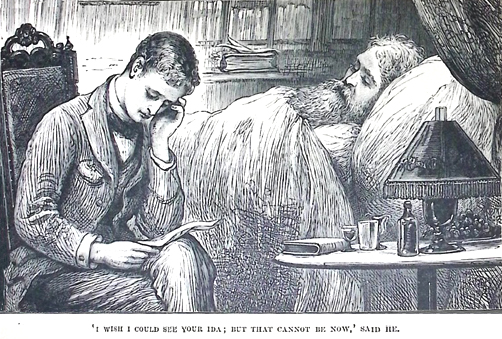
"I WISH I COULD SEE YOUR IDA;
BUT THAT CANNOT BE NOW," SAID HE.
"I will tell her all, dear uncle," said Andrew. "I am sure she will lay your words to heart. I can wish nothing better for her than that our married life may resemble yours."
The old man smiled and continued, "I have yet another message for Ida. You will be lonely when I am gone; there is no spare sister under your father's roof who can come to keep house here, or I should have asked for one when Grace was taken, so I want you to marry as soon as possible. Tell her so, and that in consenting to come soon to Steynes-Cote, provided her brother does not oppose it, she will grant my last wish."
All Dr. Fereday's messages were duly delivered when, immediately after his uncle's funeral, Dr. Crawford hastened to London to see Ida.
One glance at the girl's sweet, blushing face, alternately beaming with glad welcome and then full of tender sympathy, as she thought of Andrew's recent sorrow, was enough to show him that her feelings towards him had undergone no change. Not that Dr. Crawford ever doubted Ida's sincerity. But the more truly noble-minded a man is, the more humble will be his self-estimate. He is always inclined to exalt the object of his affection, and to doubt his own worthiness to win and wear so bright a jewel.
In Dr. Crawford's case, he had good reason for thinking that all must look on Ida Carnelly with admiring eyes. Now that they met after a year's absence, he was more than ever sensible of this.
"You are changed, Ida," he said, as, holding her for a moment at arms' length, he looked in the fair face with honest admiration.
"I am a year older, Andrew; I wish I could hope that I am a good year wiser and fitter to be a companion for you. But alas! you have been growing wiser still more rapidly, for you have had sterner teachers in sorrow and bereavement. All the while, my companions have been bright hopes and happy thoughts of you, and of the change you brought into my life."
"My darling," (Ida was not at arms' length as Andrew said this), "I thank God for this happy meeting and those sweet welcoming words. You may be only a year older, but you are many times fairer in my eyes, and dearer to my heart, for the time that has gone since we parted. Hard work and many cares have been, in one sense, good for me. But for these constant occupations, how should I have borne the separation?"
The girl's face flushed with pleasure, and she whispered, "I am glad, so glad, Andrew! I was going to say, I only care to be fair in your eyes, but that is not quite what I mean. I like to please every one in a way, you know."
"But not in the same way; I understand, dearest, and I prophesy that you will take all hearts by storm when you come to Steynes-Cote."
Next, Andrew delivered the loving messages and wishes sent from the old doctor's death-bed, and asked, "When may I take home my wife? Let it be soon, Ida, for the house is very lonely now."
"I am only twenty yet. What will Lindsay say?"
"Will you consent if Lord Carnelly can be won to agree to our speedy marriage?"
Ida did not say yes, but she lifted her sweet eyes shyly to the pleader's face, and then dropped them again.
Whatever Dr. Crawford read in that look was enough to satisfy him; so it could not have been a negative, for the question was not repeated.
Dr. Crawford did not see Lady Carnelly on the day of his arrival in town, and he was scarcely surprised at this. He was sufficiently aware of her sentiments towards himself, for Ida's letters had given him a full account of the first passage-at-arms between her brother and his wife, on the subject of her engagement.
The colonel's hearty welcome might well make up for what was lacking on his wife's part.
"Never mind, Crawford," said he, after a brief allusion to the lady's absence; "all the better for you and Ida. Beatrice is not in the best of tempers to-day, and would make a bad third. Besides, you know the old saying about two being company and three none. It applies with particular force to you and my sister, after a year's separation."
The kindly colonel gave a practical proof of his consideration for the pair by pleading an important engagement, and leaving them to their mutual confidences.
The doctor succeeded in talking over matters with Lord Carnelly later in the evening, when he unfolded his plans.
"My home is ready," he said. "My uncle, hoping that he might be spared to welcome my wife as its mistress, insisted on a thorough renovation of the house and furniture, so far as I would permit the substitution of new articles for old favourites. Whatever Ida may wish to add in the way of little elegancies to suit a young lady's taste, she shall have 'carte blanche' to supply, when she sees Steynes-Cote."
"You are very generous, Crawford. Better mind what you are about. A 'carte blanche' in the hands of a lady is a dangerous thing, let me tell you, especially to a husband's pocket."
"I am not afraid that Ida will make any very serious inroads into mine," replied the doctor. "My aunt's tastes were those of a refined gentlewoman. Ida will not find much lacking in the home of which she was mistress."
Then he further enlightened Lord Carnelly as to his present resources and probable professional income.
His hearer opened his eyes, and uttered an exclamation of astonishment.
"Why, Crawford, you are rich to begin with! Far better off than myself, all things considered."
The colonel sighed, as he thought of his olive-branches, now increased to seven, and of the large sums which their mother remorselessly extracted from his pocket, to meet her strictly personal expenditure.
Dr. Crawford had heard whispers of Lady Carnelly's extravagance and of the anxiety it entailed on him who was, nominally, the head of the family. He could understand his surprise on being told of his own resources, and could well imagine that the colonel was engaged in a perpetual struggle to make ends meet. With his wife's insatiable vanity, wilful temper, and determination, at all costs, to outshine others, and Lord Carnelly's own simple tastes and honest wish to keep within his means, it was easy to guess that the brave soldier's hardest battles were fought within the walls of his own home. Moreover, the doctor also shrewdly suspected that they were amongst the least successful in which he had ever engaged. His seemingly weaker opponent managed, as a rule, to come off conqueror.
Not one of these thoughts, however, did Dr. Crawford put into words. He merely replied, "Then you think my income sufficient to justify me in taking home a wife?"
"I should say so, indeed. Why, Ida will be quite a rich lady. By the way, you know she has something of her own, about five thousand pounds. Or," he added, correcting himself, and looking a little confused, "she will have that sum when she comes of age a year hence. In the meanwhile, she will receive the interest, as usual. Happily you do not depend on Ida's money to make a start with."
"Certainly not. I have no wish to touch a penny of your sister's little fortune. When the time comes for the capital to be paid over, it will be at once invested for Ida's sole benefit."
Dr. Crawford did not notice the look of relief on Lord Carnelly's face, but went on urging the latter to consent to his sister's early marriage. "I only want one word from you. I have Ida's consent already."
Lord Carnelly looked troubled. "I do not know what Beatrice will say to this," he answered. "She considers that my sister ought to be introduced to first-class English society, and see something of life before she settles down. She makes a great point of her being 'presented,' as she was herself."
"It is for you to settle," urged the doctor.
"Very easy for you to assume that, Crawford. You are not a married man yet, or you would pause before making such a rash assertion. You will find out by-and-by that in whatever you are interested, your wife will like to have at least a finger. For my own part, seeing that Ida has made her choice, I cannot understand the necessity for pushing her into society on which she would so soon turn her back, or of cultivating tastes from which she would have to wean herself on her marriage. Let her begin as she is likely to go on, say I."
"Then you are agreeable, at any rate."
"Not so fast. I must sleep upon this, and to-morrow you shall have my final answer. You cannot afford to waste much time in dangling about away from your practice, especially as you must take a holiday for the honeymoon."
There is no need to follow Lord Carnelly into the privacy of his wife's boudoir, or to tell all that passed at the "tête-à-tête" during which Ida's marriage as under discussion. The result was that he gave his unqualified consent, whilst his wife less graciously agreed that it would be nonsense to take the same trouble about her sister-in-law's introduction to society as if she were going to retain her own rank and position.
"It would only cause needless expense, and give people something to gossip about. So long as nobody knows Ida personally, or associates her in their minds with you and me, we shall not be lessened by her alliance with a country doctor."
"You forget that Crawford has been with my regiment during nearly all his professional life. He is only beginning to be the country doctor. His name is well and honourably known, Beatrice."
"Please do not repeat his achievements, Lindsay; it is no pleasure to me to be reminded of Dr. Crawford's past doings, especially of his last conquest, or the mode of it," said Lady Carnelly, as she closed the door behind her retreating figure, her favourite mode of concluding a discussion with her husband.
LADY CARNELLY would not have missed having a final fling at her sister-in-law and Andrew Crawford for the world.
"I must say a word before I wash my hands of all responsibility with regard to you, Ida," she said. "Had I been in your confidence, your future would probably be a very different one, and more in accordance with what the sister of Viscount Carnelly had a right to expect. I have always felt that this engagement resulted from a disgraceful subterfuge on your part. Yes," she added, looking straight at the girl, "I daresay you and Dr. Crawford imagined that you deceived me very cleverly at the time, but I saw through the whole thing, and now I presume I must congratulate you on the success of your plot."
Dr. Crawford, equally bewildered and indignant at the sudden attack, said, "You speak in riddles;" when Ida laid her hand on his with a light pressure, and answered for both.
"Beatrice alludes to that night when you found me crying in my loneliness and appointment. You know why I sat there, hiding my trouble as best I might, in the almost darkness, and so does she, though it has often remained pleased her to taunt me with having to deceive her and serve some purpose of my own. Thus far I have been able to treat the accusation with the contempt it merited, and if I could do this when standing alone, I trust, Andrew, with you by my side, I shall not feel less strong."
Ida spoke quietly, standing erect with the dignity of a young queen, as she looked straight at Lady Carnelly. There was even a smile on her face, not of scorn, though she might well have shown it, but rather of amusement, at Lady Carnelly's persistency in repeating slander which she knew to be unfounded.
"Do you accuse me of telling an untruth?" was the angry response.
"I accuse you of nothing, Beatrice. When you first charged me with duplicity, you never believed me guilty of it. By frequent repetition of the charge, you may have persuaded yourself that you are in the right."
"Take your wilful way, Ida," was the irrelevant answer. "I would have given you opportunities and advantages enough. I have a clear conscience, and shall take care that the blame of throwing yourself away rests on the right shoulders. When you have quite made your arrangements, no doubt my husband will be able to inform me. He is in your confidence. I shall wait his pleasure, as I am not accustomed to be consulted."
The colonel gave a sigh of relief when his wife disappeared.
"There," said he, "the matter is settled. You have only to fix the wedding day. Beatrice is not really angry, only she likes to make a fuss."
He was right in one sense. Lady Carnally was not sorry that her beautiful sister-in-law would be removed to an entirely different sphere, and yet there would have been a certain reflected glory to herself as the chaperone of a girl who was so certain to have attracted attention in society.
After the first outburst, Lady Carnelly settled down, and, finding that the marriage was to take place in a month, condescended to give Ida the benefit of her undoubted good taste in choosing her trousseau. She would have led her into a good deal of useless expenditure, but this was quietly overruled by the girl herself.
"More than half the things you suggest would be useless at Shelverton," she said. "I have no wish to make myself conspicuous by the extent and costliness of my wardrobe."
"You owe something to your family, and if I may venture to remind you of the fact," said Lady Carnelly, "to me. In a sense, you are considered to be under my care. I trust you will bear in mind that I should be compromised were you to leave this house with an outfit suitable for a petty tradesman's daughter, but not for the Honourable Ida Carnelly."
"Do not fear, Beatrice. No one who looks at your tasteful dress will blame you if mine should be found wanting."
"I have no anxiety about that, where I am known, Ida, but you are going amongst strangers, and ought at once to take the leading place. You hardly understand how much depends on first impressions. People can only judge of new-comers by externals."
Ida laughed merrily at this. "Then," she said, "I will take care not to overpower the Shelverton people by outside grandeur, lest, on a closer acquaintance, they should find nothing better beyond; beside, position and name go a long way in saving money."
"What do you mean?"
"I learned this in a shop once, when the mistress showed me some pretty imitation lace. I said how like real lace it was, and she answered, 'You may safely wear it, Miss Carnelly, because no one will suspect you of using anything but the real thing.'"
As Ida was to wear the dresses, it was not unreasonable that she should wish to choose for herself, especially as her sister-in-law would scarcely see them again. She said as much, in a good-humoured way, and made her purchases with excellent taste and judgment. Even Lady Carnelly owned this, though she qualified her praise by the remark which followed it.
"It was natural you should have a better idea than I as to how a country doctor's wife ought to dress."
In the face of Ida's moderation, she could hardly persist in making a great display, so the colonel's pocket was less taxed than might have been expected.
Dr. Crawford managed to steal a few hours each week to visit Ida until the close of the month, and then there was a modest wedding, and he took away his fair young bride from her brother's roof.
No one could have shown himself more full of sympathy than Lord Carnelly. He was sorry to part with his sister, and up in the nursery, he knew that the loss of Aunt Ida was causing weeping and wailing amongst the infant Carnellys.
It was not the parting only which caused the gloom on the colonel's face to deepen, after the last wedding guest was gone, and he and his wife were left alone together. He paced the room in silence for some time, then remarked, "I ought to have told Crawford about Ida's money. I should have done but for you, Beatrice. I cannot feel that I have acted quite honourably."
"Nonsense! What does it matter? You told the truth, and nothing but the truth."
"Yes, but not the whole truth. I only said to Crawford that the principal sum would come to Ida when she was twenty-one."
"Well, is not that what your father's will also states?"
"Yes, but it adds, 'Or on her marriage.' Of course, with my consent is implied, for, as her guardian, I could have refused it, and in such a case I should have felt justified in withholding the principal until she was of age. As it is, I know my father intended that his daughter's little fortune should be handed over to her when she married, provided that she became the wife of one whom I could approve. Now I never mentioned the alternative to Crawford, but I ought to have done so, and paid over the five thousand pounds. It is little enough for my father's daughter to take with her as a marriage portion."
"I thought you said you were not prepared to hand over the money immediately," retorted Lady Carnelly in a hard tone.
"Neither am I, unfortunately; but still—"
"Where would have been the use of saying a word about it, then? Really, Lindsay, it seems absurd for you to worry about the mere telling, if you could not follow up the information by fulfilling the conditions. You will pay Ida the interest, and it will be time enough to speak of the principal when Dr. Crawford expects to receive it," was the prompt reply.
Lord Carnelly remained silent, but unconvinced. Conscience spoke more effectually if not so loudly as his wife had done. And beside, there would, he knew, be difficulties in the way of producing the five thousand pounds when the day of payment should arrive. He could only hope that by some means he might then be enabled to give a satisfactory account of his stewardship, and end it at once and for ever.
Dr. Crawford, seated beside his bride in the railway carriage which was conveying them northward, troubled himself not a whit about Ida's fortune. If she had been absolutely penniless, she would have been equally precious to him. His mind was filled with glad but solemn thoughts, as a good man's must needs be, at such a time and after having entered on such responsibilities.
He poured in Ida's attentive ears the details of many a plan for her future comfort and happiness. He tried to interest her on behalf of the poor of Shelverton, by telling her of his aunt's life work, and the love she won on all hands.
"My uncle's hope and prayer for you, Ida darling, were that you might fill just the kind of place at Shelverton that my Aunt Grace did," said he. And then, waxing eloquent, he spoke of her beautiful Christian character, and repeated the message sent to Ida by Dr. Fereday on the last day of his life.
The girl listened, but when he finished there was no reflection from her face of the light that shone in his. On the contrary, she seemed a little disconcerted, or as if she only half understood her husband's meaning.
"You make me half afraid, Andrew," she said. "If Mrs. Fereday was so perfect and so good to everybody, I am sure they will care nothing about me at Shelverton. You see, I have never been used to go about amongst poor people and to cottages, and all that sort of thing. At school, we were always lectured about keeping our own places and not losing our position. We walked two and two, you know, dear, with the eye of a governess always upon us, and looked like this."
Ida put on a demure face and folded her hands primly, then, breaking into a merry laugh, she added, "I do believe poor Miss Ferguson, who was our senior bodyguard, would have fainted if she had seen us speak to an ill-dressed person, to say nothing of her fear that we should catch some dreadful ailment or other if we came in contact with rags."
"I do not suppose you have seen much of the ways and wants of poor folk, my darling; but I have no doubt you are like what my aunt was in this. You have the heart to feel for those in trouble, and the will to relieve it. I believe you could give nothing but a gentle word and a kindly look to all with whom you come in contact, and these are not lightly valued."
"You must not be too sure of that, Andrew; you have only seen my best side. How could I give you anything but loving looks and words when you have brightened my life ever since I knew you?"
The young wife turned a beaming, tender face towards her husband. There could be no doubt of her true love for him. What Dr. Crawford wanted to realize was that his young wife had higher aims and hopes, like his own, and springing from the same source.
He longed to speak of these things to Ida, and was almost angry with himself for the feeling of shyness which came over him whenever he strove to introduce them.
Dr. Crawford's was no uncommon case. Often enough, the Christian is drawn into conversation with a fellow traveller in a railway carriage, or as he walks with some one, hitherto unknown, on the same road. Some word is let fall which acts as a spark to kindle the hearts of the wayfarers into a very glow of Christian love. Their "hearts burn within them," as they talk by the way, and those who have apparently met by chance are loth to part, and would fain put off the moment of farewell. But it is otherwise when those to whom we wish to speak, and whose earthly interests are identical with our own, are always walking side by side with us.
Dr. Crawford had let fall little words now and then, in Ida's hearing, of the kind alluded to, but they had produced no response, no answering word, no lighting up the face with gladness, no sense of communion in holy things. He put this down to shyness, and argued with himself, "If I feel it difficult as yet to speak on these subjects to Ida, it is likely that she will be timid also. The dearest, most precious thoughts ever lie deepest in the heart."
Hence the talk about Aunt Grace and her life of good doing. Hence the words that followed: "My aunt was what every one loved, because she loved her Saviour, and humbly strove to follow His example. You and I have said little about these things, Ida, but I trust they will grow more familiar subjects with us day by day."
Young Mrs. Crawford looked at her husband with wide-open eyes. "Andrew," she said, "you talk as if you thought I ought to be a very religious person. I did not know that—that—" She hesitated, as if unable to express her meaning.
"Were you going to say you did not know that I professed to be a religious man?"
"Not quite that. I have always thought you so good, better than any one I knew; only you never talked of such things before."
"I am ashamed to own that I never did but, dear Ida, let me say it now. If there be anything of goodness in me, it can only be of God's good gift that I have been taught my need as a sinner, and been led to Christ as my only Saviour. Knowing Him as such, how can I help loving Him? Loving Him, how can I help wishing to follow the example of His most holy life?"
In his heart Andrew Crawford thanked God that he had been enabled to say even these few words as a reason for the hope that was in him, and once more he looked at the beautiful face of his young wife for some expression to show that she felt with him.
"I do not quite understand you, Andrew; it seems strange to me to hear you talk in this Way. But though I am not like you, dear, I am not quite a heathen. Would you like to hear me say my Catechism? I believe I can do that yet without missing a single word. Suppose you question me."
Again with that light, musical laugh of hers, Ida placed herself before her husband in the attitude of a schoolgirl ready to repeat a lesson, and waiting to be questioned.
That laugh of Ida's had always before sounded pleasantly in Dr. Crawford's ears, but now it jarred sadly, being out of harmony with his own feelings. It, and the words of his wife, told him only too plainly that, having been fascinated by the fair outside and winsome ways of Ida Carnelly, he had taken more important things for granted, and credited her with higher hopes which had no existence.
Well, it was useless to blame himself now; besides, the doctor's affection for the beautiful, bright girl who had become his wife was far too deeply seated to allow of present regrets. He was abundantly conscious that, even with his actual knowledge of Ida's comparative indifference to those things which he regarded as of the first importance, he should do again as he had done, make her his wife, and trust that the time would come when the difference would no longer exist.
It was as yet early in the honeymoon, but from the day of their marriage Dr. Crawford had always read a portion of Scripture aloud, and knelt in prayer by his wife's side morning and evening.
Ida had said, "It is like school-days coming back again, Andrew. We always had prayers there, but at Lindsay's, we had got out of the way of it."
And she put her white hands before her face almost like a child again, whilst he fervently asked for God's blessing on their marriage, and thanked Him for having given them to each other.
On this particular evening, Dr. Crawford was fated to undergo another shock. He was about to begin his reading, when Ida laid her hand on his, and in a pleading voice said, "Andrew, please do not read that chapter."
"Why not, darling? I chose it because it is so very beautiful, and I thought you would enjoy hearing the sweet words of comfort as I should do the reading. I thought every reader of the Bible must love the fourteenth of St. John."
"I hate it, Andrew. Please do not be shocked," she continued, as she saw the look of pain, almost of horror, on her husband's face. "If you had been made, when at school, to repeat chapters out of the Bible as a punishment for any little breach of discipline or forgetfulness of rules, you would feel as I do. There were certain chapters, quite a number of them, which most of the girls had to learn and repeat in this way at some time or other. They used to be called 'punishment chapters,' and this was one of them. I do believe every girl in the school felt as I do, and learned to hate the very sound of the words that were always associated with privation and punishment. If you had heard them dinned in your ears in every variety of angry or sullen tones, you would never want to listen to them again."
Ida spoke, for her, quite vehemently, and, with a feeling of indescribable pain, her husband closed the Bible and sat still and silent.
His wife sprang towards him, and, clasping her white arms round his neck, burst into tears. "You are angry with me, Andrew; I am very sorry. I could not help it. Forgive me, dear, and please read something else. I did not want you to give up reading altogether, only not to read that. You will think me dreadfully wicked, I know."
"No, my darling wife, only very unfortunate in having been robbed of treasures of comfort and strength and guidance by those who knew not their value, and who were to be pitied for their ignorance also."
He drew the shining head to his breast, and wiped away the tears were flowing down Ida's cheeks.
"We will read, dear, and you shall choose the chapter, lest I make another unfortunate selection."
Crawford turned the leaves of the Bible to and fro for a few moments, and then said, "Read this, Andrew; I always liked it."
He at once complied, and, as he read the touching parables of the "Ninety and Nine" and "The Prodigal Son," he thanked God in his heart that the fifteenth of St. Luke had not been included in the "punishment chapters." ¹
¹ It may seem incredible that any teacher could ever have acted as
Ida's is stated to have done, but the writer of this story was told,
by a highly intelligent girl of similar age, that owing to the system
of giving passages of Scripture to be learned as "punishments" for
breaches of school rules, she had learned to dislike the very mention
of those chapters. It took years to efface the unfortunate impression
thus produced, though in time it passed away.

THOUGH Shelverton, the future home of young Mrs. Crawford, was in itself less populous than some manufacturing villages, its inhabitants would have been highly indignant if such a name had been applied to it. It was an old market town, the centre of a wide agricultural district, and once in the week its irregular thoroughfares, by courtesy called streets, were thronged country folk bringing in garden and dairy produce. The sellers stood in the open air in all weathers, whilst the farmers, more highly favoured than the gentler sex, transacted business beneath the roof of an ungainly structure, called the Corn Exchange.
It was most amusing to pass through the market, and notice the costumes in which, especially in winter, the women attired themselves for standing in the market. Old riding-coats with many capes which had once covered masculine wearers, ancient pelisses made of sad-coloured but substantial cloths, large woollen shawls tied over bonnets of no particular fashion, even pattens to lift the feet from the cold pavement, were to be noticed by careful observers. Whatever would keep out cold and wet was pressed into service, and, quaint as was the headgear and varied, the rosy, wholesome faces of the buxom country girls and matrons might have made amends for less picturesque coverings.
The west end of Shelverton was called The Park, and within its enclosure resided most of those who belonged to the upper ten.
Steynes-Cote was not originally in The Park, for it was built before a great unoccupied plot of ground was parcelled out for building upon and so named. But Dr. Fereday good-naturedly took down a portion of his fences on one side, and made sundry alterations, so that the older house became part and parcel of The Park, though it continued to excel the newer dwellings, both in picturesqueness and in the extent of its grounds.
Steynes-Cote was equally pleasant and commodious; the rooms were large and well-proportioned with windows delightfully varied in shape and size, low wide bays, with cushioned seats suggestive of cosy chats, or of places to nestle in with a favourite book, while trellised roses, stirred by the summer breeze, courted attention by tapping at the pane.
"A gentleman's place, as it ought to be, for we should never tolerate a medical man amongst us who was not a gentleman," was the frequent remark.
Naturally, the tidings that Dr. Crawford was about to bring a new mistress to Steynes-Cote set Shelverton society in a flutter of pleasant expectation, and of anxiety to know all about the lady.
There being nothing to conceal, they soon ascertained that their doctor's wife was the only sister of a viscount, and was actually the Honourable Mrs. Crawford.
Shelverton had its good old county families at no great distance, and one baronet—a very new creation—within the parish itself. But of titled people, there were none, and the ladies were gratified at the prospect of having an "Honourable" in their midst, and especially as her position would enable them to visit her on equal terms.
"As the doctor's wife, the Honourable Mrs. Crawford must be one of us, you know," said Mrs. Prattely, a lady of about forty, who, having nobody to look after at home except a most indulgent husband of the easy-going type, devoted her energies to the regulation of sundry other Shelverton households.
Mrs. Prattely possessed ample means, a luxurious home, a generous disposition, and a kindly heart. But—what a pity there must be a but!—she was a little apt to think that, as she dipped her hand into her purse and freely gave of its contents for the benefit of her needy neighbours, she had a right to dip at least a finger into every domestic pie. She gave advice and money with equal liberality, which is by no means a common way of distributing the two.
People are often generous, not to say lavish, in bestowing advice alone, and then it matters little whether it is accepted or not. But when bestowed along with the money which is very badly wanted, it is different, as the recipient can hardly take the one and refuse to act upon the other.
There were numbers of poor people in Shelverton who liked the food, clothing, or money which came at the nick of time to help a sick husband on to his working legs again, to fit out the girl for service, or buy necessaries for the home. But amongst these were many who, being mothers of large families, thought they knew more about managing them than did Mrs. Prattely herself. So they lauded her generosity, but now and then, behind her back, made uncomplimentary allusions to an old proverb which states that "Bachelors' wives and old maids' children are sure to be perfect."
It was Mrs. Prattely who first called Dr. Crawford's wife "poor thing."
The expression dropped out, as it were, when a number of Shelverton ladies were discussing the imminent home-coming of the doctor and his bride, and the social position of the latter.
"It is most satisfactory to know that Mrs. Crawford is a thorough lady; we have been used to that in our doctor's wife, for no more well-bred woman need we wish to meet than Mrs. Fereday was. In places like Shelverton, everybody is more or less known to everybody else; but we have our own circles. We may be conscious of people's existence and be kind and friendly, without over-intimacy."
"Acquaintances may be countless, friends must always be comparatively few," said one of her hearers in reply.
And to this, there was a general assent.
It is perhaps needless to state that Mrs. Prattely lived in The Park. Land was plentiful at Shelverton, and each handsome house in the enclosure had its own grounds, Mrs. Prattely's, after Steynes-Cote, being reckoned the finest. She was, moreover, what is called house proud, and her home was a worthy example of what money could do when combined with good taste.
Mrs. Prattely was given to be eloquent on the subject of Shelverton Park.
"Our residences are houses," she would say; "not mushroom places, run up in a few days, and as unhealthy and poisonous as most fungi are. They are homes built to stand, to last, and, above all, to live in. We have no cracked panels, letting in daylight, through the use of unseasoned timber; no rattling windows, ill-fitting doors, or thin walls just held together with plaster. Not even a semi-detached house, so the risk of objectionable neighbours is reduced to the minimum."
Mrs. Prattely was always strong on the subject of neighbours thus connected. "For my part," she said, "I would rather live in the tiniest cottage, or even in a street, than in a semi-detached house, for in the case of persons whose dwelling is actually tacked on to your own, it is almost impossible to remain strangers. Semi-detached persons have so many opportunities of being disagreeable, to say nothing of the difficulty of keeping your fronts uniform in appearance. There are two houses of the kind—outside The Park, I am glad to say, but which I am compelled to pass each time I drive in. Would you believe it? One of the occupants mows his half of the front lawn in one week, and the other portion is cropped days later by the dweller to the right. One thinks his outdoor painting should be done in the autumn, while his neighbour considers spring the correct season, and acts upon this opinion. Even in the matter of blinds they manage to differ, though both have venetians, for they are of different colours, and, though harmonizing with the inside, the outside effect is something dreadful. And it is hardly credible, but these semi-detached people are excellent friends and neighbours. They are simply born without eyes as regards taste or reasonable uniformity."
Mrs. Prattely sighed, and continued pathetically, "I could not endure such a state of things, and I am truly thankful that in The Park each residence stands absolutely alone. We Park people are quite independent of each other, with plenty of room to turn round in, and we know just whom we please."
The Park people exercised this privilege to the full, and even succeeded in dividing the upper ten of Shelverton society into two lesser tens, or, as somebody wickedly expressed it, "into two bunches of fives."
Mrs. Prattely was the acknowledged leader of one set. The other, owing to a removal, was merely in opposition, but hoping to enlist the doctor's young wife when she would become resident among them, though Mrs. Prattely did not intend that this should be effected without a counter effort on her side.
It is convenient to quote this lady's sayings, as they give an idea of the state of feeling in one portion of Shelverton society.
"At any rate, Mrs. Crawford, poor thing, will have no cause to find fault with her future home. Plenty of titled people would give a little fortune if they could transplant the doctor's fine old house into May Fair for the season."
Mrs. Prattely was holding forth to a couple of young lady callers about Dr. Crawford, his home, and his marriage. So much was she interested that she talked almost continuously, and her visitors' share in the conversation was limited to mere words of assent. It was before the days of "afternoon teas," but the hostess, always hospitable, had offered refreshments of an even more acceptable character, in the shape of strawberries, thick cream, and sponge-cake. These occupied the young people very pleasantly, and rendered mere listening all the more agreeable.
The arrival of Dr. Crawford and his wife was imminent. They might enter The Park at any moment, and, while hospitably entertaining her visitors, Mrs. Prattely cast frequent glances towards the window, which commanded a view of the drive by which Steynes-Cote must be approached.
"I suppose you know the Crawfords are expected this afternoon. What a change it will be for her!" said the elder lady.
The younger ones smiled, and one replied, "The change from a single to a married life must always be a great one."
"True, my dear, but in this case it is particularly so. It is not every day that a nobleman's sister marries a country doctor. I am told Mrs. Crawford is very beautiful, and would have made a great sensation in society if her friends had not allowed her to throw herself away."
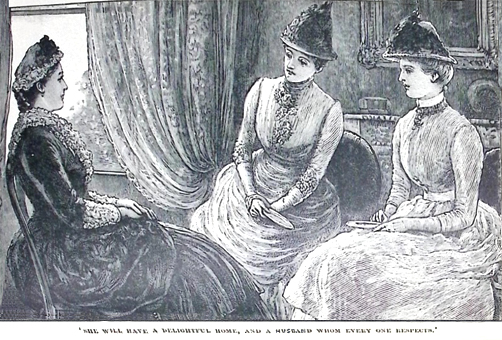
"SHE WILL HAVE A DELIGHTFUL HOME,
AND A HUSBAND WHOM EVERY ONE RESPECTS."
"Dr. Crawford is very fine-looking, and everyone says he is a brave and a good man. He has mixed on equal terms with the same class of people as Mrs. Crawford has," returned the elder Miss Isherwood. At the bottom of her heart, she considered Andrew Crawford worthy of any girl living. She and her younger sister, Mary, were comparatively new-comers, who were keeping house for their brother, the rector of Shelverton, yet they had already seen something of Dr. Crawford, and knew how the poor and suffering spoke of his ready skill and his tenderness, and faces brightened at the mention of his name.
"Andrew Crawford is most excellent, my dears. I have known him ever since he first came, a boy, to Shelverton. But what he is, has never been questioned. I was only speaking of the change his wife will experience."
"She will have a delightful home, and a husband whom every one respects."
"The home will be only a professional man's place—a business house, one may call it, after all else is said. Though the surgery and consulting-rooms are well placed in the rear, there must be the jingling of door bells day and night. A doctor never knows, when he goes weary to bed, whether he will have a chance of resting there till daylight or not. And remember she will be quite alone, except for servants, when Dr. Crawford is called out. Poor thing! I quite pity her."
As the Isherwood girls could not honestly echo this last sentiment, they said nothing, except that no doubt Mrs. Crawford would find pleasant neighbours, and soon be on excellent terms with some of The Park people. They looked towards their hostess, as if to indicate her as a probable friend, and Mrs. Prattely answered promptly—
"I only hope, my dears, that Mrs. Crawford may get into right hands to begin with. I shall not be wanting as a neighbour, but whether my advances may be received in the same spirit, I cannot judge. In Shelverton, the lady will be the doctor's wife, for she takes her husband's rank; but she may think of herself as the sister of Viscount Carnelly, and then—"
Whatever Mrs. Prattely might have intended to add to her sentence was cut short by her catching a glimpse of Dr. Crawford's carriage turning into The Park.
The girls were in the act of leave-taking, so bidding them a rather hasty farewell, the elder lady rushed to an upper window, whence, by means of a well-directed opera-glass, she obtained "a good look" at Dr. and Mrs. Crawford without being herself seen.
Ida's beautiful face was beaming with pleasure as her husband pointed out Steynes-Cote, and she bent forward to catch a view of it through intervening trees.
The doctor looked so well, and such a fitting mate for the young creature beside him, that Mary Isherwood indignantly exclaimed, after the carriage was well past, "What could Mrs. Prattely mean by calling Mrs. Crawford 'poor thing'? I felt so angry. I wish I durst ask her to pity somebody who needed to be pitied, and not a woman who had everything that a reasonable being could desire."
The elder assented, and I am afraid that even the memory of the good things they had just received at Mrs. Prattely's hands did not prevent them from saying further hard ones about that lady.
If the girls could have looked again in the face of their late entertainer, they would have seen a very tender expression upon it, and a suspicious moisture about the eyes. Mrs. Prattely owned a kind heart as well as a busy tongue, and her thoughts were travelling back twenty years to just such a home-coming, when she was the girl-bride. She had known no hardships, for she had fair surroundings and a husband who never said her nay. But the home had been too quiet, that was all.
"If my one little girl had lived, she would have been within a year of Mrs. Crawford's age," she thought. "How delighted I should have been to plan for her! Well, I can pray, may God bless these two, and give them many a happy year together, and may she, poor thing, never know the loneliness I have so often felt, when I daresay one half of the people who know me think I am one of the most enviable of women! And so I am," she added, with a remorseful feeling, as she remembered how completely she was surrounded with good things.
And she breathed a prayer that she might be forgiven for cherishing a repining thought even for a moment.
As to Mrs. Crawford, this mother, who was without a living child to love, determined, so far as lay in her power, to be a kindly neighbour and faithful friend to the new mistress of Steynes-Cote.
THERE were staid, respectable servants who had been in the service of Dr. and Mrs. Fereday, ready to receive Mrs. Crawford at Steynes-Cote. The verdict amongst these was, "The new mistress is just as homely as she is bonnie, and you only need to look in her face to know what that means."
Ida was delighted with the house, servants, furniture—in short, with everything around her.
"What charming rooms! And how spotless everything is! The order in this house is perfectly astonishing. I feel almost afraid to put my foot down," she exclaimed.
"It is just a little too orderly, darling, as rooms are apt to become when not sufficiently used. You will mend all that. There are some little matters to be supplied, but I find there are many parcels to be opened, containing marks of good-will from old friends. These and your other wedding presents will fill gaps, no doubt; and for the rest, I give you leave to please yourself. Experience has shown me that my wife will not err on the side of extravagance."
These words of praise, accompanied by a tender caress and a look of thorough trust, sounded like sweet music in the ears of the girl-wife.
Nestling for an instant on her husband's shoulder, she answered, "I like to be trusted, Andrew, and I do not think I shall tax your purse very heavily, or suggest many additions. Everything looks perfection to me. I should be positively wicked if I were not contented and happy here, and," she softly added, "with you."
Truly, such a home-coming seemed to be laden with bright promise for the future. Andrew Crawford felt it so, and with a full heart thanked God, and, taking up the words of the Psalmist, said truly, "My cup runneth over."
He uttered the thanksgiving aloud and from the very depths of his soul, but there was no response from Ida, neither was her face lighted up in sympathy. She smiled at his earnestness; she saw that he was deeply stirred by some feeling she could not fully comprehend, but this did not trouble her. She always said to herself, "Andrew is so much wiser and better than I am in everything! What a comfort it is to be able to look up to him!"
And she settled in her own mind that after say ten years of companionship, she must become more like her husband, and necessarily better in every way.
At this moment, an entirely different thought flashed across Ida's mind. Remembering the relatives she had left, she broke into a low, musical laugh, and said, "If Beatrice could look in upon us just now, I wonder if she would consider me so much to be pitied as the wife of a country doctor. Surely even she would be forced to acknowledge that I am a very lucky girl."
Perhaps few things could have better illustrated the difference between the minds of these twain who had become one flesh than the varying expressions which fell from their lips on arriving at home. The husband sent up a fervent thanksgiving to the Bestower of all good, and reverently took his happiness as coming straight from the Divine Hand.
His wife basked in the sunshine and brightness that surrounded her, amused herself by comparing the past with the present, and decided that, all things considered, she was "a lucky girl."
So far Ida had not seen Dr. Crawford's parents. There had been some thought of including a brief visit to their home in the wedding tour, but this had not been carried into effect.
"You have seen your father and mother since your return, Andrew," said Ida, "and I should like better to go about just with you for this once. Your family are strangers to me yet, and I am sure I should be shy and uncomfortable to go, so soon after our marriage, all amongst new faces. We can only have one wedding tour, you know."
So the doctor had yielded, perhaps nothing loth, and decided to have his parents to visit Steynes-Cote with as little delay as possible. The young wife was not, however, forgotten by her husband's father. Amongst the packets that lay waiting to be opened was one from the Manse. It contained a large and very beautifully bound Bible, and was accompanied by loving words, wishes, and the prayer that among the many costly gifts which would no doubt be offered to her, Ida might find in the Book of books her greatest treasure, and "love its commandments above gold, yea, above fine gold."
"See, Andrew," she said, calling her husband's attention to the gift and the letter; "this great beautiful Bible is from your father and mother. I am very glad to have it from them, and I shall write and tell them that I shall keep it with its large print to use when I am quite an old woman."
"I think my father and mother would be better pleased, darling, if you were to write and say, 'I will make a bit of this gift of yours my own every day. By degrees, I will get some of its sweetest messages laid up in the treasure-house of my memory; then, if I live to be quite an old woman, I shall possess what no one can take from me.'"
Ida looked just a little hurt. "This is not my only Bible, Andrew," she said. "By writing that I should take such care of the new one, I did not mean that I would not read any in the meanwhile."
"Of course not, dear," replied the doctor.
But he vainly strove to call to mind an occasion when he had seen Ida engaged in reading God's Word except during public or family worship.
From the time of Mrs. Crawford's arrival at Shelverton, however, she made a favourable impression. Belonging, as even The Park people acknowledged, to a higher step on the social ladder than they did, she was the only person who appeared to forget this.
Wherever he went, Dr. Crawford had to listen to praises of his charming wife.
"Your ears ought to tingle, Ida," said he, as he gave one of them a playful little pinch. "Your neighbours say so many kind things of you that I have several times caught myself blushing violently, as I listened to these oft-repeated compliments. What witchery have you exercised to win all hearts so quickly?"
"Indeed, Andrew, I have done nothing; only I think every one is disposed to receive me kindly for your sake," replied Ida, her face all aglow at the sight of her husband's pleasure.
"Of course not. You have been your own sweet, natural self, and, as I well know, that is quite enough to account for your triumphs."
The doctor was right. It was in his wife's unaffected manners, joined to her grace and beauty, with her ready appreciation of the kindly advances made by her neighbours, that the witchery consisted.
It is a fact worth recording that their utter inability to disagree on the subject of Mrs. Crawford's merits was the means of reuniting the "two fives" of Park society into a harmonious "ten." Having found a central rallying-point in the doctor's wife, they forgot past differences, and congratulated each other on their social acquisition.
Mrs. Prattely was particularly emphatic.
"If any person in Shelverton has a right to give herself airs on the score of looks, style, and family, Mrs. Crawford is the one; yet she alone seems able to forget how very charming she is."
All this was pleasant enough, so far as it went; but it must be owned that the qualities which had taken Shelverton by storm were only superficial. There were a good many, especially amongst Dr. Crawford's poor patients, who wondered whether, on closer acquaintance, the young mistress of Steynes-Cote would manifest those Christian graces which had won for Mrs. Fereday the esteem and affection alike of rich and poor.
It was unfortunate for Ida that during the first year of her married life she was so much alone. She had not understood beforehand how absorbing are the duties of a busy professional man, or how unreasonable are the calls made upon his time. She never anticipated that when the summons came he must obey it, and she chafed a little, because their holiday ended abruptly at the close of a very short wedding tour.
Mrs. Crawford at first asked Lady Carnelly to let two of her children come to Steynes-Cote. "Let me have Donald and Rose," she pleaded. "You know how fond I am of the children. You have so many, you could well spare me a couple for three months. With the five youngest now at home, and the eldest two coming almost immediately, the house will be full. Let me have some of my pets as soon as I am settled at Steynes-Cote."
"The children have been separated for a long time, and that is why I mean to keep them all together for a while. I have engaged an efficient governess that they may be taught at home. Thank you very much, Ida, but I wish than all to begin and go on under the same teacher," replied Lady Carnelly.
Ida tried to induce her to reverse her decision, but in vain. Her sister-in-law was obdurate, the children and herself bitterly disappointed. They had been so much together in India, where Ida had been useful in relieving the mother from all anxiety about the little people, and she consequently felt this refusal the more.
Lady Carnelly's jealous temper now manifested itself in this fresh direction, and, with the prospect of a new governess to take the oversight, she determined to gratify the feeling by wholly separating the children from their aunt. The tears and disappointment of the youngsters gave her little concern. She had her way, and that was always the first aim of Beatrice Carnelly.
The colonel felt that his wife was treating Ida unkindly, and protested against her decision.
"You might gratify Ida in so small a matter," he said. "By all accounts she has a delightful home in which to receive the children. It would do them a world of good to run wild in the country for three months, and under Crawford's experienced eye. They look too pale and sickly for school-work at present."
"We shall all go to the seaside in three weeks. I told you so before, Lindsay. I shall take care they are not overtasked. Surely, whilst the children are young, a mother ought to be the best judge as to where they go and what they do. When the boys are older, of course, I shall hand them over to you."
"I think Crawford and Ida would like us to take the youngsters down to Steynes-Cote. As my only sister, it is natural she should wish me—us, I mean—to see her in her new home."
Lady Carnelly laughed ironically.
"I appreciate the correction, Lindsay. Ida may wish to see you and the children; she will have no sisterly yearnings after my society. It would be all the same to me if she had. It is long enough since I spent a season in town, so I mean to make the most of it, and stay to the close."
"And I am afraid it will be the last you will have for some years to come, unless we can live at less cost than we are doing now. I cannot afford our present expenditure; and remember, Beatrice, Ida's money has to be paid when she is twenty-one."
"That is entirely your affair, Lindsay. I leave business matters to you." By which Lady Carnelly meant the bills and asking no questions.
She was treading on dangerous ground, so she hurried away, perfectly assured in her own mind that her husband would not avail himself of the opportunity to go alone to Steynes-Cote.
She had a sense of petty triumph in the thought of her sister-in-law's disappointment, and said to herself, "Those people amongst whom Ida is located will be less favourably impressed by the 'Honourable' before her married name when they find that not a single titled relative crosses her threshold." It was a paltry triumph, but it was worthy of so small a mind as that of Lady Carnelly.
Thus, many things concurred to make the first year of Ida's married life a season of comparative loneliness. She had formed no intimate friendships at school, or kept up any correspondence with old companions there. She had left her more recent acquaintances behind in India, and now her brother and his family were separated from her by his wife's imperious will. If only she might have had Donald and Rosa!
Ida shed her first tears at Steynes-Cote over the cool letter in which Lady Carnelly declined the invitation for the children.
Agnes and Mary Isherwood tried to enlist Mrs. Crawford as a helper in Sunday-school and parish work; but these, she owned, were quite out of her line. She was as sweet and good-humoured as possible when the girls asked her, and told them she only wished she could be of any use.
"But," she added, with a merry laugh and amused look, "I should be worse than useless, should be in other people's way, for I have had no experience in work of the kind."
"We must all have a beginning," said Agnes. "Dear Mrs. Crawford, do come and try."
"You do not know what you ask, dear. I am so hopelessly ignorant that I should disgrace myself in the eyes of the children. Poor little things! I should be sorry for those who want to learn if they had me for a teacher."
It was difficult for the girls to suggest that Mrs. Crawford might learn. By taking a small part at first, she would gain experience to do more. However, they ventured a few words of persuasion, which Ida answered by asking, "Do you think I ought to absent myself from home at all on Sunday, when it is the day my husband is most there?"
"Certainly not; but you could do a little on other days in the way of visiting, could you not? We have heard so much about what Mrs. Fereday did, that it made my brother hope you would, just in a small way, take up her work. It would encourage other workers."
Again Ida, with equal sweetness of manner, pleaded incapacity.
"If I were to go to a cottage door, I should not know in the least what to say, unless to ask how the people were, and to kiss the baby—always provided it had a quite clean face. So many have not, you know. Then I might add that it was a fine day, and then, I am afraid, having got thus far, I should run away, for want of understanding what to say or do next."
The Isherwood girls could scarcely help laughing at the word-picture thus drawn, and yet they were almost angry at themselves for the inclination. They tried no further persuasion, but quietly took their leave. What they thought, let their own words tell.
"I felt quite indignant at Mrs. Crawford," said Agnes; "she talked as if she had not a notion of personal responsibility, either towards God or her neighbour, and she looked so lovely and winsome all the time, like a perfect picture in an exquisite frame, as she sat in the drawing-room at Steynes-Cote.
"Do you remember how angry we were on the day the Crawfords came home, that Mrs. Prattely called the bride 'poor thing'? Well, in my own heart, I called her 'poor thing' to-day, though not for the same reason. She is rich in home and the comforts which surround her, rich in the affection of a good man, and the good-will of many. But she is not rich in the only thing which gives value to the rest—in knowing the love of God in Christ Jesus."
Agnes and Mary Isherwood were both a little younger than Mrs. Crawford, but they had been trained in a different school, and looked at life and its responsibilities with different eyes from hers. Perhaps they might, at one time, have been inclined to think her an exceptionally enviable person. To-day they joined Mrs. Prattely in calling her "poor thing."
Dr. Crawford was troubled at having to leave his wife so much. Even when he was at home, there were so many calls upon his time that she merrily told him she must become his patient in order to enjoy a share of his society.
"These calls bring grist to the mill, my dear," he would say. "I did think that by engaging a second assistant, I should have more leisure. But the practice still grows, and it extends over such a wide area that we are all kept at work."
"But you need not work so hard; you are not a poor man, Andrew."
"No, Ida, but still I must work. If it were no matter of money-getting, I could not be contented to spend my time idly. It would never do to waste the training and experience of so many years, when they can be used for the relief of suffering, apart from the pecuniary advantage to myself. Then, dear, I have others to look to me for help of a substantial kind, and I can well afford to give it. My dear father and mother have had to bring up a large family on small means, and ever since I possessed any regular income, it has been my pleasure and privilege to add to theirs."
"You are good to everybody, Andrew, most of all to me, for there is nothing you would not give to or do for me," said Mrs. Crawford.
But in one of her idle moments the thought crossed her mind, "I shall not really cost Andrew anything, for Lindsay will pay him the interest of my little fortune. I wonder if he has received it for the first year. He has said nothing about it to me."
DURING the first months of her married life, Mrs. Crawford often accompanied her husband in his rounds, and waited for him in the carriage with a book, or walked on, to be overtaken by it. But when winter came, this was less practicable, and Ida herself less fit to join him, whilst feeling his frequent absences more and more.
In his affectionate consideration for his girl-wife, Dr. Crawford had been a little too anxious to make her first essay at housekeeping as easy as possible. He knew her to be absolutely ignorant of domestic matters, and that she had never been called on to think or plan for others.
"She will be in good hands," thought the doctor. "Jean Graham will put her in the way of things, and a sense of her own responsibility as the mistress of a home will come gradually and naturally; only give her time."
But time did not effect much change in this respect. Mrs. Crawford was only too well satisfied to let household cares rest on the faithful shoulders of Jean Graham, who was the very essence of capability. Jean had first come to Shelverton, a girl of sixteen, to serve Mrs. Fereday, and with strong recommendations from Andrew Crawford's parents, and had been twelve years at Steynes-Cote when her mistress died. By this event, Jean was placed at the head of the household. She had "just guided the house," as she expressed it, until Master Andrew should bring home a proper mistress.
Contrary both to her expectations and wishes, she was allowed to guide it still. For though Mrs. Crawford nominally took the reins, it was Jean's head that planned and her hands that directed, so that all ran smoothly as before. Jean felt a certain awe of her fair young mistress, because she was "a high-born lady," but this was mingled with a sense of pity for her utter ignorance of domestic affairs.
"I cannot make out what her folks must have been thinking of," mused Jean. "They have taught her just nothing. Why, by all accounts, the very daughters of the Queen, when they were bits o' things, used to play at housekeeping, and guide a little cottage they had, doing their cleaning and cooking with their own hands. Food tastes sweet when it's flavoured with work, and a spread table has a bonnie look in the eyes of those that have planned the dishes, to say nothing of cooking them. It's no letting down to the most high-born lady to know how the homeliest things are done. They were grand housekeepers in the old Bible times, when Sarah was not ashamed, at the bidding of Abraham, to knead the meal and bake the cakes."
Day by day Jean went to receive orders from her mistress, and always with the same result. There would be a pretence at consultation, then Mrs. Crawford would say, with her winning smile, "Do what you think will be best, Jean. Everything is certain to be right if you arrange it, for you know what Dr. Crawford likes far better than I do."
"Indeed, mem, I'm much obliged to you," Jean would say, drawing herself up with a gratified air. "It's pleasant to be trusted, but all the same, I am not afraid of every corner being looked into. And would it not be well for ye, mem, to learn the doctor's likings, and for your own satisfaction to look round a wee bit more, and cast up the accounts at the week end?"
"I am quite satisfied, Jean. Even Mrs. Prattely's lovely house is not more beautifully kept than mine. Besides," she added, with that musical laugh of hers, "if everything were not right, you would not be so anxious for me to examine the corners and reckon with you for every halfpenny. No, no, Jean; I am not clever at proverbial sayings, but there is one which Dr. Crawford often uses when people want him to give them medicine for imaginary ailments. It is, 'Let well alone.' I mean to act upon it with you."
Jean Graham had a very soft heart under a somewhat rugged outside, and when Mrs. Crawford smiled in her face, she was as wax in the delicate hands that were of so much less use in the world than were her work-hardened ones. She felt as though she had not only the house to guide, but a beautiful child to care for. The faithful woman would have scorned to take the smallest advantage of her young mistress's easy-going trustfulness, which, though complimentary, sorely disappointed Jean. How to rouse Mrs. Crawford into taking her rightful place was a problem that she was constantly striving to solve, but every effort was answered by increased assurances of confidence.
"If it were anybody else but you, Jean, I should see to things. With you, it would be time wasted," Mrs. Crawford would say.
"Had ye not better begin with me, mem? Then, whoever comes after, ye will be in the way of doing it."
"Surely you are not going to leave me now, Jean," said her mistress, with a look of dismay.
"Indeed, no, mem, I'm not meanin' to leave ye; but life is uncertain, and ye should be ready to take the guiding of things if I were called."
Mrs. Crawford's brow cleared. Was that ell? The idea of Jean conjuring up such a bugbear to frighten her with! She was ready to laugh as she looked at her maid's solemn face, and she said, "Why, Jean! You talk as if you were seventy, instead of being a fine, hale young woman of twenty-nine. You are actually a little younger than Dr. Crawford."
"That's true. But, mem, we must mind that the stones in the churchyard have all ages on them, and the prayer, 'So teach us to number our days, that we may apply our hearts unto wisdom,' fits you, my bonnie young lady, that are only just into the twenties, as well as it does me, that am getting close to the thirties, or the folk that are older than both our ages put together. Surely it fits us better than it would suit the threescore years and ten. It would be almost too late to begin numbering our days then, when we had passed the regular span of human life."
"Well, Jean, now you have done preaching, I will take a line out of that same Book, and remind you that 'Sufficient for the day is the evil thereof.'"
"And that's true enough," returned Jean reverently. "There's always plenty of ill to battle with, and we want more than our own strength to come off conquerors; but we may be quite sure we can never get too much of good into any one day, or start learning a right lesson too soon. You'll forgive me for preaching, mistress, will ye not?"
"You are a dear, good creature, Jean. I don't know what I should do without you," replied Mrs. Crawford warmly. "But you must go on as you have done a little longer; I cannot begin new ways just yet."
The trusty servant left her mistress's presence, wiping her eyes, and thinking to herself, "There'll be a change by-and-by; she will have something to think for and take up her spare time. There's wonderful wisdom and staidness often comes to a young mother along with a baby. It brings these with it, as well as the love, the poor bit thing!"
Certainly the arrival of the baby-girl brought a vast sense of riches to Jean herself, and there were that glad tears in her eyes when the doctor said he hoped the little one would be called after her late beloved mistress.
"God grant that the babe may be like her both in ways and name!" she said, as Dr. Crawford bent to kiss the little face of his first-born.
"If she does, she will resemble a good woman, Jean; but I think her face is like her mother's."
Jean laughed.
"Eh, Master Andrew," she replied, lapsing into the old familiar name, "we aye see in a new bairn's face the image of that we love best. Ye're no clearer-sighted than the rest o' folk, if ye can find your leddy's likeness in the bit red thing before ye."
The doctor echoed Jean's laugh.
"I daresay you are right, Jean," he said. "Little Grace will have to be very fair to resemble her mother, and very good to be worthy of the name I hope she will bear."
Dr. Crawford said "I hope," because the question of the baby's name had not yet been mooted between his wife and himself. When it was, he was not a little disappointed to hear Ida say,—
"No, Andrew; we must not call her by such an old-fashioned name. I never liked it, and I am afraid I have cared less for it lately, because I have heard so much of Mrs. Fereday's perfections from everybody who knew her. The name repeated, in baby's case, would sound like a perpetual reproach to me."
The words were lightly said, but they pained him who heard them. At once, he resolved that the little one should not be called after his aunt.
"The child shall not bear the name of her I so loved and honoured, if the sound of it is to be less sweet in her mother's ears than in mine," thought he. He said nothing of the feeling of pain engendered by Ida's careless words, and even in his mind, he did not blame her for them.
Love is ever ready with excuses, and Dr. Crawford had one ready for his wife, and said to himself, "She never knew Aunt Grace, or she would now feel as I do."
To Ida, the doctor said, "Choose any name you like. With that one exception, all names are pretty much the same to me."
"Then we will call her Doris, for I think our little baby is the most precious of gifts," replied Ida.
And the matter was settled.
Baby Doris was just a fortnight old on Mrs. Crawford's twenty-first birthday. And then the doctor pointed triumphantly to the pink and white face, and asked Jean who had been right about the likeness.
Ida was lying on a couch in her room in the daintiest of invalid wrappers, and looking more beautiful than ever. Rather too beautiful, thought her husband, for her face was more flushed than he liked to see it, and bore a troubled expression.
"The second post is in, Andrew, and there is no letter," said Ida in a tremulous voice, while the tears began to steal down her cheeks. "I did not think Lindsay would have allowed his only sister's birthday, the twenty-first too, to pass without a line or a good wish."
"Perhaps he has forgotten the date, darling; men are so often careless about such things. Lord Carnelly could not be wilfully unkind. Depend on it, we shall either see or hear from him very soon."
"I have given up all hope of seeing him here. Beatrice will take care of that, and keep him away always, if possible. She never liked me, and she has used her influence to prevent either my brother or his children from coming near us, though we have been nearly a year married. Besides, if Lindsay did not care enough about me to write a word of congratulation, he ought to have written about the money. His trust in regard to my little fortune ends to-day."
Dr. Crawford became alarmed, as he noticed his wife's increasing excitement, and he strove to soothe her by appearing to make light of the matter.
"You may hear from Lindsay yet," he said. "It would be so like him to recollect your birthday when it was too late for writing, and to send you a telegram. I shall not give up hope before midnight. And, darling, remember, I am not only concerned for my wife, but answerable for the well-being of my patient also. If you make a trouble of this little matter, you will do yourself harm and the child too."
Dr. Crawford spoke of Lord Carnelly's neglect as a little matter, but his conscience reproved him as he used the term. He could not think lightly of it himself, though he strove to turn his wife's mind from dwelling upon it. Only the day before, Ida had been so bright and happy, smiling on her child's face, as she told the unconscious little one that her coming had cheated mamma of her birthday party.
"But we will have it by-and-by," she said, "my baby Doris and I will share in it, for it shall take place on the christening day, and celebrate in a simple way my coming of age. We shall hear from Uncle Lindsay to-morrow. I shall not need to beg for the company of nephews or nieces, now I have this precious little daughter of my own."
On the following day, when no message came from Lord Carnelly, the sunny look faded from Ida's face, and was followed by a troubled one.
Dr. Crawford needed no explanation to tell him that his wife was deeply pained by her brother's neglect, and that it was preying on her mind. He did not, however, attribute Lord Carnelly's silence to want of affection, but to lack of money, and said to himself, "How could Lindsay write a congratulatory letter without also alluding to business matters? Poor fellow! He desires to do what is kind and right, but his wife's influence stands in the way of the one, and her extravagance renders the other impossible."
Dr. Crawford had long been aware, through another channel, that his wife's little fortune ought to have been paid to him on her wedding day, and that Lord Carnelly had purposely deferred the payment. He was more really sorry for the want of candour in his brother-in-law than concerned about the money itself. They had been such friends in the old days, and Dr. Crawford thought sorrowfully, "He might have trusted me. Surely I was not likely to be less his friend because of the new family tie between us."
The doctor had abundant cause for displeasure, as even the interest of the money had not been paid; but he was far more anxious about Ida herself, and desirous that she should not be injured by the uneasiness which her brother's silence had caused. He accordingly telegraphed to Lord Carnelly, and begged him to send a message to his sister through the same medium, as she was grieved at his apparent neglect. The answer was prepaid, and it came in these words:—
"Lord Carnelly absent; yachting with a friend. No certain address.
Expected home shortly. Telegram shall be forwarded as soon as possible."
Dr. Crawford recognised the name of the sender, John Morris, as that of Lord Carnelly's butler, and wondered a little that no allusion was made to Lady Carnelly.
"She must be from home also," he thought; "and no doubt Morris, who is a trustworthy man, is left in charge, and bidden to answer any such communication as mine."
The doctor was mistaken in this supposition. Lady Carnelly was at home, but did not choose to answer the telegram herself. She therefore bade Morris use his own name, though she wrote the message apparently sent by the servant.
Scanty as was the intelligence thus conveyed, it was better than nothing, and Dr. Crawford hastened with it to his wife's side.
"I telegraphed an inquiry about Lindsay," he said, "and here is the reply. You see, darling, your brother is away, and probably out of postal bounds, so there is a fair excuse for his silence. You will hear from him before long."
The doctor spoke cheerfully, but Ida was not satisfied.
"He ought to have written," she said. "He had no right to pass over this birthday. I did so wish you to receive the little I can claim as my own, Andrew. So little, too, in comparison with Lindsay's share, and yet he withholds it."
The doctor would only treat the matter lightly.
"Then, dearest, we will not make a great trouble about this little, but rather be thankful that we are in no way dependent on it. When you placed this dear hand in mine, you bestowed the best you had to give, for I know your heart was given with it."
"No, Andrew," interrupted Ida, with a bright smile. "The heart was yours long before."
"True, darling, and I like to hear you say so, and to see the shadow clearing from your face." He kissed her tenderly, adding, as he passed his hand lovingly over her shining hair, "For ten times the sum your brother holds, I would not have you suffer an hour's real heartache. The settlement is only a question of time."
Won back to smiles by her husband's cheery words and bright face, Mrs. Crawford strove to think that this neglect of Lindsay's did not arise from wilful unkindness.
"He never was a good man of business," she said, "and he always put off letter-writing as long as possible. I am sure you are right, Andrew. I will not worry myself and you about what cannot at present be helped. I suppose, so long as the interest is paid, a little delay cannot matter much."
"Certainly not, dear," was the cheerful answer.
But Dr. Crawford did not tell his wife that hitherto he had received no interest from Lord Carnelly.
Before night, a second telegram was delivered at the surgery door, and this caused serious anxiety to Andrew Crawford.
THAT second telegram might well trouble Andrew Crawford, for it brought the tidings that his father was lying speechless and helpless through an attack of paralysis.
"Come if possible. You can surely do something for him."
This was part of the message which came from his mother, and it would be hard indeed for Dr. Crawford to refuse compliance. Yet how could he go? He might leave his other patients, but there was Ida to be considered. He had but just succeeded in soothing her wounded feelings and bringing back a smile to her fair face. How would she endure the thought of his leaving her?
Dr. Crawford decided to take counsel with Jean Graham, knowing that the faithful woman might be relied upon to care tenderly for her young mistress during his own enforced absence.
"Eh, Master Andrew, but I'm sorry for ye," said Jean. "This news is a sore trial to ye, but a far-away worse one to your mother. Ye'll be wanting to set off without loss o' time. The sight of ye will be her best comfort, to say nothing of what ye may be able to do for your father, poor man!"
"I want to go with as little delay as possible, and but for my wife, I would start by the mail train to-night," said the doctor.
"And why should the mistress hinder ye, sir? Has she said ye must not leave her?"
"I have not told her about the message yet, Jean. I feel half afraid to carry bad news to her, for she has already been more excited than I liked to see her about another matter."
"But the mistress is doing finely now, and looking bonnier than ever. At the fortnight's end, ye may surely feel content to leave her for a day or two. Ye may trust me, Master Andrew; I'll watch over her and the baby whilst ye're away, and if there's the least thing amiss with either of your treasures, I can send a message to bring ye back."
"I know how good and faithful you are, Jean, but your mistress is so young and inexperienced, and seems to want me at this time more than ever. If there were only some kind, motherly lady in the neighbourhood, who would come in and out during my absence, I should feel more easy about my wife."
A little pang of jealousy passed through Jean Graham's breast as she heard the doctor's words. Could he not trust Mrs. Crawford to her alone? Would any outsider, lady though she might be, care for her bonnie young mistress as she would do, to say nothing of the nurse, who was older still, and chosen by the doctor himself as exceptionally qualified?
But the character of Jean Graham was far too noble to permit of her harbouring petty jealousies. The thought was scouted almost as soon as it was conceived, and she began to consider who could be found to fill the mother's place to Mrs. Crawford whilst the doctor was away.
"Doctor, there's Mrs. Prattely," said Jean, as the result of her cogitations. "She's very fond of the mistress, and a real kind body too, though she talks a bit fast and enough for two ordinary ladies. Still there's no harm in her. Ye cannot say of Mrs. Prattely that she's o' the sort that carry the poison of asps under their lips, for she advises folk for their good, and says ill things of nobody. There isn't a sting in a twelvemonth of her talk. And, eh, Master Andrew, if ye set her over the mistress, she'll be as proud as a hen with one chick. She has been a mother, too, though she has no child living."
Dr. Crawford was very sensible of Jean's large-heartedness in making such a suggestion, for if there was a human being who could rouse a spirit of antagonism in her breast, it was Mrs. Prattely. But with Jean Graham the question was not, "Whom should I like to have coming in and out?" but "Who would act a mother's part to the girl-mistress of Steynes-Cote?"
Very gently did the doctor tell Ida of the bad news he had received, but it was with a mixture of thankfulness and disappointment that he saw how little she was stirred by the intelligence. He did not want to see her beautiful face flushed with renewed excitement, but he did long for sympathy with his own sorrow and anxiety on account of his parents.
It is true that Ida said, "I am very sorry about your father, Andrew," but the words had a matter-of-fact ring with them, and immediately afterwards she spoke of some trifling matter, as if the trouble were already dismissed from her mind.
"I am afraid I must leave you for a day or two, Ida darling," said the doctor gently. "I am the eldest son within reach, and my professional knowledge may be of some use to my poor father."
"Leave me! No, Andrew, you must not think of it; I cannot bear you to go now. Why, my birthday even is not yet over, though I wish it were, for it has brought nothing but trouble, and I had reckoned on its being so bright."
Just what the doctor feared had come to pass. His wife had received the tidings of his father's illness with calmness, but at the first mention of his leaving her, she had broken down utterly, and was now sobbing on his shoulder.
Ida might be indifferent about many things, but never as to the presence or absence of her husband. The faults of this girl-wife were the results of wrong training, for her nature was essentially sweet and tender, and with her to love once was to be true always.
Dr. Crawford held her to his breast, and strove by quiet words to show her how impossible it would be for him to disobey such a summons as that of his mother.
"Think, darling," he said, "how terrible it would be for me in after-life to look back upon this time, and to feel that I had refused to go at my mother's call to what may be my father's death-bed. You are doing so well that I have no fears for you, if you will only keep quiet and avoid agitation. You will have our good Jean, and she has suggested that I should ask Mrs. Prattely to act a mother's part, and spend as much time as possible with you."
Mrs. Crawford was very fond of this kindly lady, and appeared to take comfort from the very thought of having her at hand. But she would not consent for the doctor to set out before the morning, and he reluctantly yielded to his wife's wish, and remained with her, though by doing this he lost time, the journey would be longer, and the early morning train a comparatively slow one.
Whilst travelling northward, the doctor had ample time to think over all that his father's illness might involve. The pastor might never be able to mount the pulpit again, and if he were strong enough to resume his duties, there would be constant danger of a second attack. Or he might be spared, to be for years a helpless invalid, needing constant care and nursing—he who had been so helpful, and made such a blessing to his flock.
There were still two children at school, who would need years of further training before they would be able partially to maintain themselves, much less to assist their parents.
Hitherto, Dr. Crawford had been the staff on which his parents had leaned, and found it never fail them. Their other children were willing to help, but some were already married, and none had much to spare.
"I am still the rich man of the family," thought the doctor; "they will look to me to supply all deficiencies. Thank God, I can do my part, and He knows how willing I am to do all. But if my father's health has utterly broken down, they must leave the Manse, and there will be another home to find for them, and four to support entirely. I did not trouble myself yesterday about Carnelly's neglect, but if the worst come to the worst, Ida's little fortune would be of more importance than I considered it to be a few hours ago. She must wonder that I have never alluded to the income arising from it, and which Lord Carnelly ought to have paid direct to herself, according to my request. My poor Ida! I cannot bear to let her know the full extent of her brother's neglect."
This was a mistake of the doctor's, kindly meant, but unfortunate in its results, as everything but perfect confidence must always be where husband and wife are concerned.
When Dr. Crawford stood by his father's bed, his worst fears were confirmed. He could see that the pastor's earthly work was done.
To his mother's eager, pleading look, he replied, "I think he will rally; most likely he will be spared for years." But he had not the heart to add, "probably of helplessness."
Indeed, he took shame to himself for giving up hope so soon; he who had so often striven to cheer others by telling them that none should despair while life remained.
So Dr. Crawford strove to make the best of things, and to comfort his mother and the two sorrowful-faced lads, whose looks of mute appeal touched him deeply. They had profound faith in the skill of that brother of whom they had heard so much and seen so little, and followed the expression of his face as if it settled their future with unerring certainty.
Two days passed, and brought no appreciable change in the patient, and Dr. Crawford was beginning to think of returning to Steynes-Cote. On the third, however, he was cheered by receiving a few pencilled lines in his wife's handwriting.
"I have had a delightful letter from Lindsay," she wrote. "He expected
to reach home several days ago, but the yacht was delayed by contrary
winds. You will be as glad as I am to know that he did not neglect
me intentionally. He has sent me the loveliest opal and diamond
bracelet,—quite too handsome for country wear,—and Beatrice a pendant
to match. They say I shall find them useful when I pay them a visit
later on, and that I must take our baby with me, as they are so used to
a tribe of children that one more or less makes no difference. Beatrice
says that her present would have reached me sooner, but she waited for
Lindsay's return, in order that both articles might come together.
Lindsay says he is going to write to you about business matters, so all
will be made right. I am so glad, for I had felt terribly hurt at his
neglect. You need not be the least bit anxious about baby or me. I am
feeling quite well, and my wee darling is lovelier than ever. Do not
scold me for writing. It is better than medicine for me to send you
a few lines with my own hand, and I really take as much rest as you
could wish if you were here. Mrs. Prattely is staying at Steynes-Cote
altogether, her husband being away from home at present. She watches
over me with the most jealous care, and makes me feel as if I had a
mother. You see that you may be quite easy about me, dear Andrew; so if
you can be a comfort to your mother, by all means remain with her until
your Shelverton patients need you here."
Then there were loving, sympathetic messages to Dr. Crawford's mother and the family, and lastly a postscript in which Ida wrote:
"I do think the coming of our dear baby will be the greatest possible
blessing to Mrs. Prattely, who seems positively enriched, as if Doris
were as much her property as ours. She is the kindest creature, and I
am very fortunate in having such a good motherly neighbour. You will
hardly believe it, Andrew dear, but she has actually talked less than
other people usually do ever since she came to look after me."
Dr. Crawford read this postscript, he could not help laughing. For good Mrs. Prattely to become such a quiet companion manifested an amount of self-devotion which deserved to be appreciated. The whole letter, so far as it concerned those at home, was very cheering to the doctor, and he was so rejoiced to have it that he sank the professional man in the husband, and did not scold Ida for writing in those early days of motherhood. He was sure, from the tone of the letter, that it would have done her more harm to stay her hand than to allow her to write.
Then, again, he was pleased at the consideration she manifested for his mother, and reproached himself for having thought her indifferent. Ida had really seen so little of his parents that they were almost strangers, and it was perhaps hardly to be expected that she could feel his father's illness very deeply, especially as she could not yet understand all that it might involve.
The doctor read that paragraph in the letter which referred to the costly presents sent by Lord and Lady Carnally, and the very thought of them made him feel angry.
"Ida writes with almost childish pleasure about these baubles," said Dr. Crawford to himself. "She does not value them as ornaments, but because she regards them as tokens of affection from her brother and his wife. I doubt very much whether they have even been paid for, though no doubt they will cost me a sufficiently high price."
This conjecture of the doctor's came close to the truth.
Lord Carnelly had returned home in a rather desponding frame of mind, and not in the least regretting that those contrary winds had rendered postal communication with Dr. Crawford impossible. He would have been thankful to defer it indefinitely, for to him Ida's birthday was the "evil day," the dawn of which he so dreaded.
Lady Carnelly watched her husband as he opened and read one after another the pile of communications which had arrived during his absence. They were not of a character calculated to raise his spirits, and, as he laid down the last, he said to his wife, "Beatrice, we cannot go on spending at our present rate. Twice our income, would not suffice to meet it, to say nothing of money now owing; and I see you have purchased two costly articles of jewellery within the last few days, though I positively forbade you buying anything of the kind."
"My dear Lindsay, they are not for my own wearing; I merely chose them on your behalf to save time, and I hope you will think them suitable. We could not possibly allow your sister's twenty-first birthday to pass without some such recognition."
"She will be expecting its recognition after a different fashion," replied Lord Carnelly; "or Crawford will, which is the same thing. Has he written lately?"
"He wrote soon after you left home, to announce the arrival of his first-born, a girl, and this telegram came on his wife's birthday. It seems your silence was too great a trial for Ida's sisterly affection to endure." And Lady Carnelly laughed in a mocking way.
She touched a tender spot when she did this, for Lord Carnelly loved his one sister, and was now more weighed down by the knowledge that he had not acted rightly by her than by all the other worldly anxieties which were pressing upon him. He did not tell his wife how much she pained him by her mockery, but asked what reply she had sent to the telegram.
"Oh, Morris answered it. I told him not to allude to my whereabouts in any way, only just to tell Dr. Crawford that you were yachting, and your return uncertain. That would relieve Ida's sisterly anxiety, you know." And again Lady Carnelly laughed.
"She would be troubled, Beatrice. Ida is very tender-hearted, and cares more for me than I deserve."
"And Dr. Crawford cares about the money, though he always professed to be so disinterested. Of course it was that he wanted to hear about, but he made Ida's anxiety the excuse for telegraphing."
"My dear, you wrong Crawford; he has never written one word to me about Ida's money. We were friends, and he has trusted me implicitly, and I owe him to-day the full five thousand pounds, with a year's interest in addition. What I am to do, I know not. I never invested the money separately from my own, and at this moment, I could not command five hundred pounds to save my life. What shall I do?"
"In the first place, send a very penitent and affectionate letter, and I will enclose a note along with the bracelet and pendant. Ida is, after all, a bit of a simpleton, and will be so charmed with these that she will forget the greater matter. You had better look at the articles, Lindsay, and tell me whether they do credit."
Lord Carnelly scarcely glanced at the jewels, but replied, "I never doubt your good taste, Beatrice, though I do feel ashamed to send these things."
"Why? Are they not good enough?" asked Lady Carnelly.
"You know they are good enough for any one, but it seems so hateful to make presents at the cost of a jeweller. I know not when they will be paid for. However, I suppose the things must go, and I will tell Ida that Crawford will hear from me on business matters in a day or two."
These were the circumstances attending the despatch of those costly articles on which Mrs. Crawford had looked with glad eyes, as the outcome of an only brother's love.
IT was fortunate for Dr. Crawford that Shelverton folk could do without him at a time when his presence was so much needed elsewhere. Still more fortunate that Ida did not fret after her husband, but rather encouraged him to remain with and comfort his parents.
In the case of his father, his care was not long needed. Once the pastor seemed to rally a little, and a wistful, yearning look on his face led them to think that he was conscious and could understand what was said, though he was unable to reply.
But the light soon faded, and was followed by complete unconsciousness, and then by the sleep from which there is no earthly waking. Naturally, many arrangements had to be made, and it was fully three weeks before Dr. Crawford was able to return to Shelverton.
During his absence, Ida was surprised by a visit from Lord Carnelly, who came to Steynes-Cote without having written to announce his intention. But this mattered little to Mrs. Crawford. Lindsay was under her roof—a voluntary guest this time. Surely his presence was in every sense a good augury, and, in spite of a year's apparent estrangement, which had cost her a good many tears, the old love was warm in her brother's heart as well as her own.
Never had Lord Carnelly appeared more affectionate to his sister, and if it had not been for the uncomfortable consciousness that he had failed in the trust reposed in him by his dead father, the days spent at Steynes-Cote would have been the happiest he had known for years. Indeed, the harassed man tried to forget his cares and to enjoy the peaceful surroundings amid which he found himself.
"You have a beautiful home, a good husband, and now I suppose you are also the richest of young mothers, Ida," said Lord Carnelly, as he watched his sister's beautiful head bent over the cot of her sleeping baby. "We have had so many baby treasures that I am afraid I hardly appreciate them as I did when the first came."
"You ought to do, Lindsay; yours are all lovely children, and so they ought to be with such handsome parents."
"I will repeat those pretty words to Beatrice, my dear. She will never be too old to value a compliment on her good looks, though sometimes I half wish her share of beauty had been smaller, or that it had been less admired. A love of admiration grows with age in some people, and is as bad in its way as a craving for gold. Take my advice, Ida, and do not yield to it. Be happy in the love of the good man who has chosen you to be his wife, and contented with the portion of this world, goods with which he has been able to endow you."
"I may well be contented, Lindsay," replied Ida; "but still I did not come to my husband, quite a penniless wife." And the girl drew herself up with a little satisfied gesture which brought a hot flush to her brother's face.
She had never spoken to him about money matters since her marriage, but in the absence of her husband, and at this time, she thought she ought to do so.
"I suppose you are wanting to arrange about paying over my little fortune, Lindsay," she said. "I am so sorry Andrew is from home, but you know what has called him away. Can I do instead?"
Lord Carnelly gave an inward shudder as he heard these words, but he tried to smile as he answered lightly, "You forget, my dear girl; your money was not settled upon you at your marriage, and you are a mere nobody in the eye of the law. When Andrew said, 'With all my worldly goods I thee endow,' he knew quite well that as he walked out of the church, he not only retained absolute possession of them, but of you and your worldly goods in addition. I shall have to settle with Crawford, not with you."
"That will be all the same, or better, for I am an utter ignoramus about business. If you were to pour my money into my lap, I should gather up my skirts, run with it to Andrew, and say, 'Please, dear, take this gold and turn it to account. You know far better what to do with it than I do. It is too heavy for me to carry.'"
Lord Carnelly laughed outright at this picture. Nothing could have better portrayed his sister's innocence of business matters than this imaginary scene, in which he was supposed to pour her little fortune into her lap in the shape of so much golden coin. But the laugh ended abruptly, and the picture faded as one impossible of realization.
Subsequently, it was arranged that Lord Carnelly should meet his brother-in-law in Edinburgh, where the doctor would be detained by business on his homeward way.
As the former left Steynes-Cote, he took comfort from the thought that his sister was well provided for.
"Crawford has a right to be angry, and I am prepared for some plain speaking on his part, but I know he is not the man to visit my sins on his wife's head," he thought; "she is safe enough, both in the present and for the future."
That the withholding of Ida's money could be of any serious consequence to Dr. Crawford never entered into the colonel's head.
The men met with a mutual misunderstanding to begin with. When Lord Carnelly arrived at Steynes-Cote, Ida took it for granted that he was come for the special purpose of paying over the five thousand pounds, and she wrote to tell her husband so. Dr. Crawford was agreeably surprised at the intelligence, and, after an exchange of inquiries and expressions of condolence, he began to speak of business matters to the colonel.
"Ida tells me you want to pay over her little fortune, and I am not sorry for this, Carnelly," he said. "You know my family affairs so well that I need hardly tell you that my poor father's death will, for a time, entail additional expenses for me to meet. I have always helped my parents. Now I must do more, as I am the best able. The next three years will be the worst, then the young ones will begin to maintain themselves."
Lord Carnelly hesitated, stammered, and finally said, "Ida scarcely understood my object in running down to your place. I am sorry to say I am not quite prepared with the money. I have the interest to the date of Ida's birthday, but the principal—"
The speaker paused, and his eyes fell before the grave look of Dr. Crawford, as he answered, "I thought I understood you to say that it was safely invested."
"And so it was, Crawford, but not separately from my own. Of course I am worth far more than the amount owing to Ida. But we have spent rather more than we ought to have done, and I am short of ready money. I thought, perhaps, you would take the year's interest, and wait a little longer for the principal."
"I will do anything I can to accommodate you," replied the doctor; "though, owing to recent circumstances, I cannot now so well afford to do without the money. You see I expected it to be paid over to Ida, and, believing she would have this, I made a little more liberal provision for my mother than I should have felt justified in doing without it."
"I should hardly have thought that such an addition to your income would make an appreciable difference," said Lord Carnelly.
"And yet you say the paying of it would inconvenience you, who have, or ought to have, four times my income," replied the doctor.
"But I have now eight children, and you have only one."
"I do not see what our several families have to do with this matter of business, neither has the fact that you and I have always been friends since we first knew each other. The question is one of right and wrong. You and I both know that Ida ought to have received her portion when, with your consent, she became my wife."
"I wish you had spoken about it; I could have paid it then by making a push. It would have been a true kindness to insist, instead of letting the time pass over."
This remark was rather hard upon the doctor, who had trusted his friend so implicitly, and he could not help saying, "It was for you to speak, Carnelly, not me."
"I know it, I know it," said the colonel. "I have been a dreadful coward; I meant to make all right, but I was over-persuaded. But my sister shall not lose a penny; I will give you a second mortgage on my Lincolnshire property."
"A second mortgage! Oh, Carnelly, has it come to that already?" said the doctor.
"What could I do?" groaned the colonel. "We had spent too much even in India, and since our return, the money has seemed to fly. Beatrice was so resolved on having a season in London, and could not be contented with anything second-rate. 'It was just for once,' she said; and I was foolish enough to yield, when I knew I could not afford the cost. She is such a pretty woman, you know, Crawford, and sets off everything she wears, and, naturally, she likes to look as well as her neighbours," said the colonel, with a touch of the old pride in his handsome wife. "She is perhaps too fond of being admired, and I can't help feeling proud of her too, when I see people's eyes following her, and know that not a girl in her first season attracts more attention than Beatrice does even now. Her dress is always the perfection of taste, and really, sometimes, I feel so proud of her that I forget the cost. You know she can be so very charming, Crawford."
The doctor was both touched and indignant, as he listened to Lord Carnelly. The colonel was so brave on the battle-field, so cowardly where it was a question of doing right at the cost of contradicting the wife of whom, in spite of all her faults, he was so proud. He knew how fascinating Lady Carnelly could be, and with what grace and dignity she could hold her place in society and he knew, too, that the gallant soldier was as wax in the hands of his wife, who appealed to his pride in public, and ruled him in private by force of a strong will and a selfish disposition.
Dr. Crawford hesitated a little before he answered Lord Carnelly. At first, he felt inclined to say, "I will not take a mortgage."
Then he decided to give a contrary reply, feeling convinced that by so doing he would rather help his brother-in-law than otherwise.
"If I do not accept Lindsay's terms, he is pretty certain to raise the money to meet some other claim. By accepting them, I shall keep a hold upon the property, and do him a service, whether I ever press my claim or not."
So he said, "I will let the money remain, but on the terms proposed by you, and shall be glad to have a definite settlement as soon as possible."
Perhaps the colonel thought that his brother-in-law would be contented to wait for the money, and trust to his promise without further security. However, he could only thank him for past forbearance, and say that the mortgage deed should be prepared at once. It cost him an effort to add, "Would you care to put on another thousand taking the two hundred and fifty of interest towards it?"
He was ashamed to ask, but ready money was scarce; it would be a wrench to part with any, and his wife had bidden him try to retain this.
"Thank you, no," replied the doctor; "all my spare money is invested. I was afraid I should have to call in a little owing to heavy recent demands, but the interest will prevent this."
So the colonel could only pay it.
Then the doctor mentioned the jewellery which Lord and Lady Carnelly had sent to his wife.
"I ask this in all kindness," he said, "but are the things paid for?"
"Not yet, but they shall be, Crawford, believe me. Trust me in this; whatever stands over, those trinkets shall be paid for."
"I shall take care of that," replied the doctor. "Ida shall wear no diamonds at the cost of a jeweller. You meant to be kind, Carnelly, and I thank you all the same, but it was a mistake to send such costly articles. Ida has no longing after new trinkets. She would tell you that the bright eyes of her first-born are more to her than all the diamonds in the world. She only values these because she thinks them a proof of a brother's love."
"You will not take them from her, Crawford?" said the colonel, with a look of distress.
"Certainly not. And more, I will not tell her a single word that has passed between us respecting them. But I shall pay for them. The name on the case told me where they were purchased. Give me the bill, if you have it. It shall be settled at once, and Ida shall remain happy in the thought that she wears her brother's gift."
It was humiliating for the colonel to hand over the jeweller's account, but he knew he could not pay it, and would certainly never have incurred such a debt but for his wife. The look on the doctor's face was kind, and his tone and words conveyed no reproach as he said, "This shall be our secret, Carnelly. Do not breathe it even to Beatrice."
An injunction which the colonel thankfully decided to obey.
He thought to himself, "Whilst Beatrice thinks the trinkets are owing for, she will not go near the shop, so I shall be doubly relieved."
It was not gratifying for Dr. Crawford to discover that more than half of the money he had received from Lord Carnelly must go to pay for these so-called presents. But if the whole had been required, he would have paid it cheerfully, rather than allow the matter to stand over indefinitely.
When the doctor reached Steynes-Cote, Ida met him with tender welcoming words and expressions of sympathy. "It has been such a sad time for you, Andrew," she said. "I have thought of you hourly, and of your mother too. I wondered if she would like to come and stay with us for a time; it might cheer her a little to have the change."
"She is best in her own neighbourhood, I think, dear," replied the doctor. "Besides, she has the boys to care for, and hers has always been such a busy life that inaction would be bad for her now."
"But when the boys are away, how lonely she will be! And how sad to think that your father could not say a word of farewell! I do not think anything could give me comfort under such circumstances."
"I hope you may never be called on to pass through such a trial, my darling. But if you should be, may you have the same comfort which sustains my dear mother in her loneliness and trouble! The blessed sense of her Saviour's presence cheers the one; the knowledge that her husband sought the Lord in his youth, and served Him all through life, takes the sting from her bereavement, and gives her the prospect of an eternal reunion. This is what I look forward to, Ida, for you and me, not merely to be united on earth, but after death in the presence of God for ever."
Dr. Crawford looked in his wife's face as she clung to him with girlish trust and tender clasp, but she did not speak in answer to his solemn words. She did not say, "I, too, have a hope which reaches beyond time."
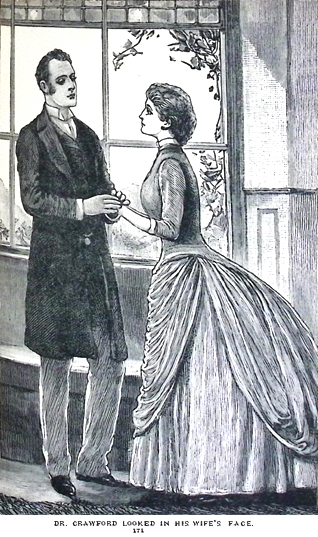
DR. CRAWFORD LOOKED IN HIS WIFE'S FACE.
Her next words had relation to Lord Carnelly and his meeting with her husband.
"I suppose Lindsay went into business matters with you when you met in Edinburgh," she said. "Is all settled now?"
"It will be soon, dear. Your money is to be invested on a new security, a mortgage, in fact. Carnelly paid me a year's interest, so you must always come to me as your banker, the same as before."
This was enough for Ida. She took it for granted that everything had been arranged to her husband's satisfaction, and dismissed the subject from her mind.
In after days, Dr. Crawford regretted that he had not given his wife his full confidence. It would have saved much subsequent misunderstanding.

"I WAS the means of bringing her to Steynes-Cote at this time, and she has been real good to the mistress, but I am beginning to misdoubt me about the outcome of her visit."
Thus mused Jean Graham as she went to and fro about her household duties, and the subject of her cogitations was Mrs. Prattely. Jean was a close observer of character, but not an unkindly one. Her judgments were usually charitable, or at least fair. She did not watch her neighbours in order to find fault with the object of laying up materials for future gossip. It was simply a part of her shrewd nature to go about with her eyes open. She was, mentally as well as physically, clear-sighted.
We know that Mrs. Prattely's presence at Steynes-Cote was due to Jean's suggestion, and yet the faithful woman was far from satisfied with the influence which that lady exercised over the mind of her young mistress. Jean had long before reckoned up Mrs. Prattely.
"She has a wealth o' kindness in her heart, but she's just a wee bit wanting in common-sense, poor body! What a pity it is that heads and hearts don't always match. A soft heart and a strong, wise head go finely together."
Subsequently, Jean was inclined to modify this last sentence. It was after the home-coming of Dr. Crawford and his bride, when even her much-loved "Master Andrew" came in for a touch of censure.
"Nobody can deny that he has a tender heart, and a wise head along with it, and yet he just spoils the mistress, and would have her tread on rose leaves all the while. I feel like sticking in a thorn here and there, just to wake her up for the good o' both of them. But, eh dear! the wisest and strongest of the men are like wax in the hands of a young lass that has crept into their hearts and taken up her dwelling there. They lose their natural sight, and the bonnie face of sweetheart or wife comes between them and their wise resolutions. It's just human nature. Why should I look for Master Andrew to be wiser than King Solomon was? I wonder now, if I were to leave the young mistress, would she rouse herself and put a hand to the housekeeping?"
It was not the first time she had asked herself this question, but Jean soon dismissed the idea from her mind. She loved the doctor and his wife too well to allow of her carrying it out, and she was not inclined to leave the management of Steynes-Cote in Mrs. Prattely's hands.
If the truth must be told, Jean had become jealous of the visitor. Mrs. Prattely had been all in all to her mistress during Dr. Crawford's absence, and the faithful servant felt herself left out in the cold. Up to that time, Ida had been on friendly terms with all her neighbours, but had made no confidential friend of any one particular. But with her husband away, the quiet doubly enforced by his father's death, and her own circumstances, the girl-wife was thrown into constant companionship with Mrs. Prattely.
It was perfectly natural that Ida should talk a great deal to Mrs. Prattely. Shelverton topics were soon exhausted, and Ida, having heard all the daily news of the little world outside, contributed her share to the conversation by speaking of her own early life and surroundings. We know how Mrs. Prattely expressed herself when Ida first came to Steynes-Cote, and unfortunately she thought fit to repeat her opinions to the subject of them.
"I am sure you must have felt that by coming to Shelverton you were burying yourself alive," said Mrs. Prattely. "You had been accustomed to such different society and far more gaiety than we have in this quiet place."
The remark amused Ida, and she replied, "I never cared for much gaiety. Even in India I lived very quietly. Before I joined my brother's family there, my life was that of a schoolgirl; I knew nothing of the world outside. Then, when we returned to England, I had been for a year engaged to be married, so where would have been the use of my plunging into the whirl of London society when I was to leave it almost immediately? My sister-in-law wished my marriage to be put off for a year, so that I might have a season in town, but the prospect had little attraction for me. Beatrice could not understand my indifference, for she delights in gaiety, and is still very much admired, though she has been married twelve years. She would consider living at Shelverton as being buried alive, but we think very differently about many things."
"Well," said Mrs. Prattely, "you do surprise me! Surely there are very few girls, tempted as you were, who would have come to a similar decision. I find I have wasted my pity upon you."
"Why did you pity me?" asked Ida, with a look of genuine astonishment.
"It was when you came to Steynes-Cote a bride. I said to myself, 'Poor thing! That young creature's life will be a terribly lonely one. The doctor will be constantly out, and, unless some of her own people come to stay with her, she will miss more and more what she has left behind. Dr. Crawford can never make up to her for what she has sacrificed in order to become his wife."
"I did not sacrifice anything," said Ida, still loyal to her husband, and anxious that others should understand his disinterested conduct towards herself. "I considered myself a fortunate girl in having gained the affection of so good a man as Andrew Crawford. You cannot imagine how much his love was to me, Mrs. Prattely. My life in India was my season of loneliness and comparative neglect, and it was to Dr. Crawford I owed all of brightness that was mingled with it."
Ida's face glowed again as she looked back upon that time; and with moistened eyes and in the fulness of her heart she told Mrs. Prattely the story of the doctor's wooing, and the change it wrought for her.
"My dear," replied her listener, "you must not think that I under-value Dr. Crawford. I consider him one of the excellent of the earth, everything that is estimable, and a very handsome man into the bargain. But I am not in the least surprised that, in spite of all his excellences, Lady Carnelly should have opposed your marrying so young, and without having given yourself a chance of something better. She, you say, is the daughter of a nobleman, as well as the wife of one. It was perfectly natural for her to feel that rank has its claims. And, my dear Mrs. Crawford, with your face,—I do not wish to flatter you,—and the advantage that rank gives, you might have married anybody. I am not surprised at the view Lady Carnelly took of your engagement. I only wonder that your brother ever consented to it. I fearlessly repeat, that, taking everything into consideration, it was much more natural to expect that you would marry a duke than a doctor. This, however, must be between ourselves. What would Dr. Crawford say if he heard me?"
"Perhaps he would agree with you," replied Ida, with a smile and a blush, as she caught sight of her beautiful face in the mirror opposite. "Andrew is always rather disposed to overestimate all that belongs to his wife. I do not think a duke would have valued me half so much as he does, and, for myself, I only wish I were more worthy of him. He is so good."
Ida meant all that she said, and felt inclined to laugh at the opinions expressed by her visitor. The words, however, were not forgotten; they lay as seeds in Ida's memory, and in after days brought forth thorns on the path of the girl-wife.
During the colonel's brief visit to Steynes-Cote, Mrs. Prattely was in her glory. For a title-worshipper like herself, it was happiness indeed to be the one inhabitant of Shelverton who was brought into familiar contact with Lord Carnelly. Her devotion to Mrs. Crawford had met with its reward, and when she returned home, Mrs. Prattely felt entitled to hold herself just a step above the other Park people, who had not been equally privileged.
But before Mrs. Prattely left Steynes-Cote, its young mistress had taken her into full confidence. She knew all about the treatment which Ida received from her sister-in-law before her marriage, all about the little fortune she was expecting even then from Lord Carnelly's hands, and of her delight in the birthday presents which had already brought with them an assurance of a better understanding for the future between Beatrice and herself.
"I really feel quite rich, now all these matters are settled," said Mrs. Crawford, with that winsome, girlish manner of hers. "I was a little anxious about these few thousands of mine, because there is no doubt that Lindsay's expenses have been very great since his return from India. Beatrice will spend so much, no matter what my brother says, and the having a title does not always mean being a rich man. I daresay Lady Carnelly counts on the fortune which will be hers some day. It is to come at the death of an aunt who might, if she chose, give my sister-in-law a handsome allowance now, without ever missing the money, but Beatrice and she are not on friendly terms. They are too much alike in temper for that, so old Miss Pelham will never allow a penny to pass into her niece's hands whilst she lives. She is very miserly, too, and looks upon Beatrice as wickedly wasteful in her expenditure, especially with so large a family to be provided for."
It seemed very strange to Mrs. Prattely to hear Ida talk of her few thousands as her fortune; to hear, in addition, that she had been doubtful whether Lord Carnelly would be able to pay it on account of his wife's extravagance. And Mrs. Prattely's own fortune would have equalled Ida's multiplied by ten. It amused her, and pleased her too, when Mrs. Crawford began to reckon how much she should be able to spend on her baby.
"I have never cared for costly dresses myself," she said, "but I shall like to be just a little bit extravagant for my precious pet. She is such a beauty, and will look lovelier than ever in some of the pretty things I mean to buy for her. We cannot have the birthday and christening party on which I reckoned so much, but my little treasure shall make a brave show in her baby finery."
It is so natural for a young mother to think that she shows her love for her infant by clothing it in the finest of embroidery and the daintiest of lace, and to be willing to deny herself some coveted article of dress that, as Ida said, "Baby may make a brave show." But as often as not, the very finery which gratifies the maternal vanity rather takes from than adds to the comfort of the child, for whom nothing is thought too costly, except that which money cannot buy—the self-devoting watchfulness of the mother herself.
Many a young mother, too, whose means are small, and who can spend but little money on the purchase of dainty garments, bestows upon them her own patient handiwork, which costs her infinitely more than the emptying of a purse which will be replenished at a word from its owner.
Mrs. Crawford did not carry a full purse with her when she went on a shopping expedition, accompanied by Mrs. Prattely. But she did bring back with her a stock of very well-chosen little garments and a long, unpaid bill, the sum total of which astonished her husband.
Ida showed him the pretty clothing before she produced the account, and the doctor, seeing her innocent delight in her purchases, duly admired them, whilst he cautioned her against sowing the seeds of vanity in the infant mind of her first-born.
"As though she could know anything about finery for years to come!" said Ida. "But I shall like my Doris to be as prettily dressed as any child can be. I am glad you like my purchases, Andrew."
"I am afraid, darling, I am no great judge of the garments; but as to baby herself, I do know that she has the dearest of little faces, and that each day it reflects more clearly that of my precious girl-wife. What is this, dear?" added the doctor, as he picked up an envelope which had evidently dropped from the parcel.
"I suppose it will be the bill, Andrew. The shopman said he would enclose it with the things."
"Is it paid?" asked the doctor.
"Of course not, dear, for I had very little money in my pocket. But I wished it to be sent at once, as I know you do not like any accounts to stand over, and I mean these things to be paid for out of my own money. Not that I want it to be reckoned mine, Andrew; only, as Lindsay has paid you, and there will be no expense about the party I reckoned on having, I thought you would not mind my buying some very pretty things for baby instead. You can open it," she added, seeing that the doctor continued to hold the envelope in his hand in a mechanical fashion.
He obeyed, and glanced over the long list of purchases it contained with a look of consternation, which, however, Ida did not see, as she was too much occupied in refolding the articles themselves.
"Ida darling, did you reckon the total cost of all these pretty things as you chose them, one by, one?" asked the doctor in a quiet tone.
"No, Andrew; I asked the price of each, and some of them were rather expensive, but then they are so very good and handsome. And Mrs. Prattely, who was with me, said that good lace and embroidery are always the best worth buying. The first cost may be greater, but they wash and wear so well that it is true economy to buy them." And Ida looked quite triumphant at being able to quote Mrs. Prattely as her authority.
The doctor said nothing, but pointed to the figures at the foot of the bill. If these were correct, Ida's shopping expedition had cost her husband fifty pounds.
"Oh, Andrew, there must be a mistake! I never thought they would come to half that. I am afraid you are displeased, but I thought they would last and look so pretty, and that you would not mind so much for once, if they came out of my money."
"I can see how it happened that you were drawn into spending more than you intended, Ida," said her husband. "I felt a little surprised at this bill, because you have never been extravagant for yourself. I am afraid, however, that you forgot how soon babies grow out of their clothes, and that all your pretty purchases will be useless to Miss Doris Crawford before many months have passed over her head. Then, if she were to require a renewal of her wardrobe at a similar cost, I should have to take up the cry of one of my patients, who lamented that she found her baby a very expensive luxury."
The doctor had not the heart to distress Ida by using a graver tone, though the sight of the bill had disturbed him a good deal, and she saw that such was the case.
"Perhaps the shopkeeper would take back some of the things," said Ida. "I could say I had made a mistake in taking so many of a similar size, and that I would have some larger ones by-and-by."
"Never mind them, dear; you shall keep your purchases," replied the doctor. "And the next time you go to make any, it will be better to fix beforehand how much you will spend. This bill must be paid to-morrow."
And so it was; but the doctor looked rather ruefully at the small balance left out of the year's interest paid him by Lord Carnelly. Half of it had gone to pay for the costly, useless, so-called presents, which lay glittering in their cases under lock and key. Fifty more must go for baby finery almost as useless, the only satisfaction about this last being that it delighted the young mother.
And yet Dr. Crawford did not tell his wife how the money had already melted out of his grasp, or that he was doubtful whether any more would come from the same quarter.
As a matter of course, Mrs. Prattely was one of the baby's sponsors, Lord and Lady Carnelly being the other two, though they did not attend her christening, but were represented by Dr. Crawford and Ida. And Mrs. Prattely further manifested her interest in her god-daughter by costly gifts of plate and still more dainty lace than that already purchased. Also, by hunting up a nurse who was to take all trouble off the young mother's hands, and who, as Jean Graham said, "took more waiting on than the doctor, his wife, and baby put together."
DURING the three years which followed the birth of Dr. Crawford's first baby, many changes took place at Steynes-Cote. Additions were made to the inmates, and some familiar faces disappeared from beneath its roof. Little Doris was no longer the one child of the household, but the eldest of four, there being, as Mrs. Prattely pathetically remarked, "actually two that could not walk. Really, Mrs. Crawford, poor thing, was quite borne down by her tribe of little children."
"I don't see why she need be," said her husband, who, good, easy man that he was, could now and then express a very decided opinion. "If you said that Andrew Crawford was borne down by the force of circumstances, I should be inclined to agree with you. Poor fellow! I could not help noticing, when I met him the other day, that his hair is going grey already. How can a mother be over-weighted who has a couple of nurses to do her work for her? Does Mrs. Crawford keep even one of her little ones by her side the night through, or wake or watch for their sakes? Not she. Hers is motherhood made easy."
"My dear James, you surely do not consider that a young lady of Mrs. Crawford's—"
"Do not bring up her 'family,' if you please. She should have remained the Honourable Ida Carnelly, if she had not intended to take upon herself the duties of a wife with the honest name of Crawford. It is the present family, the four little children who call her 'mother.'"
"My dear James, two of them cannot call her anything yet, for Archie, though fourteen months old, is singularly backward with his tongue."
"You know what I mean, Maria," replied Mr. Prattely, rather testily. "I say that those little children constitute the family of whom Mrs. Crawford ought to be proud, and to them, together with her husband, her best affections, thoughts, and efforts should be given. What matters it that she is the sister of an impecunious viscount, with a fashionable wife, a large family, and an army of clamorous creditors besieging his gates? Whose untiring labour is it that maintains Steynes-Cote, feeds the small mouths, pays the troop of servants that Mrs. Crawford considers necessary to relieve her of domestic cares, and earns the money which is too often unwisely spent? Is it not Andrew Crawford?"
"Of course, my dear James, Dr. Crawford does all these things. Is it likely that any one else would keep his home, wife, and family, or that he would allow them to do it?"
"Then if he does, and if he neglects no duty, ought that young wife of his to be contented without taking any share of parental responsibility upon herself? Is it enough for her to preserve her good looks, by delegating to others all the motherly cares that might perhaps take a little of the bloom from her cheek or the brightness from her eyes? Does a man's heart crave for nothing in the companion of a lifetime but a beautiful face, a graceful carriage, tasteful dress, and smiles and pleasant words when he comes in wearied in mind and body?" asked Mr. Prattely.
"I am sure, James, there are many men who would be only too thankful to have all that you describe, and which every one must admit the doctor has in Mrs. Crawford. I really think she grows handsomer every year, and she looks as young as she did on the first day she came to Shelverton. If she were a slattern like that young Mrs. Iverson, whose house is a disgrace to The Park, or a scold like Mrs. Harrington, whose voice can be heard across two gardens, and not small ones either, you might find fault with Ida Crawford," said Mrs. Prattely, looking aggrieved for her "protégée."
"Maria, you are one of the best of friends and most illogical of women. Can you not understand that I do not blame Mrs. Crawford for being so beautiful, graceful, or soft-spoken, but for not being so many other things in addition?"
"I am certain she is devotedly attached to her husband and children," persisted the lady.
"Not devotedly, my dear Maria; you misapply the word. There is no devotion in the matter. Mrs. Crawford loves her belongings in a war; she delights in hearing them praised for their pretty faces, sturdy limbs, and healthy appearance. She repeats with genuine enjoyment the clever sayings of your rather precocious godchild, Miss Doris. She exercises admirable taste in choosing the garments which cover those tender little bodies, and she takes care, by proxy, that all their wants are supplied. But the doctor pays for all this, Maria my dear, not only in purse, but in mind and body."
"Now it is you who are absurd, James. Does the doctor sit up with the children, or nurse, wash, and dress them?"
"Yes, Maria, also by proxy, for, in order that his wife may sit at ease, he works much harder than he ought to do. The smoothness of her cheeks is preserved at the cost of untimely lines of care which are stealing across his brow. Her sleep is undisturbed, or interrupted but for a moment, whilst he dresses at midnight to scour across the country and carry relief to suffering folk miles away," said Mr. Prattely, waxing more and more earnest.
"Well, you know doctors must get up when they are called to visit patients, no matter whether they are needed at night or by day," replied his wife.
"But Crawford has too much work and too little rest. Do you know that Soames has left him, having bought a practice in another county, and that no new assistant has been engaged to take his place?"
"I knew that Soames was gone, but I thought Dr. Crawford would be sure to have some one else as soon as possible. He cannot do all the work with only a dispensing assistant," said Mrs. Prattely.
"It seems he is going to try, for he told me so himself. I said he was wrong to think of such a thing, and that it was of no use to kill himself to keep himself. But he smiled in rather a wintry fashion, and said that even with an assistant less, there would be thirteen of them to keep. He must try for a little while with one assistant. Reckon up the thirteen, Maria, will you?"
"Let me see," said Mrs. Prattely, beginning to count up the inhabitants of Steynes-Cote on her fingers. "There are Dr. and Mrs. Crawford, four children, and two nurses; those make eight. Jean Graham, who, by the way, makes herself so disagreeable that if I were Ida, I would give her a month's notice. You may keep a servant too long, until she forgets whether you or she is mistress."
"Jean Graham makes nine," interposed Mr. Prattely, in order to bring his wife back to her arithmetic.
"Yes, nine. Then there are the housemaid and waitress, eleven. No laundry-maid, for most of the washing goes out. Those are all the female servants, but the groom lives in the house, because there is no telling when he may be wanted, and the boy. He is the one who takes out medicine and answers the surgery door during the assistant's absence, but he does not sleep at Steynes-Cote. Thirteen in all."
"Without the assistant, who makes fourteen. Perhaps the doctor counted the two smallest children as halves, the same as the railway people do youngsters under a certain age. At any rate, he has fourteen human beings to keep; six of them to feed and clothe, eight to pay, all to house. One cannot look at such a sum total without feeling that the doctor's shoulders had need to be pretty broad to bear the weight they have to carry."
Perhaps, as Mr. Prattely paused at the close of this calculation, he might be inclined to think that arguments could be adduced by comparison in favour of his own childless condition; his surroundings were so thoroughly comfortable, and he could roam away from Shelverton, or live at home at ease, without having to consult any one but his own inclination.
All at once he broke out again with the exclamation, "Why, Maria, we forget the Steynes-Cote gardens! They must cost the doctor a pretty penny."
"Not now," said Mrs. Prattely, rather dolefully. "They used to do in Mrs. Fereday's time, and they well repaid what was spent on them. But now the doctor has contracted with Milner, the nursery-man, just to keep the grounds in decent order. They look very different from what they did even a year ago. This change is quite a trial to Mrs. Crawford, who is such a lover of flowers, and has such refined tastes, poor thing!"
"Maria," said Mr. Prattely solemnly, "I beg that you will never apply those words to Mrs. Crawford in my presence, unless you wish irritate me beyond endurance. Call Crawford 'poor man,' or 'poor fellow' even, if you like; I will join you in pitying him, but not his wife. I would not say it to a soul except yourself, but Andrew Crawford made a woeful mistake when he married a young lady with a handle to her name."
"She is only a girl now, just turned four-and-twenty, and she is very fond of her husband and children. Say what you like, James, but never intimate that Ida Crawford does not love her husband," replied Mrs. Prattely, moved to tears in defence of her favourite.
"My dear, there are so many kinds of love. There is the love which talks about itself, which says all it feels, which gives smiles and pretty words and caresses, which is a mere sentiment, because unaccompanied by the deeds which should prove that it is a real thing. And there is another kind of love which is seldom heard to assert itself in words, but which surrounds its object as with a band of silent ministers. This love renders unobtrusive service, anticipates wants, smooths rough places, is ready to sympathize in words, if these seem best, or in quiet deeds of kindness, which show what is in the heart, when speech would jar on the troubled ear. This love in the wife goes gently to the husband's side, when it sees that the world's cares are weighing him down, and tries to draw a portion of the burden on its own shoulders. This love does not order a new dress in the latest fashion, and call upon the weary, toil-worn husband to admire it and the wearer, and to pay the bill. It looks first to see whether the good man's coat is getting frayed out at the wrists or white at the seams, and asks whether it will match with the new gown before it orders one, or if both can be afforded, and if not, true love finds pleasure in going without that its object may have of the best.
"So with a mother's love too. You say, Maria, that Mrs. Crawford loves her children. If God had spared us our one little daughter, would a like manifestation of love have sufficed to satisfy your heart and conscience? Ah, my dear, I remember when our child was ill, you did not bid a hired nurse go watch beside her. Your love would let you know no rest until your darling's blue eyes closed for the last time on earth. You were a pretty girl when I married you, Maria, as pretty every bit as the doctor's wife, but you never looked so fair in my eyes as on that never-to-be-forgotten night. You were almost worn out with watching, the roses were gone from your cheeks, and there were dark rings below those tearful eyes that you raised to mine with a world of love and pity in them. But in the midst of the greatest sorrow you ever knew, you tried to comfort me, though your loving heart was ready to break."
The picture so vividly drawn was almost more than the mother could bear to look back upon, even after four-and-twenty years. But the words were sweet, though they recalled a time of sadness, and the middle-aged wife drew near her husband, and clasped in his arms, shed tears of mingled joy and sorrow on his breast.
After a while, Mrs. Prattely raised her head and whispered, "James, my dear James, I wish I were half as wise as you are. I so often mean to be kind, and I am afraid I make sad mistakes. Your words make me feel that, while wanting to be a true friend to Dr. Crawford's girl-wife, I may have done her harm. Tell me, James, do you think I am in any way to blame?"
"My dear, I do not wish to trouble you, but I have sometimes doubted whether your influence over Mrs. Crawford would prove as beneficial as you intended it to be. I am afraid you have helped to foster the notion that so dainty a lady is like eggshell china, too delicate for everyday use, and only meant to be looked at."
"I wish you had spoken sooner, James," said his wife in a sorrowful tone. "You seldom care to talk as you have done to-day, though I try to tell you all that passes between others and myself."
"Take comfort, my dear. You have acted, as you always strive to do, from right motives. You wanted to be very good to this stranger girl, and you have been very kind and motherly to Mrs. Crawford. But the most loving mothers are sometimes the very ones whose excess of kindness does much to spoil their daughters, by taking away the need for exertion. People have been thinking and caring for pretty Mrs. Crawford until she neither thinks much for herself nor for others. You would have been sorry for the doctor to-day, Maria, he looked so harassed and careworn. I never realized how things were with him until to-day. He will work himself to death to keep up that far too costly establishment. When thirteen pull against one, the odd man must come to the ground in time."
"Surely you do not mean that Dr. Crawford is getting into debt?" said Mrs. Prattely, with a look of genuine concern.
"Not so bad as that; but he is getting poorer in spite of harder work, and his expenses increase with his family. Then he has had to help his own people in Scotland, though he tells me his young brothers are beginning to feel their feet now, and assisting to keep the mother."
"I am glad of that. Mrs. Crawford told me her husband was helping his mother and her younger children," said Mrs. Prattely.
"Surely she did not object to that," replied her husband quickly.
"No indeed, James; you sorely misjudge Ida Crawford if you think her capable of such a thought. On the contrary, I know it has been her delight to send many little presents to the doctor's mother. She has wanted her to come to Steynes-Cote to spend some months at a time, and has repeated the invitation again and again, though it has not once been accepted."
"And a good thing too, though I am glad she has been thoughtful for the old lady. Still, the presents were really at Crawford's expense."
"No, James, you are mistaken; Ida bought them with her own money. It is true she had to ask her husband for it, but that is because he receives the interest, not Ida herself. I know, because she told me all about these things when Doris was born. She was a little afraid that the money would not be forthcoming, but Lord Carnelly gave the doctor a mortgage on his Lincolnshire estate, so it was made quite safe," said Mrs. Prattely in a decided tone.
There was a look on her husband's face when he said he was glad to hear this which would have conveyed the idea of doubt rather than conviction to most people. And it is true that Mr. Prattely did say to himself, "I wonder how much interest poor Crawford has received on that mortgage?"
Mr. Prattely knew a good deal more of Lord Carnelly's affairs than his wife gave him credit for, and he made a shrewd guess when he put down Dr. Crawford's receipts on account of interest at "nil."
With the exception of the two hundred and fifty pounds which the colonel so reluctantly parted with when the men met in Edinburgh, Dr. Crawford had not up to this time received a single penny from his brother-in-law.
Lord Carnelly had not ignored his liability, but each half-year, instead of the interest, a letter had come pleading for an extension of time, and giving a doleful list of debts that must be paid to more persistent creditors. And Ida, knowing that her brother had written, took it for granted that all was right, and did not hesitate to draw upon her domestic banker, because had not Andrew always told her that she alone should have the spending of the money that was her very own?
Surely Dr. Crawford was not free from blame in withholding his full confidence from the loving, if childish girl-wife.
THERE was one relative of the late Mrs. Fereday with whom Dr. Crawford had always kept up a friendly though rather desultory intercourse. This was the Rev. Walter Steyne, younger brother of the gentleman who inherited the entailed estates at the death of Mrs. Fereday's father. He was rector of Hillstead Magna, a village about twenty miles from Shelverton, and possessed in addition to his living some private means, a delicate wife, and a large family, of whom his daughter Grace was the eldest. This girl had not been specially called after Mrs. Fereday, for the Christian name common to both had been borne by some feminine Steyne in each generation for ages past.
She had often visited at Steynes-Cote when a child, and was a great favourite with the Feredays, whom she was accustomed to call "aunt" and "uncle," though Mrs. Fereday was really her father's first cousin. There were no little Steynes at Hillstead when Andrew Crawford was sent for to be the adopted son at Steynes-Cote, and it was chiefly during his college course and absence in India that the two or three eldest amongst the rectory children came to stay at Shelverton with the Feredays.
Since Dr. Crawford's marriage, there had been no visiting between the families, though he and Mr. Steyne met occasionally, and exchanged friendly letters at rather long intervals. The chief reason for the suspension of Grace's visits to Steynes-Cote was owing to the fact that the girl's presence was almost indispensable at home. Within the last five years, her mother's delicacy had increased to such a degree that she was wholly confined to the house during the winter, and, at best, able to take only a small share in the management of her family.
Hillstead people were continually saying what a truly providential arrangement it was that the rector's eldest child was a girl. "If it were not for Miss Grace, what would become of all those little ones?" was a common question, and it was one which often recurred to the minds of both father and mother.
It is surely the exception to find unanimity in village female society, but there were no two opinions in Hillstead parish as to the merits of the rector's daughter. Yet, many a motherly heart, felt deeply for the girl and the parents, while thanking God for so precious a gift, sighed at the thought that Grace was growing old far too soon.
That Grace Steyne did wonders in her character of deputy-mother, there could be no doubt, also that her being the eldest was a great blessing in a family containing a disproportionate number of boys. But whether the girl felt this arrangement quite satisfactory for herself is somewhat questionable. To be the eldest of nine when one is just fifteen, and to act as the mother's deputy in every department of household management from that age to one's twentieth birthday, is not always a matter for self-gratulation.
Such a position may be invaluable, as tending to encourage domesticity of character, and is certain to give an amount of experience in the management of children which nothing else but actual motherhood can furnish. Indeed, as was Mrs. Crawford's case, it is possible to be a real mother without fulfilling many of a mother's duties.
Still, it is possible to have too much experience even of a good thing, or it may be too wide, when compared with the time spent in acquiring it. Young shoulders may be over-weighted and young hearts feel very heavy, whilst the heads and hands belonging to them are taking the work of old ones. The fact that they have won the unlimited confidence of all around them does not always compensate the young folks for the loss of a large share of girlish enjoyments.
If such thoughts passed through Grace Steyne's mind, she did not put them into words, but showed a brave front and a cheery face to all lookers-on. She knew that one of her mother's greatest troubles came from the thought that her darling child had far too much work and too little relaxation. She noticed how the invalid's eyes would follow her wistfully, as if in dread that the girl's strength and courage might alike give way.
But Grace did not complain. She returned the anxious look with a smile which gave renewed confidence and comfort to her mother's heart. She made time from household calls and on the busiest days to tell Mrs. Steyne all that was going on outside, and when, by her humorous way of putting things, she beguiled the invalid into a laugh, she went away feeling abundantly rewarded.
Children are always harder to manage when the presence of an invalid renders quiet essential in a house; and to secure this Grace Steyne's ingenuity was often strained to the utmost. Happily, she was a famous tale-teller, and many a time she succeeded in coaxing the smaller fry to give up an hour and go to bed so much sooner, on condition that she would sit in the large night nursery and tell tales for their benefit.
Then, when the last young head rested peacefully, Grace would steal to the little chamber she called her own, and, kneeling there, cry to her Father in heaven to give her strength according to her day, and enable her to persevere in the path of duty, to put self aside and care for others.
Only the pale moon and the silent stars which peeped through the uncurtained window knew of these brief moments of solemn heart-crying to God. Only these and the walls of the little room, if they could have had ears to hear and tongues to repeat, would have been able to report concerning the girl's struggles against the natural longings of youth for the simple pleasures from which she was almost wholly debarred.
The girl needed a brave heart and a brave face, for her daily life was one battle-field. With her bright temperament, vigorous health, strong sense of humour, and love of the beautiful, it did seem hard to be chained down, as it were, to this unvarying round of household duties. To see other girls going off to the tennis parties to which she had also been invited, and to have to shake her head when they dropped in at the rectory to say, "Do come for once, Gracie," required no little courage. To do it without a look of discontent, and even to jest over her disappointment, required more still.
"Cannot be done," Grace said, on one such occasion which must be chronicled. "Watty has torn his everyday jacket almost to ribbons, and must remain in 'durance vile' until I have mended it."
"Let him put on another; I am sure he has more than one jacket," cried the girls in chorus.
"He has two. The boys all have the same allowance—one for Sundays, one for week-days, and I am glad they have no more, or I might sometimes be tempted to put off the mending; then think what the accumulation would be!"
"Gracie, do come. Let Watty pay the penalty this time. It will teach him a lesson. He is always tearing his clothes, and it is really too bad to keep you stitch, stitching, to mend them on such a perfect day as this, and when everybody wants you to come out."
"Unfortunately everybody here wants me to stay in, and there is not only Watty's jacket, but a perfect pile of things on the nursery table with holes shouting to be mended, for washing and ironing days are just over."
"I will stay and help you," said one of the callers, resolutely putting down her racquet.
"Thank you a thousand times, Nelly, but you shall do no such thing. Even with your help, if I could allow a crack tennis player to make such a sacrifice, we could not finish the mending to-night. You would be missed; I shall not, for I am such a shocking player that every one fights shy of me as a partner."
"That is because you get no practice. You would play well directly if you had a fair chance."
"Perhaps I might, perhaps not. At any rate I cannot play fit to be seen now, and it is now that you are anxiously looked for at Hazelcourt. So good-bye, girls; you are only hindering my work, and keeping Watty without his jacket."
Thus Grace dismissed her visitors, and turned resolutely indoors, without even waiting to respond to the backward glances, honestly regretful ones, which were cast on her retreating figure, as she walked quickly towards the house. To her credit be it spoken, she did not keep Watty a prisoner any longer than was absolutely necessary for the repair of his damaged garment.
Grace knew that the child was longing to be set free. Nature out of doors was calling to him with a hundred voices, and human nature was specially represented by a group of small boy companions who kept casting furtive glances along the path, whilst they awaited with more or less impatience, the deliverance of their captive chum, the knight of the tatters.
The lads were going on a blackberrying expedition, and as Grace handed Watty his garment, it was with small hope that it would come back without additional rents after such an excursion. And yet the girl could sympathize with the child's impatience, for Nature was appealing to her as well as to Watty just then—nature within her own breast—youthful nature, that all a woman's sober work could not stifle or uproot.
As the swift-flying needle brought together the frayed edges, Grace's thoughts followed the friends who had reluctantly left her at the rectory gate. In fancy, she saw them welcomed on their arrival at Hazelcourt, and heard inquiries and regrets on account of her own absence. She wondered whether a certain masculine brow would be clouded for just a little while, because she was not there. Or would its owner be angry instead of sorry, and put down her absence to determined avoidance of himself?
He was only a guest at Hazelcourt, and she knew that his visit was drawing to a close. Probably this tennis party would be her last opportunity of seeing him, and, in spite of her being the worst lady player in Hillstead Magna, she had meant to go. Everybody could not play at once, and the girls who were willing to look on were not always the least acceptable guests at parties of the kind.
Grace had found looking on very pleasant indeed the last time she was at Hazelcourt, for the visitor aforesaid, though as good a player as she was a bad one, had been seized with a desire to watch the game in her company, instead of taking part in it. And he had walked home with her through the dewy lanes in the early evening, talking pleasantly by the way, and making it longer than was really needful by unreasonable dawdling.
Then, when Grace asked if he would come into the rectory and see her father, because he kept lingering at the gate as if he expected such an invitation, he promptly accepted it, and spent a full hour with her parents, who enjoyed his bright companionship almost as much as she had done on the homeward way.
Grace said to herself that this acquaintance with a neighbour's guest would be only a passing affair. The young man would go away, and no doubt forget the people whom he had met during an idle month at Hazelcourt. But whilst he remained, he was a great acquisition to Hillstead society. He was well-born, well-educated, had been, for his age, a great traveller, and could talk about so many places and things which Grace had often vainly longed to see.
He was rich, too, though from his simple, unaffected tastes and ways no one would have thought so; or at least village minds would not, for simple folk who have spent their lives within a narrow circle generally imagine that the possession of wealth must be associated with much external display.
Yet, though the acquaintance with this young stranger would prove of a transitory character, Grace Steyne did feel that she should like to have as much pleasure out of it as possible. She did wish to be at the tennis party, and thought she might be spared to go. She had even risen an hour earlier than usual to forecast her work, and make sure of going with a clear conscience and a sense that nothing would be left undone in the meanwhile.
Then everything had gone against her. That tiresome Miss Barber had come to speak to the rector about the clothing club, and he being from home, Grace, to save her mother from the infliction, had endured two hours of wearisome talk, the substance of which might have been given in ten minutes. Other unexpected calls had taken her from work that must be done, so that when the time came, Grace had to send away her friends without her, and submit to the disappointment as best she might.
We have seen how she acted, and that she dismissed her girl friends with a smile and a jest, mended Watty's jacket without scolding him or boxing his ears for having torn it, and next set to work with a will to lessen the big pile of articles that needed, some a few stitches or an odd button, others a good hour's work, before they could be laid away ready for use.
A very prosaic occupation was this of darning and patching. But taking all the circumstances into consideration, it had its poetic side. The girl had fought a pretty tough battle with herself. Every feeling of her young nature, with its capacity for enjoyment, its longing for fellowship with other young life, and that special little secret hidden far down in the very depths of her innocent heart, had pleaded against the stern call of present duty on that bright afternoon. And yet one brief prayer had gone up from her heart to God, "Help me to do right at any cost!"
Who, looking at the calm face, or receiving a pleasant answer from the girl's lips, could have guessed what a real trial it had been to her to give up the visit to Hazelcourt? But Grace Steyne was just the one not only to bear pain, but so to hide what she endured that others might not guess its existence, and thus be grieved for her sake.
Nobody living, not even Mrs. Prattely, could have called Grace "poor thing!" or even "poor girl!" She might be over-worked and over-weighted in that busy house, where every one referred to her as its presiding genius, but no person could have used terms of pity which savoured of contempt when alluding to the rector's brave daughter.
Tea was over, the younger fry, including Watty, were all in bed, and Grace was still bending over her work by lamplight, when she heard steps and voices on the gravel outside. Masculine voices, one of them her father's, were coming nearer, and Grace's cheek flushed and paled as the second fell on her ear. It seemed so like that to which she had listened with more pleasure than she durst confess to herself, during her last walk home from Hazelcourt.
"I must be mistaken," thought Grace, pausing in her work to listen more attentively.
But her mother prevented this by saying, "Grace dear, your father is bringing some one home with him. Is there anything in the house for supper if the visitor should stay?"
No chance for the girl's thoughts to dwell on anything which savoured of life's poetry. She must turn from the household clothing to its commissariat department, and speculate as to the possibility of bringing in the mere scrap of cold meat left from dinner in a presentable form.
Grace's guess as to the personality of the coming visitor was set at rest by his entrance with her father. At sight of him, she ceased to hope that he would not stay to supper, despite the fact that there was next to nothing in the larder, for he was the individual who had occupied the largest share in her thoughts that afternoon—Mr. Carnelly.
"MR. CARNELLY has walked with me from Hazelcourt, where I dropped in, expecting to find Gracie and bring her home with me," said the rector, as he entered the room. "He is leaving Hillstead to-morrow, and wished to say 'good-bye' to you before setting out."
The rector hardly expressed Mr. Carnelly's wishes correctly, though he was not to blame for this, inasmuch as he had been made only very partially acquainted with them. It is probable that if the gentle invalid lady at the rectory had possessed no daughter, Mr. Carnelly would have been content to send a farewell message by her husband instead of calling at this unorthodox hour to deliver it in person.
Mrs. Steyne held out a welcoming hand to the young man, and looked not a little gratified by such a mark of attention, as she told Mr. Carnelly that it was very good of him to take so long a walk for the purpose.
"I assure you it has seemed a very short one to me," said he; "Mr. Steyne's conversation is enough to beguile any walk of its length. I could hardly believe we were here when we stopped at the gate. I had a second object in calling, which was to convey a long string of reproaches to Miss Steyne from our mutual friends at Hazelcourt."
He was shaking hands with Grace as he spoke, and there was a look of gentle reproach on his face which seemed to say to the girl, "How could you be so cruel as to disappoint me?"
"Yes, Gracie, and I have a budget of messages to the same effect. How was it you never made your appearance? The Dixons all sent their love and no end of regrets on account of your absence. What kept you at home, my dear, when you had promised to go?"
"Not positively promised, father. I only said I would go if possible; but it was not possible, and so I had to stay at home. I wished to go very much indeed."
The look of reproach vanished from the visitor's countenance, driven thence by this last sentence, which, though addressed to Mr. Steyne, was a sufficient and satisfactory answer to its mute questioning. Grace had not stayed away willingly in one sense; that was enough for Mr. Carnelly.
"Whence arose the impossibility, Gracie?" inquired Mr. Steyne.
"Oh, there were ever so many things in combination, and, first and foremost, old Miss Barber, who wanted to see you, must not see mamma, and did see me, to the extent of the two longest hours I ever spent in my life."
"My dear child, I am so sorry for you," said the rector in tones of such genuine commiseration that his wife, Grace, and the visitor laughed heartily in unison.
"I will never forgive Miss Barber, though I know her not," said Mr. Carnelly, as soon as he could speak for laughing.
"Surely Miss Barber was not the sole offender," said the rector. "What else hindered you, my child?"
"Ever so many things, quite too small to mention separately," said Grace. "Let me see, the first was—"
"Watty's jacket," solemnly interposed Mr. Carnelly, with a look of infinite amusement on his handsome face.
Grace's countenance scarcely reflected it. She was saying to herself, "The girls must have told him. How unkind to go and proclaim at Hazelcourt that I was forced to stay at home to mend my little brother's tatters instead of going to a tennis party! They must have wanted to make me look ridiculous."
The very idea that the friends she loved and trusted, or any one of them, could have been thus unkind when her back was turned, stung the girl to the quick, and she strove hard to keep back some rebellious tears which threatened to put in an appearance.
Mr. Carnelly noticed the look of distress, and said, "Miss Steyne, I must confess that I this afternoon quite unintentionally acted the part of eavesdropper. You know the pretty summerhouse, the back of which is close to the road? I was sitting there, when two groups of guests coming to Hazelcourt met just behind the great holly hedge against which stands the summerhouse. They paused for a moment to exchange greetings, and, on one side, to inquire after a young lady who ought to have been with the other group, but who, alas! was missing. I heard nothing but kindly words and honest regrets when it was found that the young lady was busy at home. But there was one inquirer who insisted on knowing what the absentee was doing—I believe in the hope that she could rush into her presence, take the work out of her hands, and return with her in triumph—and the answer, was 'Mending Watty's jacket.'
"Miss Steyne, you may believe me or not, but those three words brought a host of childish memories to my mind. In my early days I was an incorrigible ragamuffin. My clothes would tear, no matter how new or of what substantial material, and I had a very dragon of a nurse, who objected to do more than a fair average of repairs. If my garments needed more,—and they always did,—I paid for the extras in various ways, such as being caned, imprisoned, or sent supperless to bed. I had no mother, and my dear father—the greatest man of his generation in his own line—had no time to do more than look in upon me now and then. He saw me strong and healthy; he knew nothing of the discipline I underwent at nurse's hands, and I was rather proud of being too much of a man to complain. But I had a sister then, several years my senior, though a mere girl. She used to stand between me and nurse's wrath, by repairing my tattered jackets and other garments, and thus saving alike my skin and my supper. Now you will understand why the allusion to Watty's jacket roused such sympathetic memories."
It would have been impossible to keep up the least bit of formality with Mr. Carnelly after this revelation, and Grace looked bravely up, and confessed that she was not detained at home by one piece of mending, but by the family accumulation which necessarily followed the fortnightly wash. She had recovered all her courage after asking herself why she need be ashamed of womanly work done for the comfort of those who were nearest and dearest to her. And in this spirit, she placed the piles of mended garments in the basket and sent them away to the several rooms, then proceeded to carry out her father's hospitable intentions with regard to supper.
"We can offer you nothing but what is of the simplest," said the rector. "I generally take a cup of coffee or a plate of porridge. Gracie joins me, and my wife has milk; but I daresay we can find you something more substantial."
"Is it coffee or porridge to-night, Miss Steyne?" asked Mr. Carnelly, with a grave interest that amused everybody. "If I dare express a hope, I should say I am longing for porridge, because I like it, but seldom get it."
"It is porridge," replied the girl, with a merry laugh, and troubling herself no further about the bareness of the rectory larder. "You can have bread and cheese in addition, if you like."
"I shall not like, unless I am stinted of porridge. I prefer mine served in a soup plate, Miss Steyne. Will there be enough, do you think?"
The pretended anxiety provoked further laughter, and it was a merry little party which sat round the supper-table that evening.
In the midst of the meal, Mr. Steyne said, "I forgot to tell you, Gracie, that I had a letter from Dr. Crawford to-day. He again asks if there is any chance of your visiting Shelverton. He has often suggested that you should renew your acquaintance with Steynes-Cote and make that of his wife, who is but a very few year your senior. By the way, there is a pretty little scented note for you enclosed with it," added the rector, addressing his wife. "I forgot it until this moment." And he began to search his pockets for the missive.
"I suppose you met the postman on your way to Hazelcourt?" said Mrs. Steyne.
"Yes, and he gave me a couple of letters, Crawford's and one from a clerical brother, to ask for an exchange of duties next Sunday. Here is your note, my dear, inside the doctor's letter. You may as well read both."
And the rector handed them to his wife, and then, turning to Mr. Carnelly, said, "I wonder if you are related to Mrs. Crawford. She is Lord Carnelly's only sister, and the name is not a common one."
"We are rather far-away cousins, I believe, though not in the least acquainted. I wish I could make out a nearer relationship, and then I should be able to trace some sort of family connection with the Steynes, should I not?" asked the visitor.
"I am afraid we should have to make believe a great deal to arrive at such a conclusion. Dr. Crawford is not related to us Steynes. He was adopted by his uncle, the late Dr. Fereday, who married my cousin Grace. He called his handsome house at Shelverton Steynes-Cote, after the home where his wife's girlhood had been spent. In fact, it was a somewhat reduced copy of the place which had passed from one generation of Steynes to another for centuries past. My brother owns it now, together with all the entailed property, which would have gone to Mrs. Fereday if she had been of the right sex to inherit it."
"Those 'ifs' are always coming in the way, are they not? If Lord Carnelly had no son, I believe I should be next in succession to his title and the estates that go with it, but I am glad to know that he has a large family."
"Mostly girls," said Mr. Steyne, "though there is one boy, if no more. I have heard Crawford speak of them."
"Long life to father and son! I covet neither title nor lands; I rejoice more in being my own father's son than I should do in being heir to the oldest dukedom in the country, whichever it may be. Yet I might have been 'Sir David' if my father had not chosen to live and die plain 'Dr. Carnelly,' for the dear old man twice refused a baronetcy."
"I have been wondering whether you were a relative of the famous doctor whose discoveries revolutionized one branch of medical science, and have done so much to mitigate suffering. You may well be proud of bearing a name so honoured," replied Mrs. Steyne, her pale face lighting up as she spoke. "I am one amongst many who owe a debt of gratitude to your father's devotion to his profession."
"It is very pleasant to know this," said Mr. Carnelly. "It seems I can scarcely go anywhere without hearing of good that has resulted from the lifelong labours of my father. A few months ago, I was in a remote district in the Highlands, and the landlord of the little inn at which I stayed for a week discovered my relationship to the 'great doctor,' as he called my father. It seemed he had once been his patient, and at some considerable cost of fatigue and convenience my father had subsequently gone out of his way to assure himself of the man's continued well-being. He so overflowed with gratitude at the memory of these bygone services, that he manifested it in a somewhat inconvenient way, for when the time of my departure came, he would not receive a penny at my hands. He declared, with tears in his eyes, that it had afforded him the greatest pleasure to shelter the son of the man to whose skill he owed his life.
"Just fancy, Mrs. Steyne, what my feelings were, for I knew that my host had been put to considerable expense and trouble to obtain various dainties, quite foreign in that out of the way district, for my special refection, and neither by fair means nor foul could I succeed in leaving behind me any acknowledgment of his hospitality," added Mr. Carnelly.
"I should think your feelings would be, in a sense, very enviable ones, though perhaps a little mixed, on account of the thought of obligations unexpectedly incurred. I can understand the satisfaction experienced by your Highland entertainer, for it is a great pleasure to me to see you this evening, not only for your own sake, but because I, too, though less directly, am indebted to your father," said Mrs. Steyne.
"You will have no undue sense of obligation on account of the entertainment we have offered you," remarked the rector, with a smile. "If I had only known who was to be our guest, I might have vied with the innkeeper, and spread our table sumptuously for your benefit, in place of which you have been offered a plate of porridge."
"But it was a soup plate, father," said Grace, with an attempt at looking demure, whilst her eyes were sparkling with fun.
"And please to note that it is now empty," remarked Mr. Carnelly; "a sufficient proof that the porridge was duly appreciated."
Grace's proposal to replenish the plate was received with a good deal of laughter, as also was a further offer of bread and cheese, and an allusion to cold mutton in the background.
Afterwards, the conversation turned again upon the visitor's family, and he said, "You will wonder that I know almost nothing about the present Viscount Carnelly. But the fact is, that there was some quarrel between our several grandfathers, and these having drifted apart, their descendants never came together again. Perhaps you, Miss Steyne, might be the means of bridging over the gap," continued Mr. Carnelly, addressing Grace. "If you were to visit Mrs. Crawford, my cousin thrice removed, you might let her know that she possesses a kinsman of whose existence she is probably ignorant."
Grace had never hitherto troubled herself about the oft-repeated invitations to Steynes-Cote, which had usually been from Dr. Crawford himself, though in his wife's name, as well as his own. But on this occasion, she manifested considerable interest in the contents of Mrs. Crawford's little perfumed note, and, after reading it, said, "I should like to go, only I know you could not spare me, mother dear."
"I think we must try, Gracie," said the rector, "if only to keep you from being inordinately puffed up with the idea that you are indispensable here."
The girl returned her father's look of love with interest. He might jest a little, but she knew that no effort of hers passed unnoticed, no act of self-denial was under-valued by the parents for whose comfort she cheerfully sacrificed so many of the innocent enjoyments for which a young heart naturally yearns. Still, it would be pleasant to have a little change just for once, if it could be managed without harm to the dear mother. She had been a great deal better lately, and the doctor had spoken encouragingly as to the future.
There were only the four youngest children at home, and the baby of the family was five years old. There was Sarah Robinson, too, an old servant of theirs, who had left to be married when Grace was just in her teens, and whose loss her mother had never ceased to regret. Sarah had come back to Hillstead Magna a childless widow, with a few pounds a year as a nest-egg, but not enough to live upon. She would have to do something to eke out her income. Doubtless her services would be available at the rectory during Grace's absence, if she should pay the long talked of visit to Steynes-Cote.
All these thoughts passed rapidly through the girl's mind, and seemed to bring an affirmative reply to Mrs. Crawford's note within the bounds of probability. And yet, if the invitation had arrived the day before, Grace would have dreamed of nothing but a grateful refusal.
What could have brought about this change of mind? What had induced Grace to plan how she might leave home without any serious qualms of conscience? Her circumstances and surroundings had undergone no alteration since yesterday. Could Mr. Carnelly be responsible for this sudden change of inclination in Grace herself? He had made a half-joking suggestion that she should act as mediator in bringing together two kinsfolk hitherto estranged. Did Grace mean to act upon the hint, and, in all seriousness, set herself to carry it into practice?
Better not analyze the girl's motives too closely. Perhaps she thought it would be a good deed to make these distant cousins into friends at least. And—who knows?—perhaps in the process the acquaintance between Mr. Carnelly and herself, so brief thus far, and yet so pleasant, might grow into friendship, or something dearer still.
Things do not take long a thinking, and all these passed with rapid flight through Grace Steyne's mind before the visitor rose to depart, after saying "Good-night and good-bye."
"Then you really leave Hazelcourt to-morrow?" asked Mr. Steyne.
"Yes, I must move on, notwithstanding a kind invitation to stay longer. But though I have nothing to call me anywhere, I will not outstay my welcome, because I want, for more reasons than one, to visit this neighbourhood again."
Mr. Carnelly looked at Grace as he said these words, and then he passed out into the moonlight, and Grace felt as though the lamp had become dim, and the cosy room less cheerful than usual.
"COULD I be spared to take a month's holiday, mem? I've had word from home that my mother has been ailing, and would fain see me. She and my father are growing old, and it's seven years since I set foot in the house where I was born."
It was Jean Graham who made this request, and Mrs. Crawford could only consent. Jean had been most abstemious in the matter of holidays, having only taken an occasional day since her last visit to Scotland seven years before.
Her mistress gave a little sigh as she answered, "Of course, Jean, you must go. It is not a very convenient time, but I am sure you are right in wishing to visit your parents."
"Thank ye, mem; but if you thought of a better time, a week more or less would not matter. My father does not write that my mother is laid by altogether, only that she is getting into years, and feeling infirmities creeping over her with increasing age. And it is natural that parents and children should want to see each other's faces now and then, though it may be many a year since the young birds left the old nest."
What could Mrs. Crawford say to such words as these? Her heart echoed the truth of them, and she replied, "You ought to go, Jean. I do not know that any other time would be better than the present, though, of course, I shall miss you dreadfully."
Jean's face was instantly overspread with a bright smile as she answered, "Indeed, and I would not like to think that, after so many years, I could go away and neither be missed nor wanted. But it's not for so very long, and if anything very particular were to happen, ye must just send for me, mistress, and I'll come back."
"Indeed you shall do no such thing, Jean. You must go, and take whatever holiday you wish for. It would be a shame to cut short your one visit in seven years."
Yet Mrs. Crawford sighed at the prospect of being without her faithful handmaiden. She had never known by experience how much difference Jean's absence would make, but there was no doubt it would mean unwonted exertion, and much worry and vexation of spirit to herself.
Jean hoped that good would come of it.
"The mistress is sure to have her hands full, but she must learn something that she did not know before when I'm not here. That fine lady nurse will not be able to take Jean Graham's place, though it would be like her impudence to meddle," thought she. "I'm sorry for the doctor; I doubt he'll not get his meals as comfortable whilst I'm away, for it isn't everybody can manage to have a bit always ready, so that he may eat it when he happens in between-whiles, and has a few spare minutes. There's nothing worse for those that have to go from one sick-bed to another than to do it with empty stomachs. A doctor is so tempted to just make another visit or two when patients' houses lie convenient; then when dinner-time is just past they think they may as well go on. It is strange how those that are always busy trying to patch up the broken down bodies of other folk are so careless about their own health. Doctors might be made o' different stuff, or fancy that sickness is meant to be the end of everybody but themselves."
It was anxiety on "Master Andrew's" account which had already more than once deferred Jean's application for leave of absence, and, as above narrated, her mind was much exercised respecting him when she had actually obtained it. For some time past, Dr. Crawford had been culpably careless of his health, had worked too hard and fasted too long. But for Jean's watchfulness, and the dainty "bits" which she exerted all her culinary skill to keep in a presentable and appetizing condition for him whenever he might arrive, the doctor would have fared still worse.
Ida always gave her husband a glad welcome, and sometimes gentle reproaches for his long absences, when at length he made his appearance, weary and jaded-looking. If the dinner-hour were past, she took it for granted he had dined elsewhere, until enlightened by Jean. And then she only said, "You must take care the doctor has something nice, Jean. Be sure you look after the doctor;" which injunction had been faithfully obeyed hitherto.
"I've left everything straight and orderly, mem, and here are the keys," said Jean, on the morning of her departure. "I hope Jessie will manage the cooking to your mind, but being young, she's just a bit thoughtless, and not to be trusted about the doctor's dinners. The regular meals will be served right enough, but I have my fears for any between-whiles cooking, so ye'll please not take it amiss if I say to ye that it would be well ye should give an eye to this one matter yourself."
"Never fear, Jean; the doctor shall not starve during your absence," said Mrs. Crawford.
"And, mem, I hope ye'll not be angry—it's for the good of the children, bless them, and because I think ye should know—"
Mrs. Crawford's face grew hard as she listened to this preface, and she promptly interrupted the speaker.
"I have said before, Jean, and I repeat it now, that I will not have you interfere with nursery matters. I know there is a little jealousy between you and Bennett, but it cannot be expected that she will allow you to meddle in her department, any more than that you should like her to give orders in the kitchen."
"She has tried to do it many a time, mem, and would like to guide the whole house,—you and master and the children, to say nothing of the other servants. But it's not of any meddling with me I would speak now."
"As to the children, Jean, I know how good you are, and that you would help to spoil them by your very kindness. You must not blame Bennett if she objects to your putting their stomachs out of order by giving them too many nice things."
"Indeed, mem," said Jean earnestly, "I never gave them bit or sup that was not good and wholesome for the youngest among them. I would rather take what would harm myself than hurt a hair of their heads. Mistress, believe me, the nurse knows this as well as I do, but she wants you to credit her, and not me. You say sometimes how wonderful quiet the children are kept, and how seldom they disturb anybody. They sleep too well, and Bennett knows best what she gives them to keep them from disturbing her rest."
Jean persisted in finishing her sentence, though Mrs. Crawford, with flushed face and in an indignant tone, tried to stop her.
"I never thought your feeling of jealousy would induce you to try and injure another servant's character, Jean," said the lady. "I know you have never liked Bennett, I suppose because she is in a manner placed above you."
"Dear mistress," cried Jean, her eyes filling with unwonted tears, "if you do not believe me, ask Mr. Armstrong how often he has caught Bennett in the surgery, helping herself to drugs that she had no lawful business with. She could be only wanting them to make sleeping stuff for those precious children. I could not bear to trouble the doctor, for just now he is working himself to death. But I cannot go away without warning you, mem, and I must speak out, whatever comes of it. Take those keys into your own keeping, and, though it may cost you a little trouble, do not let them out of your hands."
The keys indicated by Jean Graham were those of the wine cellar and the beer barrel. She had time to say no more, for the housemaid came at this moment to tell her that if she stayed another minute, the cabman would not be answerable for catching the train.
Jean seized Mrs. Crawford's little white hand, and clasped it between both hers, then kissed it, and with a "Ye'll forgive me, mistress, and may God bless and keep ye, and the doctor, and the children!" she hurried away.
The rattling wheels of the cab soon told that, Jean was gone, and, though her mistress had felt inclined to be angry, she could not help a sense of desolation as she realized how much must depend upon herself for four long weeks to come.
"Poor Jean! She means well, but she almost hates Bennett. What a ridiculous notion that was of hers about the laudanum! I wish I had been able to tell her how it happened that Bennett went into the surgery for it," said Ida to herself, as she mused on Jean Graham's words of warning. "The explanation is so simple, though, perhaps, with Jean's feeling of prejudice against Bennett, she would not have believed it to be the true one."
The fact was that the nurse had entered the surgery during the temporary absence of Mr. Armstrong, the assistant, and helped herself to some laudanum. Twice he had surprised her doing this, and threatened to speak to Dr. Crawford. But the woman boldly set him at defiance, and said that her mistress knew why she wanted the laudanum, and that had Mr. Armstrong been in the surgery she would have asked him for it.
As it was, there was no harm in her helping herself to such a small quantity. She was not a child to make a mistake about a teaspoonful of laudanum, or to use it improperly when she had got it.
Bennett's confident manner disarmed the assistant, and the nurse took care that any complaint from Mr. Armstrong should fall harmless, so far as she was concerned, if he carried out his threat of speaking to the doctor. She went straight to Mrs. Crawford, carrying with her the little bottle of laudanum, and said that she was going to prepare a camomile fomentation for her face.
"I have been just wild with pain, and hardly had an hour's sleep at once for the last two nights," she said. "I feel quite worn out, and if I cannot get some rest I shall not be fit to look after the children. I went to the surgery to ask for something, and, Mr. Armstrong being out, I took the liberty of getting a small drop of laudanum to use with the camomile. I once heard a doctor say that it was better to put a little laudanum in than to boil poppy-heads, which were only like husks. Then you would be able to measure the exact quantity, whereas it was all guess-work with the poppy-heads."
Mrs. Crawford was full of sympathy with Bennett, and said she must lie down at once, and she would come to the nursery herself.
"There will be no occasion for you to trouble, ma'am, thank you," said Bennett. "Ann is out with the children, all but baby, and she is asleep. I shall not lie down now, but keep fomenting my face, and if I get relief from the pain, I shall make up for loss of rest by a good-night's sleep. Only, if Mr. Armstrong should say anything to you about my taking the drop of laudanum, you will maybe explain how it was, and that you are aware it was only needed for outside use."
To this Mrs. Crawford readily assented, and even went out of her way to mention the matter to the assistant.
If she could have followed Bennett's movements, she might not have felt so satisfied, for she would have seen the laudanum bottle hidden away with its contents untouched, and found further that, though the nurse made a show of preparing a fomentation, she did not trouble herself to apply it. To her mistress's kind inquiries later in the evening, Bennett replied that she was now quite free from pain, and Ida, perfectly unsuspicious, rejoiced with her in having obtained such prompt relief.
Though Mr. Armstrong did not mention the abstraction of the laudanum to Dr. Crawford, he was far from satisfied, and it was a hint from him which aroused Jean Graham's suspicions, and set her on the watch, with what result has already been told.
Mrs. Crawford's easy-going method of delegating her domestic and maternal duties to her servants was patent to all around her. And yet, though she received a certain amount of censure, it was softly uttered, and accompanied by a sort of tender pity for the girl-wife, and praise of her many charming qualities.
"She married so young, and without any training to fit her for household duties or family cares."
"And she is so pretty, and has such perfect taste and fascinating manners, no one could help liking her," some other enthusiast would say.
And so the one voice of blame would be turned into a chorus of praise, or of regrets that Dr. Crawford, poor man had married out of his own sphere, and was paying the penalty of his mistake. Mrs. Crawford did not repeat Jean Graham's warning words to her husband, but she could not wholly dismiss them from her mind. Jean might be prejudiced against Bennett, but no one could doubt her uprightness and devotion to those she served.
"Dear old Jean!" thought Ida. "I am sure she thinks Andrew will be famished, the children poisoned, and the whole place go to wreck and ruin whilst she is away. There will be no harm in my keeping my eyes open, if only to convince her that she is mistaken about Bennett. I will look in at the nursery a little later than usual this evening, and every night for the future."
As a rule, Ida did not superintend the washing and dressing of her little people. There was the accomplished head nurse and her younger assistant. What were these for, if not to take such work off the mother's hands? But sometimes she spent a little while in the nursery during the bathing process, dabbling her white hands in the water, and throwing it over the round, chubby limbs of the children. Or she would play little merry games with them, whilst the nursery rang with baby laughter, and the scene brought back memories of the old days in India, when she used to delight her brother's children in a similar manner. She did no serious work amongst Lord Carnelly's youngsters, but she was greatly beloved by them, and brightened many a dull hour by her girlish presence. It was the same now in her own nursery at Steynes-Cote, only that Bennett did not always seem over-pleased if her mistress stayed too long, especially towards bed-time.
"Don't you think, ma'am, that playing with the children when I am getting them ready for bed is very apt to wake them up?" she would say in an injured tone, and then probably add, "But, of course, I shall take care that you are not disturbed if they are restless in the night."
Naturally, such a speech made Mrs. Crawford feel quite guilty, and would send her out of the nursery. Sometimes she would steal in still later, and, with gentle footfall, creep to the bedsides of the little sleepers, just to kiss the soft, round cheeks and delight herself in the sight of their infant beauty. But such visits were manifestly opposed to Bennett's notions of nursery discipline, and she would look severe and remain silent, or sigh audibly, as if in anticipation of wailing children and broken slumbers.
So the two domestic departments at Steynes-Cote had each a head, yet neither was under the rule of its mistress. Jean Graham held sway as housekeeper because Mrs. Crawford would have it so, and Bennett governed the nursery, and Mrs. Crawford in addition. The wily nurse took care to impress her nominal mistress with the idea of her own importance and superior knowledge, and lost no opportunity of showing up Mrs. Crawford's inexperience.
It is due to Mrs. Prattely to say that Bennett was not the nurse recommended by her when little Doris was born. That first nurse had been carefully chosen, and proved to be everything that was satisfactory. But, unfortunately, her strength proved unequal to the demands made upon it by the rapid increase of the family, and she was compelled to resign her post. Against this first nurse Jean Graham was strongly prejudiced to begin with; but in time she learned her value, and the two worked well together.
Bennett was of Mrs. Crawford's own engaging, and had been taken on the strength of written testimonials, and rather hastily, Ida being terrified at the idea of having the children left on her own inexperienced hands.
On the day before Jean Graham started for Scotland, Mrs. Prattely told her husband of the intended journey.
"I wonder what they will do without Jean for a month," she said. "I think I must look in at Steynes-Cote and see if I can do anything for Ida."
"No, my dear," replied Mr. Prattely; "let that girl-wife feel her feet and learn a lesson of self-reliance."
"She will think me very unkind, James," pleaded the lady.
"She shall have no excuse for so doing, my dear, for we will start to-morrow for a little tour in North Wales," said Mr. Prattely. "We have been talking of it for some time past, as Mrs. Crawford well knows."
The suggestion was carried out with great promptitude, and Ida found herself unable to refer to her old friend during Jean Graham's absence. It gave her a rather desolate feeling, and produced one ill effect by making her afraid of offending Bennett.
The nurse was extra important and touchy in temper at the time, and Ida asked herself, "What would become of the children if nurse were to leave in a huff?"
"EH, Robert is that you? Who thought you'd be waiting here? I doubt your patience has been sorely tried, for the train is an hour behind time."
Jean Graham was the speaker, and her words were addressed to a man of similar age to herself, by whom her hand was warmly grasped as she descended from the railway carriage.
"Did ye not think I should be here, Jean?" was his response, and there was just a shade of reproach in the tone. "Have I not been waiting for ye for years, and should I trouble about an hour more or less?"
The last sentence was uttered in a lower voice, and was plainly intended for Jean Graham's ear alone, as also was the meaning look which accompanied it for her sole reading.
Jean laughed, and a heightened colour spread over her comely face as she answered,—
"Well, Robert, I'm glad to see you again after all these years. It has been hard work to get away, and I doubt they'll be wanting me back before I'll be ready to go."
"Nobody can be wanting you back so much as you are wanted here, Jean," was Robert's reply; but he did not wait for an immediate response.
Assisted by the porter, he placed Jean's luggage on the spring cart which was waiting outside, and, having helped her to the front seat, took the reins and drove homeward.
No one at Steynes-Cote—not even Dr. Crawford—suspected that Jean Graham had her love-story. But such was the case, and the sunburnt, tawny-haired, rather rugged-featured young farmer beside her was its hero.
Jean could not remember the time during her early life in Scotland when Robert Hamilton had not been mixed up with it. He and his sisters had gone to the same school with her and her brothers and sisters. When Jean left home to take service in England, the honest blue eyes of this sandy-haired "neebor lad" had followed her departing figure with sad and wistful looks, until it could be discerned no longer. Whenever Jean took holiday, Robert Hamilton's voice was the first to greet her, and the last to say "Farewell, and God be with ye!" when the time came for her to return.
The two had "understood each other" for many a year past, yet Jean had kept on serving the Feredays and Crawfords in succession, and Robert ploughing, sowing, and reaping on his Scotch farm as if there were no engagement between them. Jean well knew, however, that this was not the result of want of true, heart-felt affection on either side. But before Robert could take home a wife, he must act the part of son and husband to his widowed mother, and be both father and brother to the troop of young children who looked to him as the head of the family.
The young farmer was not out of his teens when this burden was laid upon him, but he had shouldered it willingly, worked cheerfully, and earned the grateful love of the younger Hamiltons, who had gone out into the world one by one to do credit to their home training. Now there was only the old mother left, and her great desire was that Robert should bring home the wife for whom he had so long waited.
"Jean must come now, Robert; and your mother will be the happier for knowing that you have a true helpmeet by the old fireside. I shall be near, but the farmhouse needs a younger mistress. Bring Jean home, and may the blessing of God be upon you both!" said Mrs. Hamilton, when she knew Jean Graham was expected at her father's.
Robert lost no time in quoting his mother's words, and urging upon Jean that they had now nothing to wait for but just herself. After his long patience, he was ill-prepared for her answer.
"You must bide a wee bit longer, Rab; I cannot be spared just yet; I did not know ye were ready. You should have told me, and I would have spoken to the mistress."
"And who has the right to say you nay, Jean, if you make up your own mind? You're no bond-slave, to be held against your will."
"It is just a question part of pity, part of duty, that holds me to Steynes-Cote," replied Jean.
And then she gave Robert Hamilton a graphic description of the state of things at Dr. Crawford's.
"It seems, Rab," she continued, "as if it were laid upon me to try and rouse the young mistress to a sense of what she owes to her God, her husband, and her children. Of Him I doubt she has but little serious thought. Not that she speaks lightly of holy things, but they have no reality to her. D'ye mind what I mean?"
Robert assented, and Jean resumed her story.
"Of the doctor she thinks much, but not in the right way altogether. She's proud of him, and thinks him a grand man, clever and wise, and she dresses herself in her best, that she may look fair in his eyes. She meets him with a smile, and she bids him look at her new gown, and gives him welcome with all her heart. But, Rab, she is so much taken up with her bits of finery, and with the thought of looking fair in his eyes, that she does not see that he wants something else besides smiles and winsome ways. They are like the sauces that come in with the good meat—very tasty to go along with it, but not enough to feed and live upon.
"I often see the doctor come in with a weary, far-away look on his face, and I feel that he needs, above all things, to be quiet and to be waited on silently, but with thoughtful care and loving hands. Mrs. Fereday knew in a moment when the old master wanted word-sympathy and when he would fain be let alone."
"Eh, but I shall have a wise woman when I get ye, Jean. Ye've had one mistress for a pattern, and the other to warn ye," said Robert.
Jean, laughed, and replied, "Better not reckon too much; I might follow the wrong one. But, Rab, I hope I shall feel always with ye and for ye, and it is just in that the young mistress comes short towards Master Andrew. I cannot understand it. If I were in her place, I should want to hear about his work, and especially about those whose pains had been relieved by his skill. The young mistress will hear nothing of the kind. When he began once to speak of the way in which a mother's precious life had been saved and given back, in a way, to the longing hearts of her husband and children, the mistress put her hands to her ears and cried,—
"'Don't, Andrew; I cannot bear to hear of those horrid things!'
"The doctor's face was all aglow when he came in, and I doubt not he was thanking God for that He had made him wise-hearted and given him understanding, and blessed the use of his talents to the sick and sorrowful. But when his wife's words fell on his ear, the light died away from his face, and he went straight out of the house without speaking again. She gave him a sore wound, but she never meant it, or even knew what she had done. Then she does not think or reckon how much it costs to keep up Steynes-Cote, and pay all the troop of servants. She gets her will, and she never asks herself where all the money comes from, though she will say to the doctor,—
"'Andrew, what a slave you make of yourself! You ought not to work so hard, for my sake; I see so little of you.'"
"He should tell her," interposed Robert. "He should let her know that it is by this hard work alone that she keeps her house and her servants, and buys all she sets her mind on. Would she not heed his words?"
"No doubt she would, for the doctor is before all the world to her, according to her light. But he has taken the bonnie young lady, and because her father was a lord, and no common man, he has made up his mind that she must flutter in the sunshine like a butterfly, whilst he labours like a bee to store her home with sweets."
Robert Hamilton echoed the sigh with which Jean closed her word-picture. Then, after a brief silence, he asked, "How about the children?"
"The mistress thinks they are just the bonniest bits o' playthings in the world. She looks almost a bairn herself amongst her babies, and when I hear her laugh ringing out above theirs, the music is so sweet that whiles I laugh myself without being able to tell why. Next moment, I wipe away a tear that has come as unbidden as the laugh did, for I know the young mistress leaves the care of those precious living treasures to a woman that is not fit to be trusted with the guiding of a kitten. I warned her as well as I dare before I left, and I bade her take good care of two keys in particular. But I can hardly sleep o' nights for thinking whether the mistress has given heed to my words, or says to herself,—
"'Jean is cross and jealous. Who cares for her old-maidish words and ways?'"
Robert Hamilton listened patiently whilst Jean told her tale. Then he said, "You have done right, Jean, my woman. And if, after all your years of service, your word is not worth heeding, you'd better leave your young mistress to look out for herself. I want ye, Jean, to rule at the farm instead of serving in the great house."
"And I want ye to give me a few more months, Rab, to finish the task that is laid upon me. You have been very patient through all these past years; it is no long time I ask for now."
"You have been patient, Jean, and I have waited because I could not help myself," replied Robert. "Fretting would have hindered work, and if the work had not been done, how could I say to-day, 'Jean, the house is ready for its mistress, and I want my wife as the reward for past years of patience and of labour?' A few months may seem short when compared with them, but to me every day will be as a week now, because there is not the needs be for waiting."
Such pleading was very hard for Jean to withstand. Indeed, her own heart joined in it. Was she not pledged by the most solemn of engagements to this good, true man? Had not the thought of her spurred him on to greater efforts, and made him toil when others had gone to rest, and work on in spite of weariness? Had he not the first claim upon her? Ought she, for the sake of her girl-mistress, to entail further waiting and self-sacrifice on Robert Hamilton?
There were yet others to be considered—the parents from whom she had been parted, except at rare intervals, during nearly twenty years. Had not they openly expressed their joy at the thought that Jean would for the future be very near them, and that as years increased she would always be within call and ready to minister to their wants?
At last Jean said, "I must go back to Steynes-Cote and give reasonable warning."
To this Robert answered gravely, "If you give more than due notice, Jean, I shall begin to fancy that I am losing grip of you altogether."
The speaker's look and tone expressed dissatisfaction,—almost doubt,—and troubled Jean, though she answered cheerily,—
"No fear of that, Rab. I'm owre old to change; but you would think badly of me if I were not to consider those I have served so long."
"I shall think you are putting them before me if you give them more than the lawful month's notice," persisted Robert.
After this speech, he was strangely silent, and then he went away sooner than usual, after a less kindly and affectionate leave-taking.
Poor Jean! She was not a very demonstrative woman, but she was true to the core, and there was in her a wealth of tenderness, despite her business-like, self-contained manner.
Through so many years of absence, she had kept her love-story to herself, even while longing for sympathy. But never for one moment had she varied in her whole-hearted affection for Robert Hamilton. She never believed it possible that he could have any doubt of this, or that he could be less true than herself. Yet Robert's abrupt departure wounded her sorely, and his dogged words seemed still to sound like a threat in her sensitive ears. His manner to-night had been to Jean a new and sorrowful experience.
Anxiety for the safety of the little ones at Steynes-Cote had of late interrupted her rest and kept her on the alert at times. But it was not often Jean's personal concerns robbed her of the nightly sleep she so well earned by her conscientious daily work. On this night, however, Jean's heart was too full and her mind too busy to allow of much rest. First she grieved over Robert's hardness of manner, then began to make excuses for it.
"Poor Rab! He can only see what a long wait he has had already. When he has made all smooth by his patient work, it must try him sorely for me to put hindrances in the way. How can he enter into what I feel for the master and mistress that are strangers to him? How can he understand that I shall be happier all my after-life, if I can only think that the mother is awake to her children's needs, and is watching over them herself, instead of trusting them to such unsafe hands?"
No doubt Robert had planned to give her a glad surprise, by hiding the fact that his preparatory work was now done, and his home ready for Jean. But he had plainly forgotten all other claims upon her, in thinking of his own.
How could he expect her to blurt out all at once the story that had been so long kept secret, and say, "I must leave on the shortest possible notice"? Would not Dr. and Mrs. Crawford feel that she had treated them very ill?
Jean could not blame Robert for demanding the wife so long promised, so patiently waited for. He had right on his side, and yet, in thinking matters over, Jean could not help saying, "And so have I."
Agitated by contending thoughts and interests, she passed a sleepless night, and came down early, a weary-eyed, sad-faced woman, very unlike the Jean Graham whom Robert Hamilton met at the station a few days before.
Probably his night had also been one of unrest, for he presented himself at the door before Jean's parents were down-stairs.
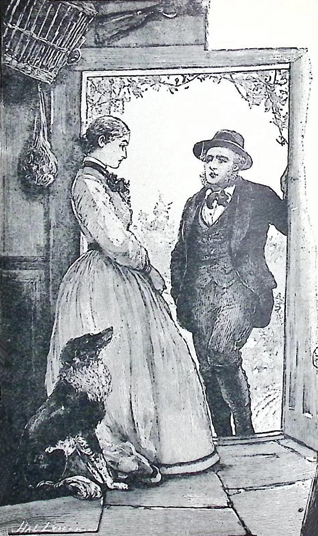
"Jean," said he, "I want a word with ye. I doubt I troubled ye last night, and I troubled myself no less. I have come to tell you so. I did not mean to grieve ye, Jean," he pleaded. And he looked wistfully at her, as he read on her honest face unmistakable traces of suffering.
"I was troubled, Rab," she replied, "for you hardly seemed like yourself. Best forget what passed altogether, as one forgets an ill dream." And with a smile, Jean extended her hand to meet that which Robert was holding towards her.
"If your dreams were as few as mine were, you'll have none to forget for the last night," said Robert, as their hands met with a hearty clasp. "I could not sleep for thinking of my Jean's face that spoke, though her tongue was still when I left her."
Jean's looks were eloquent enough now.
Robert's words made amends for all, and he saw that he was forgiven.
"And now, Jean, my woman," said he, "I want ye to take away from me, once and for all, the temptation to part as we did last night. Why need ye go back to Steynes-Cote to serve, when you can be mistress here? Write and tell Mrs. Crawford that you want no more wages, and ask for your clothes and all belonging to ye to be sent. Let her know that you have been promised to me since we were boy and girl together. She cannot say you ought to go back just to serve the month after all these years."
"If I had told them, Rab, it would have been easy, but I never said a word; and if I were to leave them in this sudden way, they would have a right to think I had behaved ill to them. I must come to you with a clear conscience, Rab, and to do this I must first serve out my time at Steynes-Cote. Bid me go, and you will make me very happy, and I will make up to you through all my life for this little extra patience."
But Robert did not say, "Go, Jean!"
He turned away and left her without a word.
And the glad look died away again, and the unwonted tears streamed like rain down Jean Graham's cheeks as she gazed on the retreating figure of her lover, who deigned no backward glance, and who, having come to heal the wounded heart, now left it sorer still.
"PERHAPS this letter will give you promise of a girl visitor, Ida," said Dr. Crawford, as he handed one to his wife about a fortnight after Jean Graham's departure. "I see the postmark is Hillstead Magna."
The doctor looked pleased, but Ida remarked, "After asking Miss Steyne so many times, it would not do to put off her visit, but I rather hope she may not have fixed to come before Jean returns."
"I was hoping she would come soon, dear, for I thought, with Jean and the Prattelys away, you would feel a little at a loss for companionship, and be more pleased to see Grace Steyne."
Grace's letter did, however, announce her willingness to come to Shelverton almost immediately.
"I cannot tell you," she wrote, "how much I am reckoning on seeing
Steynes-Cote once more. It was a perfect paradise to me in the old
days, when Aunt and Uncle Fereday were living. I have been so long
hoping to revisit it, and have so often been obliged to refuse the
kind invitations sent through my father, that now I can scarcely
believe myself free to accept yours, dear Mrs. Crawford. However,
matters have been so arranged that I can leave my dear invalid mother
without anxiety, and, unless I hear from you that the time would be
inconvenient, I hope to reach Shelverton on Thursday afternoon, by the
3.40 train."
"That will be the day after to-morrow," said Dr. Crawford, as Ida paused after reading aloud this portion of Grace Steyne's letter. "You will send her a line to say that she shall be met at the station, will you not, my dear?"
"Yes, I suppose I must," replied Ida in a rather hesitating tone. Then, seeing a look of disappointment on Dr. Crawford's face, she added, "Do not think that I shall be unwilling to meet and welcome Grace Steyne, Andrew. It was only the thought of Jean's absence which made me suggest that a few days later would have suited better. When the principal servant is away, she cannot fail to be missed."
"Grace Steyne will be less surprised at the absence of one than at the number still remaining," said Dr. Crawford. "The establishment at Hillstead Rectory is by no means extensive, so far as servants go."
"I will send a line to Grace at once, Andrew. Do you think I can have the carriage for Thursday afternoon, when I go to meet her?"
"Certainly, dear," replied the doctor, and then hurried away to keep an engagement.
From the above conversation, it will be understood that the Steynes' old servant, Sarah Robinson, had been found willing to stay at the rectory, and perform the manifold duties which usually fell to Grace's share, during the girl's absence. Mrs. Crawford had not been very anxious to invite Grace. The old, unreasoning prejudice which prevented her from calling her child after Mrs. Fereday had not died away, and she was not prepared to like the coming guest better because she bore the objectionable name.
But the very first sight of her visitor's face impressed Ida most favourably. She led the way to the pretty room which Grace was to occupy, and saw with pleasure the glad expression on the girl's countenance as the door was opened.
"Did you know that it was in this room I always slept when at Steynes-Cote?" she asked. Then, before Ida had time to answer, she continued, "But how could you know? Dr. Crawford was almost always absent when I stayed here."
"You forget; I had Jean Graham to enlighten me," replied Mrs. Crawford, pleased at her guest's manifest delight.
"You asked, then, and you gave me this room on purpose! Thank you so much, dear Mrs. Crawford."
Acting on the impulse of the moment, Grace raised herself on tiptoe and lifted her bright face for a kiss. She was not nearly so tall as her graceful hostess, and Ida had a very queenly carriage, but she bent a laughing face to that of the girl, and gave her the welcoming kiss which she had not offered when she first met her young guest. It would have been impossible to preserve any stateliness of manner with Grace Steyne.
Before she had been an hour at Steynes-Cote, Ida found herself rejoicing in such cheery companionship, and hoping that she might retain it for some time to come.
Refreshments were offered to the new arrival, but Grace declined to take even a cup of tea.
"I need nothing, thank you," she said; "I had lunch—it was really our dinner, you know—just before I left Hillstead, and a twenty miles' railway ride cannot be called a journey. I travel so little that it was quite a treat to be in a railway carriage, and, but that I was so anxious to see Steynes-Cote again, I should have wished that I was going to travel a greater distance."
"Not a cup of tea?" said Mrs. Crawford, again bent on hospitality. "Every one takes one now-a-days in the early afternoon."
"We do not," replied Grace. "At home, an early cup of tea would bring the meals much too close together, so we never make it except for callers who dine late. We dine at half-past one, to suit the children who go to school; and then we have proper tea at a quarter before six, and supper for the elders at nine."
"Who are the elders?" asked Ida.
"My father, mother, and myself, except on Sunday nights, when we have supper—a very simple one—directly after church, and then the four youngest are allowed to sit up too. This is the grand treat of the week, so it comes at the close of the best day."
Ida was struck with these last words, and the simple picture they brought before her eyes, but she made no direct reply to them. She could not help noticing that Grace's eyes were perpetually wandering towards the window, and that there was a wistful, longing expression in them, the reason of which she was not slow to guess.
"Grace," she said, dropping the "Miss Steyne" with which she first greeted the girl, "I do believe you are longing to have a race round the grounds and to renew your acquaintance with old favourite nooks. Will you put on your bonnet, and see as much as possible before dusk?"
"Thank you very much. You have read my two wishes, for I was possessed by a double longing, and granted both. The first was that you would call me by my Christian name; second, that you would suggest a run round the grounds. I have a third wish now."
"Is it for loneliness or companionship?" inquired Ida, with the charming look and smile which every one found irresistible.
"Companionship, of course, if I may have yours," said Grace; "only I hope you will not mind my talking a good deal, for at home there are so many of us that I am afraid I get into the way of chattering too much."
"And I, as a rule, have almost too little company. Make haste, dear. The late September evenings grow chilly, and we must make the best of our time."
Grace ran for her hat, a thing she seldom troubled to put on when merely going into the rectory grounds, and quickly joined Ida, who had merely thrown a light Shetland shawl over her head and shoulders, and was waiting for her on the step.
It was hard to tell which looked the more girlish of the two as they went down from the terrace, Grace's arm resting on that of her young hostess, and her eyes sparkling with delight, as she recognised some favourite tree or resting-place, never forgotten during years of absence.
"I am afraid the grounds are not quite so pretty as they were," said Mrs. Crawford. "I have no doubt you will discover this more and more."
Grace had already noted changes which were not improvements, but she could truthfully say, "They are very beautiful still. If there were only the trees and the grass, they must be that; but I think some parts look a little wilder than they used to do."
At first she was nearly saying that they looked neglected; but she chose the softer word, and Ida replied, "Yes, the whole place has a wilder look, the result of having less time and labour expended on it. I am very sorry for this myself; but Andrew thought our establishment too large, and by way of lessening it, he dismissed our regular gardeners, and arranged with a nursery-man in the neighbourhood to keep the place in order. I am afraid the result will be anything but order. However, my husband seems to think that the man is honest, and will give a fair return for the money he receives."
Grace knew far more about ways and means than did Mrs. Crawford, and at once judged that Dr. Crawford must have made the change alluded to rather from necessity than choice. She could not imagine that he would become careless about preserving the beauty of the gardens, which had been the pride of his uncle's heart and the constant delight of Mrs. Fereday. With this thought in her mind, she carefully abstained from alluding to any change for the worse, and drew attention only to those spots which reminded her of happy childish hours.
"I have not seen your children yet," said Grace, as they re-entered the house, "or even heard them," she added. "They must be very quiet little things."
"I should have thought it a relief to you to be out of sight and sound of children for a time," said Mrs. Crawford. "Andrew has told me that you have been quite like a mother to your young brothers and sisters."
"I have only one sister, and she is almost the youngest. There are seven boys, and I am the eldest of the family. But I never get really tired of the little ones, though just now and then I may have rather too much of their company. Children have been so mixed up with my whole life and all occupations that I should be perfectly lost without them. I have quite reckoned on helping you with the little darlings, especially since I heard that Jean Graham was gone for a holiday."
"My dear Grace, I should never think of troubling you with the children. Jean Graham's absence does not affect them, as they are in no respect under her charge. I have a very superior nurse in Bennett, and she is assisted by a girl of eighteen belonging to Shelverton. One of my great troubles is that our good Jean and Bennett do not agree."
"That is a pity," said Grace, "for Jean is so good and true. I shall never forget her kindness to me as a child, and I was quite reckoning on seeing her again. But if she is to be another fortnight absent, I am afraid I shall not."
Grace spoke modestly as to the probable duration of her visit, having mentally decided that a fortnight would be its proper limit, and as long a time as she could be spared from home.
"Not see Jean!" echoed Mrs. Crawford. "My dear Grace, you talk as though you would be allowed to run away again directly. I hope you may be happy enough here to stay willingly for a good many weeks to come. Now we will have just a peep at the children before dinner."
Ida led the way to the nursery with noiseless tread, having made a sign to Grace to follow her example. She was going to surprise the little ones by a visit at an unusual time. She opened the door softly, thinking only of the shout of delight that would hail her entrance when the children caught sight of their mother.
But no children were to be seen. The only occupant of the day nursery was Bennett, who started from her seat, and, hastily covering something with her apron, passed without a word into the next room. This was the large night nursery, in which the children and Bennett slept. The bedroom of the under-nurse was up another flight of stairs, but she could be summoned at any time by means of a bell.
"The children are all in the night nursery, and Bennett has gone to them," said Mrs. Crawford.
"No doubt she will bring them back with her in a moment."
"I heard them drumming at the closed door as you opened this," replied Grace, "and one seemed to be in trouble. I never can hear a little wailing voice without longing to comfort its owner."
"It was very strange of Bennett to rush of without speaking," said Mrs. Crawford, with a look of displeasure. "Sit down for a moment, dear, and I will bring some of the children."
Bennett's face was unnaturally flushed as she turned towards her mistress when the latter passed into the night nursery, and there were traces of confusion, which she vainly strove to hide. However, she was ready with an excuse.
"I was not aware that you were bringing a visitor, ma'am," she said, "and when I saw a strange young lady's face in the doorway, I felt a little confused. You know, there are often little matters about where there are young children that one likes to put out of the way before strangers come into the nursery. I know I must have looked rather ill-mannered, but I hope you will excuse me, and let the young lady know that I did not wish to be rude. I had sent Mary on an errand, and told her she might call to ask after her mother, who has been poorly for a week past. I shut the children in the night nursery till I straightened things here a little before giving Archie and baby their baths."
Bennett's words were plausible, and Mrs. Crawford readily accepted the excuse. Lifting baby in her arms, and bidding nurse bring the next youngest, she returned to Grace, crying, "Here they all are! Do not be alarmed. Nurse is a little scandalized at our coming without being properly announced, for she likes the children and all belonging to them to be exhibited in apple-pie order. But I have told her that you have lots of brothers and a sister all younger than yourself, and know everything about children."
Grace's bright face was full of interest as she tried to make friends with the elders. After having kissed the pink cheeks of the unresisting baby, she looked pleasantly at Bennett, and said, "Though I have had so much to do with children, I am never weary of them. I hope to be a very frequent visitor here, and to make great friends with your little charges."
Bennett's reply was civil enough, and then Grace had to hurry away with Mrs. Crawford, that the doctor and the dinner might not be kept waiting.
No sooner were the ladies out of the nursery than Bennett closed the door behind them, and, with an expression of face most unpleasant to behold, muttered,—
"Not with my good-will, miss. You are just the sort to come pretending that you like children, and then to pry and poke about and tell tales. As if anybody cared to have more to do with such little plagues than they could help. I would stay with no mistress even that was everlastingly in and out of the nursery. But I am not likely to have that to complain of here."
Bennett gave an unpleasant, mocking laugh; then, without the smallest warning, she swept away the playthings from the elder children, and put them out of reach for the night.
Some whimpering and crying followed this raid on their treasures; but Bennett gave herself no trouble to soothe her little charges.
"Cry if you like," she said; "it's all the same to me, and nobody else is near enough to hear you now Jean Graham is out of the way. I wish I may never set eyes on her again, the meddling tell-tale that she is! She did not get much, though, by trying to warn the mistress and set her against me before she started."
Whilst Bennett was muttering to herself, her hands were busily engaged in taking out the children's night-gowns and the other articles required before the beginning of the bathing process. She was not very gentle in her movements, and by a sudden jerk, she caught the end of a towel, unrolled it, and threw down and broke a small bottle which had been wrapped in it.
Bennett hastily swept up the fragments and dropped them into the very midst of the fire, then carefully washed away the liquid spilled by the breakage.
"Most haste, least speed," she said. "I've lost every drop of the stuff, and how shall I manage to get more?"
It was evident that she came to some sudden resolution, for, having carefully put the children into the night nursery and out of harm's way, she hurried down the back stairs and towards the surgery.
WHEN Bennett hurried down to the surgery, she calculated that it would be untenanted, as the dinner-gong had sounded a few minutes before. All seemed quiet when she reached the door, and after a brief pause, she turned the handle very softly and entered.
To her surprise, Dr. Crawford looked up from the desk at which he was writing, and said, "What do you want, nurse? Anything amiss with the children?"
"No, sir; I am glad to say they are all right. It's only my face-ache come on again, and I was just going to ask Mr. Armstrong for a drop of laudanum, as I want to foment it after the children are asleep."
As Bennett spoke, she placed her hand to her cheek, and put on a doleful look, as if she were in great pain. Out of the surgery was a smaller apartment, which could only be entered from it. In this were kept all drugs except those of a very simple character, and Mr. Armstrong was accustomed to mix the medicines there, in order that any risk of mistake through interruption might be avoided.
He was in the drug-room at the moment of Bennett's entrance, and within hearing of her words, though out of sight. He had just completed his task, and, stepping into the surgery, he said, rather severely, "You had laudanum from me very lately. If you are wanting more, you must have used a larger quantity than was necessary."
"You are quite right, sir. I had the laudanum, and should have it now,—at least, some of it,—but I had the misfortune to break the bottle a few minutes since. I had put it away most carefully, as was right where there are children, for if they think you want them not to get at a thing, they'll climb like kittens to see what it is. The bottle was rolled up in some rags and a towel, and put away on a high shelf; but I happened to catch the end, dropped the bottle, and smashed it to atoms."
"Where are the pieces?" asked Mr. Armstrong suspiciously.
"Where they should be, sir—melting down in the middle of the fire. I suppose you wouldn't have me leave those on the nursery floor, or the spilled laudanum either? If you will come up-stairs you can see where I have washed the floor, for it cannot be dry yet, and smell the laudanum too."
There was no gainsaying Bennett's statement, and the woman knew it. Looking straight at Dr. Crawford, she said, "May I have a little laudanum, sir? It will be quite safe in my hands, you know."
She was not prepared for the doctor's decided negative, qualified however by a promise that he would give her some medicine which would have a more lasting effect than the outward applications on which she relied for ease.
"It is plain that you want something to remove the cause of the pain, Bennett," said Dr. Crawford kindly. "Come and see me later in the evening I am hoping not to go out again, and in order to be quite free, I had dinner put off for ten minutes, so that Mr. Armstrong and I might finish a rather pressing matter, and take our meal with quiet consciences."
"I am sure, sir, I would rather not be the means of disturbing you after dinner," said Bennett.
But the doctor did not wait for her to finish.
"Come here at eight o'clock," he replied. "I shall not call it an interruption to look after your face-ache, and, I hope, relieve it permanently."
The doctor passed out, and Mr. Armstrong waited for Bennett to follow, then locked the door with a very decided click, and put the key into his pocket. There was no tampering with that lock, as the nurse well knew, and no chance for her to purchase any drug at the shop of a Shelverton chemist without exciting suspicion, so she returned to the nursery in no very good humour.
For once, Dr. Crawford was undisturbed during dinner. And to Ida's delight, he thoroughly enjoyed the meal, then accompanied her and Grace into the drawing-room, and asked for some music.
"Sing for us, Ida," he said; "I have had very little music of late, and I want to make the most of my opportunity. When you have set a good example, I hope Grace will play or sing something, and Armstrong can join in a part-song."
Grace promised to do her best, but pleaded that her busy life gave her but little time for the practice of difficult pieces. Nevertheless, it oozed out that she played the organ at church, and trained the village choir—not a very easy task when scarcely any of the members knew their notes so as to read the music.
"How can you teach them? Are not your ears and patience terribly tried?" asked Mrs. Crawford, on finding that Grace played the parts over again and again, until her pupils mastered them by ear.
"At first it was hard work, but I remembered that it must be quite as trying to the learners as to myself," replied Grace. "They are improving now, and I have a class apart from the other practice, and am teaching them to sing by note, so each week will make it easier for both sides."
Grace played and sang when her turn came, and, though she came far behind her hostess in brilliancy and style, she attempted nothing that had she could not perform, and showed that she had a fine voice, and used it with true musical taste.
Time passed quickly, and for once Dr. Crawford forgot his appointment with Bennett, until a chiming clock on the mantelpiece told him that he was already half an hour too late.
"I must ask to be excused for a few moments," he said. "Bennett came to ask for something just before dinner, and I promised to see her in the surgery at eight. I shall blame you, who have made me insensible to the flight of time, for not having kept my word."
Ida was surprised, and stopped her husband to ask what Bennett complained of. He told her all that had passed in the surgery, and for the first time she felt uneasy, and Jean Graham's warning came to her mind with double force.
The doctor did not wait for his wife to ask any further questions, but after a few moments of perplexed silence she addressed Grace, who was the only person left with her.
"Bennett made no complaint when we were in the nursery half an hour before she went to the doctor. Did you think she was looking ill?"
"Having never seen her before, I could scarcely judge," replied Grace. "I thought she seemed confused, only she explained the reason, and—"
"And what, dear?" said Ida, who noticed that Grace hesitated.
"Perhaps I ought not to say it, but I fancied Bennett was not pleased at my being taken into the nursery."
"That is likely enough," replied Mrs. Crawford; "Bennett almost turns me out sometimes. These first-class nurses are often very touchy, and so are cooks sometimes. Jean Graham, who is cook-housekeeper, is an exception. She has always been anxious for me to look into every corner, and to choose my own time for doing it."
"I suppose such servants as Bennett stand more on their dignity than ours do, for instance. But then we have only two, and, as my help is needed in each department, I am in and out of kitchen, nursery, and dairy at all hours of the day. Of course, our servants are not of the same class as yours, but they do a great deal of work, and well, for our house and family are large."
"I do not know about class," said Ida thoughtfully; "I should be inclined to consider those you mention as very superior servants indeed. Your laundry work goes out, of course?"
"Not a scrap of it," replied Grace. "We have a woman for two days to help the servants. She is the wife of our man, who combines in his own person the offices of groom, coachman, gardener, and whatever else is comprehended in the term 'generally useful.' He is a marvel of handiness and good temper, and even helps in the mangling. I do my share of the ironing, and sometimes all the mending. I daresay these particulars sound dreadfully matter-of-fact to you," continued Grace, looking up at Ida, with a merry little laugh, and a face to which the blush of false shame was a stranger; "but our housekeeping is of necessity so different from yours. We have to calculate sixpences, and we cannot afford to have any idle hands at the rectory."
"I am afraid you think we have a good many idle hands here," replied Mrs. Crawford. "My own, especially, seem terribly useless when compared with yours."
"Oh, please do not think I meant to say anything of the kind!" said Grace, blushing violently. "I express myself so badly. I only meant to say that we are obliged to be very economical, in order to keep our expenditure within proper limits. My father's income from the living is good, and he has private means; but just think what it must be to have nine children to provide for! Only two boys have left school yet, and though the elder got an exhibition, it does not quite cover his college expenses. The second is in a merchant's office, and has a small salary, but he too needs help."
"I was not offended, Grace dear," replied Ida; "on the contrary, I am very much interested in listening to these details of your home life. I think it is very good of you to speak so frankly, and I feel like a perfect child at household management, whilst you seem to know everything about it. I wish I had been trained as you have. I think I shall ask you to teach me a little whilst you are here," said Mrs. Crawford.
"I will do anything you wish me to do," answered Grace warmly. "As to the training, I am not sure that you would have liked it, though no doubt it comes in very useful in after-life. I am not hypocrite enough to pretend that I always find my work pleasant, even after being trained to it as long as I can remember anything. But when it has to be done, one may just as well do it heartily and cheerfully. If I were to look sulky at a great pile of things that need mending, or give cross answers to the poor children and make them miserable, where would be the good to myself? All the ill-tempers possible would not fill a hole in a stocking, and if I made other people less happy by my sulks, should I not be doubly miserable?"
"Certainly you would," said Ida, with a smile at her young guest's earnestness. "But all this work must stand very much in the way of visiting and recreation?"
"Well, yes. I have a good fight sometimes when I very much wish to accept an invitation, and conscience insists on my saying 'No' to it. I have several helps, though, and if the 'No' lingers sometimes, it comes out at last; and once said, there is an end of the matter. I am of a far too stubborn nature to change after having made up my mind."
"What are the helps, Grace? I should like to know, in case I have to fall back upon them whilst I am taking lessons from you," said Ida.
"They would not all be available in your case," was the reply. "It is a help to look into my dear mother's sweet face, and to think of the daily example she sets me by her patience under suffering and confinement. She who was once so active and helpful has to spend so much of her life on one spot, yet she never murmurs or darkens our days by constantly bringing to view the shadow that has fallen on her own. Then there is my father to think of. My mother cannot meet him with words of welcome, so I must be her deputy, so far. And though it gives me more work, it is sweet to hear him say,—
"'Gracie, you must do this or that for me; you are my right-hand. What should I do without you, my child?'
"As to the children, they are dear good little things, and of course they look to me at all times, and for every kind of service. It is a help to hear them say,—
"'Gracie, I love you dearly!'
"And to feel their chubby arms clinging round my neck as if they could not part with me. Then there is the best help of all," added the girl softly. "But you know all about it without my telling."
"What do you mean, dear?" inquired Ida.
"The help that comes in answer to prayer. All the rest would be useless without it, you know, dear Mrs. Crawford. I feel impatient, discontented, disinclined for duty. The hasty, unkind words are trembling on my lips many a time, and if they are not uttered, and the work which God has given me left undone, it is just because He hears my cry for help and strength, and does not leave me to myself."
Grace paused, for her voice trembled with emotion caused by the memory of past struggles; but there was a glad, bright look on her face, which told Mrs. Crawford how real a thing was this blessed sense of an ever-present help that could be had for the asking.
There was no time for further conversation. Dr. Crawford returned to the drawing-room, and his wife immediately inquired, "How did you find Bennett? I hope there is nothing seriously amiss with her. She made no complaint to me, though Grace and I were in the nursery half an hour before dinner. Was she annoyed at having been kept waiting?"
"She had not been down-stairs," said the doctor. "Instead of coming, she sent a message to say that the children were so cross that she could not leave them, but that her face was much less painful."
"I knew that Ann was gone out, so there would only be Bennett to look after them. I daresay she would not speak about the pain in her face to me, because she knew that Miss Steyne had just arrived. She would be afraid that I should feel uneasy on her account, and yet be unwilling to leave my visitor," said Mrs. Crawford. "No wonder poor Bennett did not look very amiable, Grace," she added; "face-ache is very trying to the temper."
Grace assented; but she could not help feeling that Bennett was by no means the person to whose tender mercies she would like to entrust the little ones at the rectory.
"I have seen Bennett," said the doctor. "As she could not come to me, I went to her. I could not find out that there was much the matter with her, and, as she assured me that the pain was entirely gone, I ordered her some simple medicine, which Armstrong is preparing, and bade her use no external application without first consulting me. Ann returned whilst I was in the nursery, and the children were settling down quietly enough."
"I am glad to hear it," said Mrs. Crawford; "I suppose I had better not go up to them now."
The doctor assented, and soon afterwards Mr. Armstrong entered the drawing-room, and there was more singing, in which he joined. But Grace noticed that there was no longer the same look of enjoyment on Dr. Crawford's face. And she said to herself, "His mind is preoccupied. Something has occurred to disturb it."
Grace was more quick-sighted than Ida, for the latter, satisfied by her husband's account of Bennett, turned to the piano and began to play the accompaniment of a part-song, in which the four joined; and the rest of the evening passed quickly and pleasantly enough.
Dr. Crawford was uneasy, though his wife did not discover this, and Bennett's conduct was the cause of his anxiety. Before he went up to see the nurse, Mr. Armstrong had made him acquainted with the woman's previous visits to the surgery, and her abstraction of laudanum, as well as the plausible manner in which she had excused herself, and enlisted the sympathies of her mistress.
"You would notice," he continued, "that Bennett came stealthily to the door this evening, and at a time when she no doubt thought that we should have left the surgery. If we had left it, she would still have been disappointed, as I determined, after her last visit, never again to give her a chance of entering it in my absence. I blamed myself for having left the keys hanging in the surgery, and the outer door unfastened, though that of the drug-room was locked. I thought there were only trustworthy people about the place, and never dreamed that any one would be so daring as to take down the keys, unlock the inner door, and tamper with the drugs. Before I caught Bennett the first time, I had been much puzzled by once finding the laudanum bottle on the surgery table after a short absence. I had used a small quantity of the drug in making up some medicine, but I felt certain I had never taken the bottle from the drug-room. You know it is my fixed habit never to leave bottle, case, or drawer out of its place for one moment after I have taken from it what I require at the time, and for the single purpose."
Dr. Crawford was too well acquainted with the methodical habits of his assistant to doubt the accuracy of his statements. When, in addition to his own knowledge of Bennett's movements, Mr. Armstrong mentioned Jean Graham's suspicions, the doctor was rendered still more uneasy, and the visit to the nursery did not tend to allay the feeling. A careful examination of the nurse's face convinced him that she was playing a part, and pretending to be in pain when really nothing ailed her.
But why should she do this? Why be anxious to obtain possession of the laudanum, if she did not need it for fomentation? Here was the puzzle; and Dr. Crawford determined to keep a careful watch on Bennett's movements; but, as Graces Steyne was present, he did not mention his suspicions to his wife.
MRS. CRAWFORD was thoroughly charmed with her visitor, and after Grace retired, she repeated to her husband much of the conversation which had passed during his absence from the drawing-room.
"I believe Grace is a truly good girl, Andrew," she added. "I wish I could look back on such a useful, helpful life as hers has been, or even feel that I could begin such a one from this moment. Grace told me about her home duties in a simple, natural way, without the least sign of boastfulness. If she had given herself airs, I should have disliked instead of wishing to imitate her. But I am very stupid, and I feel almost too old to begin."
"Too old!" exclaimed the doctor, his face expressing the pleasure with which he had listened. "Darling, you are still only a girl-wife, quite young enough at four-and-twenty to begin taking lessons in all housewifely accomplishments in which you feel yourself deficient. No need for you to be ashamed of not having learnt them before your marriage, for there was no one to teach you, no school in which you could be a pupil."
"But I have been more than four years married, Andrew, and Jean has often wished me to look more into household matters. I always laughed at her anxiety, and thought there no need for me to trouble myself about such things, for you were rich, and my little income would, I thought, meet the odds and ends of expense that I might cause by—shall I call it?—my laziness. It seems strange that I should be so stirred by Grace Steyne's talk this evening. She has made me feel as if I were such a useless person in comparison. I am dissatisfied with myself. I do believe Mrs. Prattely was right when she called me 'poor thing,' though she meant the expression kindly. I am a 'poor thing' when compared to Grace Steyne."
Dr. Crawford did not interrupt his girl-wife's confession. He was only too glad to listen; and, folding her tenderly in his arms, he said,—
"I am truly thankful that you have spoken on this subject, darling wife, for I have been wishing to ask you if you could contrive some plan for diminishing the number of our servants. Grace could perhaps help you in this. I know it would delight her to be of use."
As the doctor said this, Ida raised her head from his shoulder with a startled look, which soon changed to one of inquiry and suspicion.
"Did you ask Grace here to teach me housekeeping?" she inquired.
"No, dearest; I had only two thoughts in wishing you to invite Grace. One was to give the girl a great pleasure by enabling her to see again a place which was mixed up with some of her happiest memories, and to make her acquainted with its present mistress; the other, and not the less powerful motive, was to give my dear girl-wife a bright girl-companion, whose society I was sure would be a source of pleasure to her whilst she remained at Steynes-Cote. If you should find Grace one whom you can like and value as a friend, so much the better for you both."
Ida dropped her head upon her husband's shoulder again, after having read all she wished in the frank, kind face turned towards her whilst he spoke.
"You see what I am, Andrew," she said; "always giving way to some horrid littleness of disposition. I had been delighting myself with the thought of the good Grace's example would do me. Yet the instant you agreed with me, I said to myself, 'She has been brought here to school me in housekeeping!'"
"You were mistaken, dear," was the doctor's quiet reply.
"I know it. Forgive me, dearest Andrew." And Ida lifted her face for a kiss. "Now tell me, would it be right for me to let Grace undertake new cares and work here? She came for change and rest, both of which she needs."
"Grace's idea of rest would not be absolute idleness. She leads such an active life, that, were she compelled to sit with folded hands, or so to pass her time that she could not give good account of it, she would be miserable."
Ida hesitated a little as if afraid to ask another question which was trembling on her lips. It came at last.
"Tell me, Andrew, are you not a rich man? Lindsay always spoke of your income as being better than his own, yet what you said a few minutes since about having fewer servants made me feel afraid—"
"Afraid that I was becoming poor, Ida?"
"No, Andrew; afraid that we might be spending more than we ought to spend. Are we getting into debt?"
"No, dearest. You know, without being told, that all the house accounts are paid weekly. My professional expenditure has also been fully met, but though I am only keeping one assistant instead of two, we are living to the full extent of our income. I have taken nothing from capital so far, but if our expenses increased, I should be obliged to do so. Then, it is as well to look at the matter on all sides while we are about it," said the doctor cheerfully. "You know how very large a portion of our income depends on my professional work. If that were interrupted from any cause, our actual property would not maintain Steynes-Cote and all who live under its roof. What I should really like would be to save something, if but a little, each year, and I can see no way of doing it except by diminishing our household expenses."
"Lindsay must have deceived me as to your means, Andrew," replied Ida. "He told me again and again that you were a rich man, far richer than himself."
"I do not think Lord Carnelly meant to deceive you, Ida. He would consider me richer than himself in several ways. For one thing, my property was, and, I am thankful to say it still is, quite unencumbered, whilst your brother's estates are all heavily mortgaged. He had a larger nominal income, but much of it was condemned beforehand for the payment of interest. He had many creditors who were pressing him for money. I could say that I owed no man anything. He was keeping up a large establishment, and living far beyond his means—very much against his will, I admit. I reckoned on living well within mine. He, as a nobleman, had claims upon him of which a country doctor lives in blessed ignorance. So, putting two and two together, I think he was quite justified in calling me a rich man. Am I not richer still to-day with my girl-wife and four lovely children?" asked the doctor, with an attempt at a laugh, as he drew Ida's beautiful face nearer to him, and again kissed it tenderly.
Ida listened quietly and thoughtfully to words which carried with them a revelation. As he finished, she gave a soft sigh, and clung to him a little more closely as if in dread that anything should come between them.
The doctor felt the clinging pressure, but he also caught the sound of that sigh, and it made his kind heart ache.
"My poor darling," thought he; "the very mention of life's realities frightens her. Have I wronged her by asking her to share mine? What I had to offer seemed better than anything she was likely to enjoy under her brother's roof. But Ida has never reckoned on a future which would involve real work or responsibility, and now a hint of these makes her tremble and sigh. Her notion of married life has hitherto been a rich husband, who would be also a very loving and indulgent one, plenty of servants, unlimited pretty dresses, and unbroken sunshine."
The doctor was not prepared for Ida's next remark "Andrew, I am afraid I have been, in a way, as selfish as Beatrice."
"My darling, you have been nothing of the kind. If you have made mistakes, it has been through not knowing better. Beatrice was wilfully extravagant, and cared for nothing except gratifying the whim of the moment."
"And I have been wilfully ignorant, for I might have known everything about your affairs; and wilfully blind, for I had only to look and see for myself. I knew that you had parted with your principal assistant, yet I never asked why. I could see that you were working twice as hard as before, but while I sometimes found fault with you for it, I never troubled myself to inquire whether there was a needs be for such constant toil. I have not bought very costly things for myself, but I have purchased many that might have been done without, and I should have done without them if I had known, Andrew. You should have told me, dear; but you always gave me the money so easily and readily that I did not understand."
Great tears began to roll down Ida's cheeks—tears that brought to mind the old days in India, when, as she used to say, "she was such a baby" that she could not keep them back if even a taunting word were spoken by her sister-in-law. To her husband, she looked pitifully like the girl into whose willing ear he had poured his first love-story. Now, as then, he strove to wipe away her tears, and to cheer her with words of tenderness and hope.
"My darling Ida, my precious girl-wife, there is no great harm done. The worst that can be said is that we have saved nothing. You accuse yourself, but I have far more need to blame myself, for you are proving to me that I have done wrong in treating you always as the girl instead of the partner of my life, with its cares as well as its joys, its work as well as its play. Never compare yourself to Lady Carnelly. I could not forgive you for that."
"I have been worse than Beatrice," persisted Ida. "She may be extravagant, but she knows that whenever old Miss Pelham dies, there will be plenty of money to make her and Lindsay rich again. She will not be able to spend the whole, because part of it is to go to the children as they come of age. There is some excuse for Beatrice, you see, Andrew. There is none for me, since I have no second fortune to look forward to; and you, dear, patient darling, have been almost wearing yourself out that I might have all good things without stint. But we must make a fresh start. I will plan and think, and be Grace Steyne's scholar. Who knows, Andrew, but you may some day be proud of your girl-wife's housekeeping?"
She smiled through her tears as she asked this question, and the doctor had an indescribable feeling of gladness as he saw the sweet face so determinedly bright and hopeful, so full of affection.
He was tempted to tell her about the nonpayment of the interest by Lord Carnelly, and of the still nearer cause for anxiety in the suspicious conduct of Bennett. It was from no wish to withhold his full confidence that he refrained for the moment, but because he thought Ida had already been sufficiently agitated.
"I will tell her the rest by daylight," thought the doctor. "If I were to speak about Carnelly's neglect now, she would begin with more self-reproaches, and lose her night's rest. Bennett's affair will also keep till morning, and Ida will be better able to cope with the nursery difficulty after a peaceful night. But, please God, for future, my wife shall never have cause to complain of not knowing all that concerns us both."
Ida did not tell Dr. Crawford what Grace Steyne had said about her various "helps," especially "the help that comes in answer to prayer." She had so often appeared indifferent to his words whenever he spoke on such subjects, that she shrank from telling him that a new light was dawning on her soul. She was beginning to feel that her husband possessed something she did not—a something which gave him strength and patience in times of difficulty, to which he owed all that was beautiful, brave, and noble in his character, which placed him on a higher level than that on which she stood; a something, too, that she now longed to share with him, and for which she was beginning to grope, though in a timid, half-blind fashion, for she felt that she was very ignorant.
Was it this sense of want and longing that kept the girl-wife so much longer on her knees that night? Surely it could be no mere repeating of a few set phrases that kept Ida with her fair head bowed over her clasped hands for so long a time.
No; the girl-wife was becoming conscious of her sinfulness and her need. She was finding out that she had really left undone so many things that she ought to have done, and had done so many that she would now fain undo.
Ida was recalling to herself how often she had made this confession in the midst of the congregation, and how her voice had been heard, sounding clear and musical, amongst other voices. They were the right words to say. She knew that now; but she had never in all her life meant them until now, and, though no sound escaped her lips, her heart-felt confession of sin and need was going up to God, as she knelt in that quiet chamber whilst her husband moved softly to and fro.
Not many more words were exchanged between them that night.
Only Ida whispered, "You will help me, Andrew?"
And her husband, understanding what she meant as well as though she had said, more, answered, "I will, dearest, God helping me."
Dr. Crawford was called out early, and obliged to hurry away after a hasty breakfast, so he could not speak to Ida about Bennett's doings, as he intended. However, he was well assured that Mr. Armstrong would give the nurse no chance of entering the drug-room during his absence. As he was driving rapidly on, the doctor blamed himself for carelessness in not having made more particular inquiries about the nurse, of whom he and Ida knew nothing, except what was told in a character written by a stranger. After consulting his time-table, he decided that it would be possible for him to take a short railway journey later in the day, and this would bring him within a few minutes' walk of the house of Bennett's last employer, where he would call.
Dr. Crawford made this visit, and fortunately found the lady, a Mrs. Molesworth, at home. When he explained the object of his call, she was much surprised, and at once told him that no nurse had been employed by her for many years past.
"In fact," she said, "my only son is now twenty-two, and he is at Cambridge."
"I must apologize for having troubled you," said Dr. Crawford, "but the character was written on paper stamped with your address and bearing a crest."
"Was it like this?" asked Mrs. Molesworth, handing him some paper.
"It is exactly similar in every respect."
"I cannot understand it," said the lady, "but I will call my own maid, a very reliable person. She may throw some light on the matter."
She according summoned the servant, and repeated what had passed. Then said, "Can you tell Dr. Crawford anything about this affair, Jane? As my paper has assisted in a forgery, it would be some satisfaction if we could help to unravel the mystery."
The servant turned to Dr. Crawford and said, "Would you please describe your nurse, sir?"
"Bennett is tall, dark, with black hair and eyes; quick and clever at her work, but jealous of any interference even from her mistress, and suspicious of the other servants. Her eyes are rather small, and when speaking to any one or listening, she has the appearance of watching them in a stealthy fashion."
"But she never looks you straight in the face, sir, does she?"
"She does not. I have often noticed this peculiarity."
"The description just suits Bailey, the nurse that was here two years ago with Mrs. Hawkins's children," said Jane.
Dr. Crawford started.
"I believe you have found the clue to the mystery," he replied. "My wife noticed that Bennett's aprons were marked 'Margaret Bailey,' but the woman said they had belonged to an aunt who had left her all her clothes because she was her favourite and namesake."
"As to the note-paper," said Mrs. Molesworth, "the woman could easily obtain it. Stamped as it was, I never troubled myself to lock it up, for I thought no one would dare to use it. I fear this woman has made it the medium for imposing a forged character upon you. Mrs. Hawkins, my sister-in-law, sent her away because she had nearly caused the death of one of her children by an over-dose of some opiate. She had previously suspected her sobriety, and, in seeking to assure herself that she was not judging the woman unfairly, she discovered the still more serious fault of which she had been guilty. She was at first inclined to have the nurse punished, but yielded to her tears and entreaties, and let her go, but without a character."
It may well be supposed that after such a revelation Dr. Crawford lost no time in returning to Steynes-Cote. He only waited to thank Mrs. Molesworth and Jane, then hastened home with the determination that Bennett should not spend another night under his roof.
His first inquiry was for the nurse. The answer astonished him, for Ida replied, "Bennett is gone."

DR. CRAWFORD'S surprise on finding that Bennett had left his house was equalled by his anxiety to know how her departure had been brought about. The explanation was soon given.
Eager to make friends with the little people, Grace Steyne had asked Ida's permission to visit the nursery directly after breakfast, and, after staying there as long as she chose, to bring Doris down-stairs with her.
Her light tap at the nursery door had to be followed by a louder knock before any notice was taken. Then Bennett opened the door, and, having closed it behind her, so as to prevent Grace from looking into the room, asked in very unpleasant tone what she wanted there.
"I am come to see the children, and in a little while to take Doris into the morning-room to Mrs. Crawford," replied Grace, astonished at the nurse's attitude.
"Excuse me, miss," said Bennett, "but I cannot allow strange young ladies in my nursery all hours of a day. I send the children down at proper times, and if their mamma wants any change made, I shall look to her to say so. If you wish to find Miss Doris, you will have to seek her in the grounds, where she is with Ann and the eldest little boy."
Bennett remained with her back to the door, evidently determined not to admit the visitor. And Grace, seeing that she could do nothing else, began to descend the stairs, in order to return to Mrs. Crawford. Then the woman re-entered the nursery, shut the door with a bang, and burst into a laugh, so loud that it reached Miss Steyne's ears.
"Did you not find the children in, or have they tired you already?" asked Mrs. Crawford, on seeing her visitor back so soon.
Very quietly Grace told what had happened.
"Bennett must have taken leave of her senses," said Ida in utter amazement. "What can be the meaning of her conduct? I will go to her when I have found my keys and given Jessie from the storeroom."
The keys were not forthcoming. Mrs. Crawford was sure she had left them in her bedroom, but a search there had proved fruitless. Then Jean Graham's warning flashed across her mind, and without another word she ran lightly to the nursery and entered.
No need to ask for an explanation of Bennett's insolence. On the table lay the keys, and near them a half-emptied bottle of spirits, whilst the nurse's flushed face and excited manner told the rest.
The unfortunate woman had again yielded to the temptation which had proved the bane of her life, and repeatedly lost her place, friends, and character.
At first she strove to put on a bold front, then tried tears and entreaties. But finding that her young mistress, whom she had deemed a tool in her hands, could be firm on occasion, she sat down in dogged silence, and defied her command to prepare for leaving the house.
But when Ida rang the bell and sent to request Mr. Armstrong's presence, the miserable woman resisted no further, and Steynes-Cote was soon rid of her presence.
A careful examination of the nursery discovered sundry empty bottles, which must have been abstracted when full from Dr. Crawford's cellar. There was also a small one, at the bottom of which were only a few drops of a thick liquid.
"This explains why Bennett wanted the laudanum," said Mr. Armstrong. "It was to be combined with syrup to make a sleeping dose for the children. Here is a very small quantity of the stuff in this bottle."
Well might Ida's face turn pale, when, in addition to the experience of the day, she became acquainted with the result of her husband's inquiries, and heard about Bennett's stealthy visits to the surgery.
"I can never be thankful enough," she said to her husband, "for the safety of our dear little ones. They have had a very careless mother, who was not fit to be trusted with them. I am learning new lessons very fast, dear Andrew."
"You must not take all the blame to yourself, my Ida," replied her husband; "the larger share ought to be laid to my account. The father has his responsibilities as well as the mother."
"But you are always so busy, dear; I ought to have watched over the children."
"I knew so much of which you could not be but ignorant, Ida, I ought to have warned you. Henceforth I trust we shall work together," replied the doctor. "I will instruct, you shall carry out my rules; will you not, darling?"
"Will I not? But oh, Andrew, I blame myself on that poor woman's account also. If I had not been so careless, she could not so easily have found the means for gratifying that wretched craving. Jean suspected her, and warned me not to leave my keys within reach of Bennett. I feel that I have helped to put temptation in her way. Poor thing! What will become of her?"
It was not easy to answer this question. There were so many things to be considered beside the fault which had been the immediate cause of the nurse's dismissal, and Ida was compelled to leave this.
"What is to be done with the children?" asked the doctor. "We must be very careful about engaging another nurse."
"I think of trying with only Ann," replied Ida. "She is a good, truthful girl, and really did the greater part of the nursery work. I shall find it rather difficult to give orders at first, for I know so little, but Grace will tell me how to manage. It seems strange, does it not, that an unmarried girl should be the teacher to a wife of four years' standing? But I am not ashamed to learn, because I am now realizing my utter ignorance."
"What are to be the immediate arrangements?" asked the doctor.
"Grace insists on having Doris in her room, so her cot has been removed to it. Ann will sleep in the night nursery with the others. She feels confident that she can manage them, for the two boys sleep well, and she has been used to babies at home. I know what that look means, Andrew," continued Ida, who was watching her husband's countenance. "You are wondering what is to be my share of the work. It seems very sad to say it, but baby knows Ann so much better than she does me that we think it may be wise to let her stay with the girl just at first. If she were to come to me, all would be strange around her. The little ones are certain to miss Bennett, who was so much with them. You see, dear, I have to learn how to manage the little baby. As to Doris, she will go back to the night nursery when Grace leaves us, and before then I hope I shall be accustomed to the charge of our 'number four.' Only you must not be disturbed, so if baby should be fractious, I shall steal away with her out of hearing."
Dr. Crawford smiled as he listened, and then told Ida that he was sure she was planning for the best, though he had not intended to begin economizing in the nursery department. "I had thought that with so many servants, and with every accommodation for it, the laundry work might be done at home. However, I would much rather you should take the advice of an accomplished housekeeper like Grace Steyne than follow any suggestion of mine. Grace's knowledge is founded on experience, mine is but theoretical."
"We think it will be better to go into other matters when Jean Graham comes back," said Ida.
The doctor assented, and she added, "I know Jean's value now as I never did before. I shall be glad to see her good, true face again."
Mrs. Crawford was to see Jean sooner than she expected. On that same evening, just after dinner, there was a sound of wheels on the gravel, and the doctor looked towards the door in the expectation of a summons. But the vehicle, whatever it was, did not stop at the front entrance, but passed round to the back door.
"Who can it be?" said the doctor, after a brief silence.
"I believe it is Jean," cried Mrs. Crawford, and without waiting to inquire, she rushed out of the room to see for herself.
Truly it was Jean; and though she returned to Steynes-Cote in sorrow of heart, it must have been some satisfaction to her to witness the look of delight on Mrs. Crawford's face, and to hear her words of welcome.
"Jean, dear, good Jean, is it really you?" cried Ida. "I thought I knew your voice, but I could not believe my ears, so brought my eyes to make sure."
The words were accompanied with a warm clasp of the hand—indeed, of both hands, for Ida seized Jean's between hers and held them there as she spoke.
"Yes, mistress, I am here again," said Jean.
But though she looked lovingly at Mrs. Crawford's fair face, there was a melancholy ring in the tone of Jean's voice, and the words were followed by a sigh.
"Come in here, Jean," said Ida, drawing her into the morning-room, where there was a cheerful fire, but no occupant. "You have had a long journey, and must be both tired and hungry. Warm yourself first, for the night is chilly; then, when you have taken off your things, Jessie shall bring you something here, for I want to talk to you. I have so much to tell you, Jean, about what made you anxious at the very moment when you were starting for Scotland. You were right in suspecting Bennett, only we have found out far more than you guessed at, and I have sent her away."
"Thank God!" said Jean fervently. "Your words have taken one load off me."
"One load! Well, I hope if there are other loads, we may help to remove them also—at least, if they are connected with Steynes-Cote. Do you know Miss Steyne is here, and we hope to keep her here for some time? We have become friends already; and, Jean, I am going to be her pupil and yours. But now you must go to your room, and make yourself ready for the meal, which will be laid here by that time."
"I will go to the kitchen," replied Jean. "I am not wanting much, but a cup of tea will make a new woman of me."
"Whatever you have, it shall be here," insisted Mrs. Crawford. "Miss Steyne is deep in a book just now, the doctor has to go out again, but will come to shake hands with you first, and Mr. Armstrong has some medicine to prepare, so I shall be free to have a talk with you when you come down."
"I will come back to ye, then, mistress," said Jean in a weary voice, so unlike her own that Mrs. Crawford instinctively heard in it a presage of trouble. Indeed, the first glimpse of her face had been enough to show that Jean's holiday had been productive of no gladness. The hopeful, bright expression was gone from it, and she stood there a careworn, sad-looking woman, over whose head many a year might have passed since she left Steynes-Cote.
The doctor did not notice the change, for he met Jean in the passage, and her back was to the light as he gave her a hearty greeting.
But when she returned to the morning-room without her bonnet, it was even more apparent to Mrs. Crawford than before.
Ida, however, said nothing at first to show that she observed any difference, but after pressing Jean to eat, she told her all that had happened during her absence, as well as some of her plans for household changes.
Jean answered briefly, but listened with manifest interest, and when Mrs. Crawford said, "You see, I am just coming to what you wished me to do so long ago, and I am relying on you also to help me," she turned a brighter face to her mistress than she had hitherto shown, and said,—
"You know how glad I shall be to do my best for ye and for Master Andrew."
"I believe you will always look on the doctor as a mere boy, though he is older than you, Jean," said Mrs. Crawford.
But Jean's face had lost its brightness again as she answered, "Not now, mistress—not now. I have grown old all at once." And she burst into tears.
To see Jean Graham weep was like witnessing the utter breakdown of some strong man. She had ever been so bright, helpful, and hopeful; ever the one to sustain the weak and cheer those who were cast down, both by words and acts of sympathy.
Now poor Jean sorely needed comfort, and she could hardly tell how it was, but it seemed to her sore heart that she longed to receive it from her young mistress. She did not look in vain. In a moment, Ida's arms were round the neck of her faithful servant, and her own beautiful eyes were filled with sympathetic tears.
"Tell me what is the matter, Jean," she said. "You may trust me. I know what you have been in this house and to all who have wanted the help you could give. Let me do something for you, if there is anything in my power to do."
Thus urged, Jean, in a voice broken by sobs, told her love-story to her young mistress. Part of it has already been related, the rest shall be given as Mrs. Crawford heard it from Jean's own lips.
"When Robert left me that morning, I stood in the doorway like one without power to speak or move. I felt as if I must call him back, but something held me from crying to him. I wanted Rab to be reasonable, to give me the time I asked, and yet I knew that if he were beside me, I had nothing new to say. I could only tell him that I must do the right thing by those whose bread I had eaten during all those years; that I could not leave them without a fitting warning, and to give it, I must come back and tell my tale with my own lips.
"I had said all this to him, and first he had gone away in anger, and again he had come back to make it up, but after his own fashion. I must just give in to his will and be married off-hand, though to my dying day my conscience would have reproached me for doing a right thing at the wrong time, and in the wrong way.
"But I said to myself, 'Rab must have some reason in him,' though his going right out of sight without so much as casting a look behind at me, where I stood watching him as well as I could through my tears, showed how hard he could be when he made up his mind to it. 'He will come again when the fit is past, and he has had time to be sorry.'"
"And did he come?" asked Mrs. Crawford, for Jean's voice had suddenly failed her again.
"No," sobbed Jean. "The days passed, and he never came near the farm, and father and mother wondered, and looked at me as if they wanted to ask what had happened. Their looks asked me many a time, and mine must have told that I was going about carrying a sore heart, but that was all.
"I never left the house and farm, for I was frightened of missing Rab. I never doubted that he would come in time. On the fourth day my father went to the market. It was on the Friday, and when he came home, there was an angry look on his face that I had seldom seen there. He did not tell me what had brought it, but my mother did. He had met Robert Hamilton in the town, and, instead of the old neighbourly handshake and talk, Rab had passed him with a cold 'Good-day t' ye.' He neither asked after my mother nor me, and he did not give my father a second look.
"There were neighbours at market who saw Rab pass by my father without stopping, and they wondered first and next began to talk. They had more to talk about when Sunday came, for Robert came to the kirk with a young lass, the prettiest and giddiest to be found in a long day's walk. He went home with her, never looking the side I was on. And the next day, an old gossiping wife came to our house and told my mother that Rab Hamilton had found a lass of twenty for a sweetheart, and there would be a short wooing, or she was mistaken. Also, that he would get money with the girl, and more when her father had done with it.
"My mother was too proud to let the woman know what she thought, so she said, 'Rab has been a good son and brother, and waited long for a wife, and I hope he will get what he deserves.'
"We had it all over together afterwards, father, and mother, and me. They were angry for my sake, and father would fain have seen Rab and told him his mind, but I would not have it. I only said, 'Ye'll spare me a while longer, for you did not expect me coming to stay altogether just yet, and mother is looking better than I hoped.'
"So they saw how hard it would be for me to bide longer, and, though my holiday was little more than half over, they prayed that God would bless me, and bade me come to Steynes-Cote. And this is how it happens that I am here so soon."
"OH, Jean, you have sacrificed your happiness for our sakes! Why did you not tell us about Robert Hamilton long since? I am so grieved for you, dear Jean," said Mrs. Crawford, as Jean, having finished her tale, sat weeping silently.
"We had gone on in the same way for so many years that marrying seemed a far-off thing which might never come to pass. I had not seen Rab for seven years, and I did not know how well he had got on between-whiles. No doubt he meant to surprise me with the news that all was ready, only he saw nobody but me, and I saw all that I had left behind me at Steynes-Cote, and the duty I owed to them. I should have sacrificed not only your and Master Andrew's convenience, but my own sense of right, if I had not come back. I cared for Rab. Ye may well think that, when I tell ye that no other ever had a corner in the heart I had given to him. I was as true as if his eye had been upon me all the time, and yet it has not been for want of being asked to wed with those that had more of this world's goods than Robert Hamilton will ever call his own. I never talked of these things, any more than I did about Rab himself. I did not tell him, for it is not my way to boast that a good man has offered me what I could not give him a fair exchange for. Perhaps he has thought that I waited for him as my only chance, and so prized me lightly."
"He could not do that, Jean. No one knowing you could think lightly of you," said Ida, pressing Jean's hand between both her own.
"Rab does, or he could not cast me off lightly," replied Jean. "I am grieving, mistress; I cannot help it; but my tears are for another Rab that seems to have died long since—the lad I played with when I was a white-headed bairn, and went to school with, and set up in my girl's heart, and whose life and work I saw mingled with mine till both should end. You will bear with me for a time, mistress, if whiles I go about as if I were in a dream. The sight of the children will do me good, and I'm thankful yon woman will not bar the nursery door against me now," said Jean, with a faint smile of satisfaction, as she thought of Bennett's departure.
"You shall go in and out as you like, Jean, and be, as you have ever been, my true help and comfort. To-night you shall see no one, but go straight to your room and get the rest you need. And, remember, your holidays are not over, so take a long rest in the morning. Do not try to begin work until you feel more fit for it."
Jean thanked Mrs. Crawford for her sympathy and kind forethought, but said, "There is no medicine to beat work for a sore heart. If I were to sit down and give myself up to thinking, I should be far worse. I will go to my bed now, for I am not fit to be seen after all my crying. Maybe you will tell them, mistress, that I am just a bit overdone."
Mrs. Crawford promised to do this, and Jean went quietly up-stairs, unnoticed by any eyes but those of her mistress.
Jean gave Mrs. Crawford permission to tell the doctor all that had passed. And it may be imagined how grieved and angry he felt on hearing the story.
Ida had suggested to Jean that perhaps the doctor might act as mediator between her and Rab, but her reply showed that this would not be allowed.
"Ye mean it kindly, mistress, but I should hold myself cheap indeed if I could let a friend go and ask Robert Hamilton to take Jean Graham. If you had known what it was to see the man for whom you would have given your life flaunt past you with a bit lass that cares for nought in the wide world but flattery and finery, ye would know that the Robert Hamilton who could do that is no more to me than the wind that blew on my face yesterday. It is the old Rab that I'm breaking my heart about, while I'm trying to think of him as dead long ago."
Grace Steyne, having heard of Jean's arrival, was looking forward to seeing her, and felt a little disappointed to find that they would not meet until the next day. Ida warned her that she would probably see Jean looking less bright than usual, but said that she had experienced good deal of sorrow and anxiety during her absence, and about matters wholly unconnected with Steynes-Cote.
Jean was at her usual post on the following morning, but all who saw her felt that she was unfit for its duties. She was delighted to meet Grace Steyne, and held the children in her arms in turns, as though she could scarcely bear to part with them. She was ready with sensible suggestions about domestic arrangements in view of a reduced establishment, and pleased with the warm handshake and words of sympathy which her master lost no time in tendering.
But before night came, Jean's strength gave way, and she was obliged to go to bed.
"Mistress," she whispered to Ida, "if I should be ill, promise me one thing. My poor head now is full of strange fancies, and Rab is mixed up with them all. I may be soon better, or I may get worse; but if I should be lightheaded, and begin to talk of things you know of, promise me you'll rather let me want attending to than have other ears listening, and other tongues gossiping over my words."
"Jean, if such a thing should happen, I will do all for you myself that I possibly can. In case of help being needed, it shall be such as you now choose to name."
"I hope I may not want aught but a day's rest or so, but if the worst come, there is Helen Fraser, the wife of Mrs. Prattely's gardener. We were fellow-servants in Mrs. Fereday's time, and have been good friends ever since. She would come for 'auld sake's sake,' and be a good useful body about the house into the bargain."
Poor Jean! It was like her thoughtful ways to plan beforehand how the illness she felt coming on might be best met and battled with at the smallest cost of inconvenience to all around her. Only one thought of self mingled with her plans; and who would not sympathize with her wish that the secret so long and jealously guarded should remain a secret still, after what had passed? Helen Fraser knew it, for Jean and she had been young girls together at Cote.
Jean made one more request of Grace Steyne.
"Miss Grace," she said, when the kind-hearted girl carried up the first cool draught to moisten Jean's parched lips, "promise me that if you are not specially needed at home, you will stay the mistress till I am about again and able for my work, if I am spared."
Grace readily gave the required promise; and most thankful was Mrs. Crawford to know that she should have such a helper, especially after the doctor had seen Jean and announced that she was not likely to leave her bed for some weeks to come.
Did Grace repent having given such a promise when, in a letter which she received from her father on the following morning, she read this paragraph?—
"Mr. Carnelly surprised us by a call yesterday. He is again staying
at Hillstead, but not with the Dixons. It seems that the place and
neighbourhood pleased him, and he made friends with some of the people,
so here he is again. He has taken some shooting, and engaged the best
apartments to be had, and though he will not stay here altogether, he
intends to make Hillstead his headquarters for some weeks to come.
"Mr. Carnelly inquired kindly after you, Gracie, and seemed much
interested on hearing that you were staying with his relative, Mrs.
Crawford. I think he would like to make her acquaintance. He must lead
a very lonely and what I should call an unsatisfactory life. It is a
great pity that he has no definite occupation, and that he has more
money than he knows what to do with, for his tastes are simple, and his
personal expenditure cannot be extravagant."
Then there were home details, good news of the mother's health, and sundry sheets of hieroglyphics, purporting to come from Watty and the rectory baby, also a satisfactory account of Sarah Robinson's continued efficiency.
"I am afraid," said Grace, as she refolded her letter, "that I am not nearly such an important personage as I thought myself. I fancied that home affairs would become hopelessly entangled, and parish institutions be almost at a standstill. According to this letter, I can be very well done without, for everything is going on in the usual way."
"You have not been absent long enough to be properly missed, Grace," said Mrs. Crawford.
"Yet you have been here long enough for us to look forward with dismay to the parting which must come at some time, though we hope not until you have seen sunshine as well as storm at Steynes-Cote," said the doctor. "It does seem strange that a visit so long looked forward to should have begun during the most troublesome times we have had ever since our marriage. It is an immense comfort for Ida to have you, but it is trying for you, Grace, to be mixed up with our domestic difficulties."
"I have been hoping that you would think my visit had been arranged for the best possible time. I shall be sure of it if I am really of use to Mrs. Crawford," replied Grace.
"There can be no doubt of that, Grace," said Ida, who had asked herself many times within the last three days what she would have done without her young visitor.
Naturally Grace spoke to the Crawfords of Mr. Carnelly. His name had been often trembling on her lips before the arrival of her father's letter, but she had, for some reason best known to herself, refrained from uttering it. Now she could read the paragraph in which he was mentioned without further hesitation; and when she came to the words referring to Mrs. Crawford,—
"I think he would like to make her acquaintance."
Ida promptly interposed with the remark, "And I should like to know him. Could we not ask him to Steynes-Cote, Andrew? I have so few relatives that it is a pity to remain unacquainted with a desirable one."
"We will invite him if you wish, dear; but just let Grace tell us a little more about this kinsman of yours," replied Dr. Crawford.
Thus encouraged, Grace gave an account of Mr. Carnelly's stay at Hillstead Magna, and of her own acquaintance with him. She wound up with a sketch of that last supper at the rectory, and with a merry twinkle in her eyes and a fine flush on her cheek, told first of her anxiety about the wherewithal to make a presentable meal, and then of the manner in which it was relieved by Mr. Carnelly's request for porridge in a soup plate.
Grace's way of telling the story provoked the laughter of her listeners, and then the doctor had something to add which interested her in turn.
"I knew Mr. Carnelly's father," he said. "He was a truly great man, the first in the world in the particular line he marked out for himself. But he was more than great; Dr. Carnelly was a good man and a true Christian. Whilst exercising his profession, he carried the blessed message of God's love in Christ Jesus to many a suffering, longing soul."
"You never told me anything about Dr. Carnelly, Andrew," said Mrs. Crawford. "Did you know that he was connected with my family?"
"It was in my student days that I knew the great doctor," he replied, "and, like every other young fellow who came within the sphere of his influence, I had cause to remember his wise, kind advice, as well as the professional information he gave. But I knew nothing of his relationship to your father, Ida, and the doctor died before you and I met. I was told that his one son, who must be Grace's acquaintance, was educated for the medical profession. But our paths never crossed, and, having heard nothing of him for several years, I had forgotten all about him. He would be younger than myself."
"I heard Mr. Carnelly say that he was twenty-eight last birthday," said Grace.
"We will ask him to come here," said Ida, with decision. "Your having known and honoured his father makes another connecting link between us, and Grace's acquaintance with him yet another."
This last remark brought the colour again to Grace's cheek, not unnoticed by her host and hostess.
The girl was ready to be angry with herself for her inability to control that habit of blushing rosy red, which she thought so very inconvenient, and so likely to be misunderstood. And at this moment, she complained that the room was very warm. "Do you not feel it so?" she asked, turning to Ida.
Mrs. Crawford could not honestly say that she found it too hot, but charitably remarked that people differ so much as to the degree of warmth which they find comfortable, then returned to Mr. Carnelly.
"It would be absurd to keep up the old grudge that existed two or three generations back, and of which we know nothing except that our ancestors squabbled. So I shall trust you to write in our joint names, and ask Mr. Carnelly to name a day for his visit," said Ida.
The doctor assented; but Grace ventured to put in a word.
"There is poor Jean to be thought about. Will not her illness render Mr. Carnelly's visit inconvenient?"
"I think not," replied Mrs. Crawford. "Mr. Carnelly must be made to understand that he is not asked to pay a ceremonious visit, but that he is coming to introduce himself to a kinswoman. At the worst, you know, we could manage porridge for supper, and in a soup plate."
Grace gave a laughing assent, and, much to her secret gratification, she saw that evening amongst the pile of letters ready for the post one addressed in the clear handwriting of the doctor, "David Carnelly, Esq., Hillstead Magna."
Miss Steyne did not hear a few additional words which passed between Dr. and Mrs. Crawford on the subject of that letter.
"I think," said Ida, "that Grace will like to meet Mr. Carnelly again. Did you not observe what a bright colour came into her cheeks when we spoke of inviting him?"
"My dear, Miss Steyne is usually blessed with a fine healthy colour of her own, which is extremely becoming," replied the doctor, mischievously resolved to feign blindness.
"But, Andrew, Grace's whole face, forehead and all, were one rosy glow. I am sure she was pleased at the prospect of meeting Mr. Carnelly here."
"Why should she not, Ida, when by her own account his presence at Hillstead made a very agreeable break in the monotony of village society? You remember, dear, Grace complained of the heat of the room, and her forehead was unusually red at the time."
There was a little aggrieved look on Mrs. Crawford's face. "Andrew will not understand," she thought, when just at that moment the doctor looked up from his writing and laughed heartily.
"My dear Ida," he said, encircling his wife's waist with his arm, and turning a mirthful face towards hers, "I never dreamed until this moment that you had a suspicion of the match-making element in your composition."
"Neither have I, dear. I only thought from Grace's manner that—that she found Mr. Carnelly's, society very agreeable, and that by staying here through this season of anxiety, she might miss seeing him altogether. I know that she will keep her word and remain with us as long as possible, so I thought we might arrange this extra pleasure for her by inviting my cousin, whom I really very much wish to see. Please recall your accusation, Andrew; I would not deserve the name of a match-maker for all the world."
"I believe you, dear; and now," added the doctor, as he addressed his letter, "if that young man wishes to reclaim kinship with your branch of the family, it will not be long before you see your—shall I call him 'Cousin David?'"
"Call him so by all means, Andrew. And, in spite of your insinuations, and the manner in which I have thought it necessary to repel them, I shall not be sorry if some day I am entitled to call our visitor 'Cousin Grace.'"
After having discharged this shot at the doctor, Mrs. Crawford waited for no reply, but ran away out of hearing.
The doctor remained for a little while in silent thought. Finally he said to himself, "This young man would be Viscount Carnelly after Lindsay, if he had no surviving son. There is only Donald, a boy, for the little one born after the colonel's return to England did not live very long, and all the rest are girls."
JEAN GRAHAM'S illness verified Dr. Crawford's prediction, and proved sufficiently serious. It was found necessary to secure the services of Helen Fraser, who gladly came to Steynes-Cote to help in nursing her old fellow-servant.
It was only occasionally that poor Jean's mind wandered, and she alluded to the trouble which had laid her on a sick-bed. Her old habitual reticence with regard to her one secret seemed to exercise an instinctive influence over her during her hours of unconsciousness, and the sound of an unfamiliar voice would always put a stop to her wandering talk.
This was Mrs. Crawford's first experience of sickness, and, to the delight and surprise of her husband, she manifested many excellent qualifications for a nurse's work, of which he had never before suspected the existence. He told her so, and very sweet were such words of praise in the ears of the girl-wife.
"I did not know of them myself, Andrew," she said. "I am afraid, if any dormant powers of mine have been roused to action, necessity and Grace Steyne must have all the credit."
"You do yourself less than justice, Ida," replied the doctor; "you have only just begun to understand the need for exertion on your part, and you have striven to supply it heartily and cheerfully. Grace has undoubtedly taught you a great deal, but your own instinctive tenderness and consideration for the sorrows of another have done more still towards developing the qualities I rejoice to see whenever we meet by poor Jean's bed."
It was when the invalid was showing signs of recovery that Dr. Crawford praised his wife's nursing. Long before that Mrs. Prattely had returned to Shelverton, and, having been informed of the state of affairs at Steynes-Cote, had besought her husband's permission to offer her neighbourly help.
"Go and welcome, my dear," said Mr. Prattely. "Do not imagine that I shall object to your offering assistance where it is wanted. What I objected to was your tendering help which was not needed, and encouraging a young wife in habits of uselessness, inaction, and dependence upon others."
"Then you will not mind, dear James, if I bring one or two of the children back with me, in order to relieve Mrs. Crawford."
"Bring three if you choose, Maria; but remember, I draw a line at the baby," replied Mr. Prattely.
"As if I could think of such a youthful visitor! Thank you, dear James; if I can, I shall bring back Doris and the elder boy. I am afraid things will be rather at sixes and sevens at Steynes-Cote. It makes a terrible difference when such a useful creature as Jean Graham is not only compelled to give up work, but requires to be nursed and waited on. Fraser says that his wife is helping, and that Bennett, the head nurse, was sent off at an hour's notice."
"And a good riddance too," said Mr. Prattely, with considerable energy. "That woman's face ought to have been like a danger-signal to any mother who thought of engaging her. I am truly glad that the responsibility of introducing Bennett did not rest upon you."
Mrs. Prattely assented, and then went off with willing feet on her neighbourly errand. After a couple of hours' absence, she returned alone, a little to her own disappointment, and, though he did not own it, her husband's also. She was, however, brimming over with satisfaction about something, and was not long in telling Mr. Prattely what had given her so much pleasure.
"The children are coming to see us to-morrow, James," she said, "though only for the day. There is really no need to remove them, for Jean Graham's illness is not of an infectious kind, and, though serious, the danger is now over. It seems the poor thing had been over-wrought, owing to some family trouble whilst in Scotland."
Mr. Prattely was glad to hear that Jean was improving, but he had no time to say more than this, for his wife continued, "And, James, I do believe that Jean's illness and the recent upset about the nurse will be productive of real good at Steynes-Cote. I was perfectly amazed to see how Mrs. Crawford, poor thing! has roused herself to meet this domestic emergency. She told me about everything in such a sweet, frank way, reminding me of the time when Doris was born, and I went to stay with her during the doctor's absence. She said I must have found out long ago that when she married, she was not in the least fit for the solemn responsibilities pertaining to a wife and mother, and that, indeed, she had only just been awakened to them. She blamed herself for having left her little ones in such unsafe hands, all for want of proper inquiry and care on her own part, and said that she could not be thankful enough that they had escaped without serious harm.
"I began to sympathize with Mrs. Crawford about Jean's illness, and she actually said that all the trouble which had come of late, the sickness amongst the rest, was a perfect godsend to herself, though she was grieved for the sufferings of her faithful servant. And she wound up in this way,—
"'You will remember, dear Mrs. Prattely, how you pitied me in those early days, as if I ought to be petted and to live an idle, self-indulgent life, all because my father had been a man of title. And you told me, too, how you had called me 'poor thing' for being the wife of a country doctor. I was a poor thing indeed, to live such a butterfly life, instead of striving to be a helpmeet to the good man who had chosen me, and of whose love my great ambition now is that I may in time be worthy.'"
"Bravo, Mrs. Crawford!" interposed Mr. Prattely, with enthusiasm. "You must never call her 'poor thing' after this, Maria."
"Indeed, my dear James, I wish I had never done it. My pitying Mrs. Crawford, instead of congratulating her on the many blessings by which she was surrounded from the first, was a great mistake. You said so, James, and you were right. I am an old wife, but old wives will always find they have something to learn as well as young ones, and I am not ashamed to take a lesson from my husband's lips."
"My dear Maria, only my lips can pay you for such an acknowledgment and the implied compliment." And Mr. Prattely gave his kind-hearted wife more than one lover-like kiss.
"I have a little more to tell you, James," said she, after this pleasant interlude. "You will remember that Mrs. Crawford always comforted herself, when she had indulged in any little tasteful extravagance, by thinking that the interest of her five thousand pounds would meet all such expenses. It turns out now that Dr. Crawford has never had a penny except one year's interest, though the principal ought to have been paid on his wedding day. Instead of the money, Lord Carnelly gave him, almost under pressure, a second mortgage on one of his estates, but the interest has never been paid. And that dear good doctor kept this fact from his wife, in order that she might not be troubled by her brother's conduct."
"He made a great mistake, Maria. There should be no half-confidences between husband and wife," said Mr. Prattely in a decided tone.
"'We' feel that, and so do the doctor and Ida now. He treated her too much as his girl-wife, instead of the partner alike of his joys and sorrows. And so you see, wise man as Dr. Crawford is, he must share with his wife the responsibility of the past. Mrs. Crawford would have been preserved from yielding to all those little extravagances, if she had known that they were paid for by the fruits of the doctor's hard work. And she never would have kept so large an establishment, if she had supposed that to make ends meet the doctor was doing with an assistant less, and nearly working himself to death."
Mrs. Prattely paused for breath, and her husband took the opportunity to express the pleasure with which he heard her tidings.
"But I have not finished, James," she added. "I knew you would be as delighted as myself to hear of this change of mind in my favourite, Ida. There is, however, another individual who has had a large share in bringing it about, and whom do you think it is?"
Mr. Prattely was not allowed a very long time to fail in guessing, as fail he did, for his wife triumphantly interposed the answer.
"Grace Steyne. You remember her, James? She is the eldest daughter of the rector of Hillstead Magna, who was Mrs. Fereday's cousin, and used often to visit at Steynes-Cote before her death. She has not stayed with the Crawfords until now, for there is an immense family and an invalid mother at the rectory—just the things to give a girl most valuable domestic experiences."
"If they do not make her old before her time," said Mr. Prattely. "Such experiences might be averaged with advantage both to the 'do-nothings' and the over-burdened."
"True, dear James; and though the arranging of such matters is in higher hands than ours, much might be done by ourselves if we were bent on fulfilling the law of Christ by bearing one another's burdens. Happily for Grace Steyne, she is a fine bright girl, and has done the work of a woman without losing her youth. I hope you will see her to-morrow. I told her you would be pleased to renew the old acquaintance, though your memory will recall only the child and schoolgirl who used to be with Mrs. Fereday."
Mrs. Prattely paused, then exclaimed,—
"I must not forget to tell you of another visitor at Steynes-Cote, a Mr. Carnelly, who is second or third cousin to Mrs. Crawford. She told me how they had met—through Grace Steyne, it seems, though strangers before."
"Through Grace Steyne?" said Mr. Prattely, with considerable emphasis, and with a look of inquiry at his wife.
"You need not ask questions with your eyebrows, my dear James," replied Mrs. Prattely. "I meant no more than I said, so please do not weave a story out of my words. Grace Steyne met this Mr. Carnelly at Hillstead, where he was visiting some mutual friends. The young man returned to the place after she came to Steynes-Cote, and having heard that he had a distant cousin in Mrs. Crawford, expressed a wish to make her acquaintance. There you have the whole story."
"Except that, having fished for an invitation, he got it, and is Dr. Crawford's guest at this present time."
"Only for the day; but he will probably come again, as they seem to like him very much," said Mrs. Prattely.
"What is he? Did Mrs. Crawford tell you if he followed any profession?"
"I fancy he is nothing at all. Only he is very rich, and a bachelor."
"Not a very flattering summary. Of all hard work, doing nothing is the hardest; and of all lots, to be nothing, must be the most terrible," said the gentleman, whose own lot had been cast in what most would consider a pleasant place. Probably experience enabled him to speak with authority on this subject.
If Mr. Prattely could have been the proverbial little bird, and heard a conversation which took place between Mr. Carnelly and Grace Steyne at the very time when his wife and Ida were exchanging confidences, he would have felt that the young lady agreed with him entirely.
Mrs. Crawford was about to accompany Mr. Carnelly through the grounds—Grace being also of the party—when Mrs. Prattely's arrival recalled her to the house.
So to Grace was deputed the office of guide. And perhaps neither of the remaining two felt the interruption a misfortune, much as the girl-guest liked her hostess.
As a matter of course, Mr. Carnelly was charmed with the place, and duly admired its beauties. Then he had to tell Grace all the Hillstead news, and especially all that related to the rectory and its inmates.
"You are very much missed there," he said. "What will be the ultimate result to Watty's garments if you stay away too long cannot be guessed."
"Was he so very ragged when you saw him last? Or are you merely trying to harrow my feelings by describing a state of things which exists only in your own imagination?"
"It is a positive fact, Miss Steyne, that no later ago than yesterday afternoon I witnessed Watty's arrival at the rectory gate after a prolonged absence. I am afraid he had forgotten the dinner-hour, for the young people had been granted a whole holiday for nutting purposes. A respectable widow, who I fancy superintends the wardrobe department at present, was awaiting Watty's coming with anxious looks."
"And, pray, in what guise did Watty present himself?" asked Grace, with pretended concern.
"Minus his jacket, though what remained of it hung on his arm. The absence of a sleeve sufficiently accounts for its not being on both arms. I trust you will be content with a general description of his other garments. Watty had begun to fall from a tree during the aforesaid nutting excursion, but happily he was caught, or I should say his clothes were, on a lower bough. He suffered no personal inconvenience beyond a temporary suspension of his—occupation, I was going to say. But I remember that, with commendable presence of mind, he took advantage of his position to gather and drop into the eager hands of his friends below several clusters of nuts hitherto out of reach. I saw the widow turn Watty round and round, with the remark that leather was the only material fit for some people's wear."
This word-picture was too lifelike to be an imaginary one, and made Grace laugh heartily.
Then Mr. Carnelly, having exhausted all other topics likely to interest Grace, ventured to express the regret he felt on finding her absent from home when he arrived at Hillstead.
"I was surprised when I heard that you were coming into our neighbourhood again," said Grace.
"That says little for Hillstead," replied Mr. Carnelly. "Did you think that I had enjoyed my summer visit so little that I should not wish to see it again? Many people there were very kind and hospitable to me. I do not easily forget those, for instance, who give me porridge in a soup plate."
"But it is so short a time since you left Hillstead, Mr. Carnelly; and is it not rather too soon to come again for—say—more porridge?" added Grace mischievously.
"Miss Steyne, I did not think you would be so unkind. You have wounded my self-love by telling me how short the interval has seemed to you since I bade you good-bye at the rectory. To me it has seemed very long."
"I suppose time passes quickly with me because I am always busy," replied Grace.
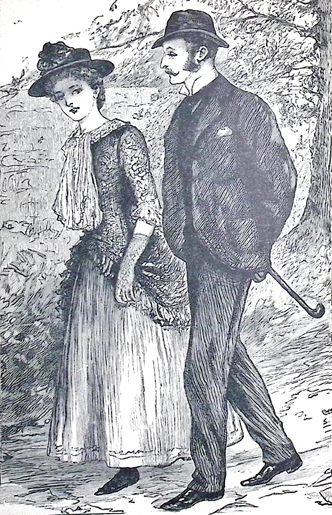
"Another home-thrust for me," said Mr. Carnelly; and it was difficult to tell from his tone whether he was in jest or earnest. "Do you not see, Miss Steyne, that an allusion to your life of active usefulness, and to the work which gives an extra pair of wings to Father Time, is a tacit reproof to a mere idler? It tells me plainly enough, though without words, that if I were equally well employed, my time would not hang heavily on my hands."
"Believe me, Mr. Carnelly," said Grace earnestly, "I never intended my words to convey such an impression."
"I must believe you; but confess—do you not think my mode of life a very reprehensible one?"
"I am not your judge, Mr. Carnelly," replied Grace, with quiet dignity. "If you ask me whether I think a life spent without any definite aim or employment the kind I should choose to lead, I should say 'No.'"
"I believe all good people unite in blaming persons who, having no need to work in order to gain money, and no ambition to become public characters, choose to lead an idle, dilettante life like mine. I go about, admiring all that is beautiful wherever I see it, and I trust, not forgetting Him to whose wisdom and goodness I owe the pleasure thus derived. I prefer the society of the good and noble amongst mankind, and I honour where I cannot hope to imitate their works and virtues. Does such a life deserve unlimited censure? Yet as a rule it gets it. But let a man make a colossal fortune by a new kind of soap, or, say, a fresh method of crystallizing ginger, and the man who has thus served himself is lauded to the skies."
"If the soap diminishes labour and promotes cleanliness, and the ginger is wholesome as well as pleasant to the palate, the inventor has conferred a benefit on mankind. He deserves to be praised, though in serving others he has made a fortune for himself," replied Grace stoutly.
"I cannot deny this; but is the other life so blamable?" persisted Mr. Carnelly.
"I am not so wedded to my busy life as to under-value rest. Indeed, I should sometimes like less work and more play," replied Grace in a half-musing fashion. "But I would say, 'Better a life with too much work than one of the kind you describe.' Mind, I blame no one for thinking differently—I speak for myself; though perhaps, if I could get rid of all sense of responsibility with regard to the use of time and such talents as God has given, I should be as comfortably idle as any person."
"Thank you, Miss Steyne," began Mr. Carnelly.
But the appearance of Mrs. Crawford prevented his saying more on this subject, and the conversation was turned into another channel.
"BEATRICE, Miss Pelham is dead."
Lord Carnelly was the speaker, and his wife the only listener to the news thus conveyed.
"At last!" was her response. "Now there will be an end of the miserable pinching and cheeseparing which I have had to practise through all my married life. The money to which I am absolutely entitled will secure this result, and the children will be well provided for. I wonder whether my aunt will have left her savings to them or to me. She has lived on next to nothing. She was too penurious either to spend on herself or to give to others. She never made me a present of anything that was worth a 'thank you' in her whole life. I suppose there can be no mistake about the news," added Lady Carnelly, turning quickly to her husband. "How did you hear it?"
"From Miss Pelham's lawyers. They wrote to me, thinking that I should break the tidings of your lamented aunt's decease less abruptly than could be done by a direct written communication addressed to yourself. The precaution was perhaps scarcely necessary."
"You need not be satirical, Lindsay. I am no hypocrite, and it is scarcely likely that I should be much distressed by the death of a relative who cared nothing for me, and who kept me out of all she could, and as long as she could."
"Miss Pelham could scarcely be expected to die before her time in order to accommodate you, Beatrice," said Lord Carnelly.
"Who ever insinuated anything so ridiculous?" replied his wife, whose sense of approaching wealth rendered her more than usually lofty in tone and manner. "She might have helped us from her hoards if she had chosen, but people of my aunt's miserly disposition never can appreciate those of more generous natures than their own."
Sadly as Lord Carnelly listened to his wife's hard words, he could not help feeling that they had a ludicrous side. For a woman like Lady Carnelly, with whom self had always been preeminent, to talk of generous natures was almost too absurd. Her lavish expenditure, which had brought no home enjoyment, but involved her husband in debt and caused him to live in perpetual dread of importunate creditors, was dignified as generosity by the lips of her who had indulged in it.
Lord Carnelly hardly dared to hope that Miss Pelham's death would bring much relief to him. The money was strictly secured to his wife, and he feared that she might refuse to free him from his embarrassments.
Whilst he mused, Lady Carnelly was silent for a short time.
Then, turning a triumphant face towards her husband, she said, "Lindsay, I have been calculating how much Miss Pelham must have saved during the last forty years, for she came into her mother's property so long since. I shall very likely get—"
The interruption was abrupt and stern.
"You had much better give up calculating on anything beyond what is absolutely certain. I do not think Miss Pelham would add a penny to it," said Lord Carnelly.
"She might have passed me by if there had been any one else for it. But I am her nearest relative, and the children come next. My aunt had a good deal of family pride, which would, I think, prevent her from overlooking her own flesh and blood."
"Well, Beatrice, you knew Miss Pelham better than I did. The fact of her wealth often kept me from paying her the attentions that I should have liked to render to the solitary old woman. I did not wish to be misunderstood. If you do get the large savings you spoke of, I trust you will dedicate a few thousands of them to paying our debt to my sister. Poor Ida! The thought that her little fortune went because we were living beyond our means is a perpetual trouble to me."
"Our debt!" exclaimed Lady Carnelly. "You surely do not consider that I have any share in that. Have you forgotten that when in India you reminded me that you were Ida's guardian, not I? The idea that I shall find money to replace the fortune for which you are accountable is a little too much!"
Lady Carnelly might have considered herself a deeply injured woman, to judge by the expression of her face as she spoke. It quickly changed as, glancing towards the window, she exclaimed,—
"The blinds have not been drawn down. What will people think of us, if there is a notice of Miss Pelham's death in the 'Times?' There may be, if the lawyers inserted it at once. Why did you not order the blinds to be pulled down?"
"As the bereavement was on your side of the house, I deemed it better to leave all melancholy details to you, Beatrice. However, I will ring if you wish it," was Lord Carnelly's reply.
It was sarcastic enough, and spoken in the bitterness of his heart, as he thought of the way in which his one request for help had been answered.
The refusal of Lady Carnelly to relieve him from the weight of responsibility on account of Ida's fortune meant more than the continuance of the burden.
What were his troubles and anxieties to her? And yet he had brought them upon himself, sooner than refuse her even an unreasonable indulgence, for he had loved this selfish woman, who was still his wife and the mother of his children.
Lord Carnelly was, however, to be relieved in an unexpected manner, though greatly to the mortification and indignation of his wife.
Miss Pelham, though far advanced in years, retained her faculties unimpaired to the last, and was well able to gauge the characters of those with whom she had to do. She was not slow to blame her niece's conduct, and, while she felt the good-humoured contempt which strong natures often entertain for weak ones, and was often heard to censure Lord Carnelly for his folly in yielding to his wife's extravagance, she yet liked the kindly colonel.
Miss Pelham proved both her shrewdness and her regard for her niece's husband by her will. Not one penny of her large savings came into Lady Carnelly's hands.
"She will have far more than she will use well, and than I would allow her to have, if I could help it," the old lady told her lawyers. "Her husband is weak but good-hearted. I have made myself acquainted with his circumstances, and find that he is over head and ears in debt. I mean to free him, and I look to you so to arrange matters that he shall not be able to place himself in a similar fix."
How the lawyers managed this is not for unprofessional persons to narrate. But it was done, and, to Lord Carnelly's deep joy and thankfulness, he found himself freed at a stroke from all his liabilities, through the will of his wife's eccentric relative. If there had been no restraint with regard to future expenditure, past experience would have been enough. Lord Carnelly had known what it was to groan under a load of debt for several past years, and had no inclination to risk it again.
Miss Pelham showed her eccentricity by one legacy in particular. Though the money owing to Mrs. Crawford was paid in full, and with compound interest from the date at which it was due, along with the rest of Lord Carnelly's debts, the old lady left an additional five thousand pounds to the doctor. She gave no reason for so doing, but it may well be imagined that she bequeathed it to make amends for any inconvenience which Dr. Crawford and Ida might have suffered through the nonpayment of the girl's little fortune at the proper time. Miss Pelham knew that her niece's extravagance had caused the money to be withheld, and knowing also Lady Carnelly's disposition, was determined not to trust her to make amends.
The contents of Miss Pelham's will made Lady Carnelly very angry, especially that part which referred to the Crawfords. She found, too, that, large as was the sum bequeathed by her aunt, it fell far short of her calculations.
Miss Pelham's charities had been of a very unostentatious character, and only after her death was it known how many homes had been cheered and mourners comforted by means of the well-timed and discriminating benevolence of her who had been called miserly.
Lord Carnelly had to listen to many bitter words respecting the disposition of Miss Pelham's money. Under the circumstances, he was able to bear the infliction with a grim sense of humour, which almost rendered his wife's tirades enjoyable.
Still, the thought would come, "If only Beatrice were different, how happy we might now be!"
Lord Carnelly, at least, was thankful, and humbly anxious that, by God's help, the future might in some degree repair the past.
To Mrs. Crawford, Miss Pelham's unexpected bequest brought great joy. The knowledge, so long withheld, that Dr. Crawford had never received the money bequeathed to her by her father caused her great trouble. Never during her married life had she felt so much inclined to reproach her husband for want of confidence in her as when he at length told her the truth about her little fortune. Happily, she refrained from uttering the words which were on her lips, for at the same moment, the thought came, "For whose sake did my dear husband keep silence? Was it not for mine, and to spare me the pain of knowing that my only brother had betrayed the trust reposed in him?"
One secret was never told—namely, the true story of the jewellery sent as a birthday gift to Ida, but for which Dr. Crawford paid. One of Lord Carnelly's first acts on becoming possessed of the means was to make the gift a real one, by repaying to his brother-in-law the amount of the jeweller's bill. It was not likely that the doctor would ever spoil Ida's pleasure in the possession of the ornaments by telling her one passage in their history.
Need it be told that, on the actual payment of her little fortune, Mrs. Crawford at once insisted that the doctor should engage another assistant?
"You work far too hard now, Andrew," she said. "I am not a clever woman of business, but I doubt whether your doing without competent professional help effects a real saving. Your practice occupies your whole time, so it would be impossible for you to extend it without another assistant. You need have no fear that I shall break out into any extravagances, though my little fortune has become a reality instead of a myth."
Dr. Crawford agreed that there was something in what Ida said. He had lately doubted whether he had begun his scheme of domestic retrenchment in the right direction. There could be no true economy in overtaxing his strength, and, at the same time, unnecessarily limiting his practice. The doctor therefore announced his intention of filling up the post vacated by Mr. Soames, and was a good deal surprised when Mr. Carnally applied for it.
"You cannot be in earnest," he said. "For a man of your means to fill such a position would be an anomaly."
"In one sense it would, but not in another. I am a fully qualified medical man, and have had some experience, though not within the last three years. I can produce testimonials which would, I think, satisfy you; and as to salary, I care nothing," replied Mr. Carnelly.
"But I do," responded the doctor. "Whoever I engage as my assistant will have to be fit for the work, and to take his full share of it, as well as the remuneration. It is too absurd to think of your filling the post of medical assistant. If you cared for your profession, why did you give it up?"
"I had two reasons. The one was, that I did not wish to be tied to any particular locality, as I had then travelled very little, and I wanted to see something of other countries. Since then, I have had above two years of travel—enough for the present. Is not this satisfactory?"
"Perfectly. Now for your second," said the doctor.
"That I thought it scarcely right, seeing there were so many men struggling to get into practice, for me to enter the arena against them, when I had such abundant means of my own. In my travels, however, I strove to increase my professional information, and I believe I have gained, instead of losing, by my wandering and apparently lazy life."
The doctor shook his head.
"The second reason for not practising on your own account holds good to-day, unless you have become poorer," he said.
"I almost regret to say that I am richer, for my tastes are too simple to allow of a large expenditure upon myself. You want to know how it is that I am now anxious to become your assistant. It is principally that I may convince a—a person, who, I fear, considers me a very useless individual, that I am capable of steady and continuous effort in the service of my fellow-creatures. I might not desire to keep the post for a very long time. I daresay twelve months would suffice."
The doctor's face assumed an expression of intelligence and amusement. "Would it be forcing your confidence if I ventured to ask, 'Is the person a young lady?'"
The colour which overspread Mr. Carnelly's brow vied with that which Grace Steyne could display upon occasion, as he answered, "It is."
"I will not suggest any name," said Dr. Crawford, "but I think it would be quite possible for you to convince her of her mistake without taking a place as medical assistant. I will be very frank with you, Mr. Carnelly. I will not accept your offer, but I hope to convince you that I am equally your friend in refusing it. I feel sure you would wish me to forget everything but the fact that you had engaged to fulfil certain duties, and I have not the smallest doubt of your ability, or that we should work well together. But there are men who need the salary that would be nothing to you, and the experience they would gain under an older medical man. Besides, you say you would not wish to remain here above twelve months. With such a prospect, ought I to introduce you to my patients, and accustom them to your attendance? People do not like strange faces by sick-beds, and object to frequent changes."
"You are right; it would be a mistake for you to engage me," said Mr. Carnelly.
Nevertheless he looked as much disappointed as if his livelihood had depended on gaining the post.
When this conversation took place, Mr. Carnelly had paid several visits to Steynes-Cote, where Grace Steyne was still a guest. Hillstead Magna and Shelverton being within a short railway ride on a main line, and with plenty of trains, what could be more easy than for him to keep up friendly relations with his newly-found kinswoman, Mrs. Crawford?
Those who wish to find excuses are never at a loss, and Mr. Carnelly was constantly running over, always with some excellent reason for taking the journey. The small people in the Steynes-Cote nursery invariably set up a shout of welcome as they caught sight of him; and but for the peremptory interference of their mother, that apartment would soon have been blocked by the toys with which he came laden almost daily.
"Cousin David" was equally a favourite with Mrs. Crawford, and speedily won the good-will of Mrs. Prattely, whose acquaintance he had made. This good lady was very fond of expatiating on Grace Steyne's excellences, and on one occasion she remarked enthusiastically, "What a wife she would make for a poor man!"
Mr. Carnelly replied, with commendable promptitude, "Why not for a rich one? Should not the girl who bravely bears a heavy weight of responsibility in her youth have a lighter burden as she grows older?"
"Grace deserves to have," said Mrs. Prattely; "but she is a born worker, and will always take a full share of whatever her hand finds to do."
From which remarks it is not difficult to guess the tendency of Mr. Carnelly's thoughts.
IN the course of a fireside conversation, Dr. Crawford told Ida of her cousin's proposal to become his assistant.
"What a strange notion!" exclaimed Mrs. Crawford. "Do you think he was in earnest?"
"I am quite sure he was, and that I disappointed him by refusing to entertain his proposal. Not but what he would be admirably qualified. He must have been a diligent student when a very young man, and he has taken every opportunity of adding to his stores of information since, especially during his recent travels. For reasons which do him honour, he gave up practice, but he is most observant, and I am not ashamed to say that I owe him several valuable professional hints."
"I have never done Cousin David justice," said Ida. "I have always classed him amongst the idle, aimless young men of whom, unfortunately, one sees so many; but at the same time, I have thought him very amiable and lovable."
Dr. Crawford took advantage of the opportunity to tell Ida a good many particulars which had come to his knowledge respecting Mr. Carnelly, and gave her his reasons for withdrawing from practice.
"Carnelly did not tell me this," added the doctor, "but I know, also from the best authority, that several poor but clever youths have been indebted to him for the means of prosecuting their studies, and for being now placed in the positions their abilities fit them to occupy."
A good deal more was said, and all in Mr. Carnelly's favour. Miss Steyne was present, but did not join in the conversation. Indeed, she was supposed to be deeply engaged in reading, as her head was bent over a book during the whole time. But as Mrs. Crawford noticed that Grace never turned a leaf until she and the doctor ceased speaking, it is just possible that the girl found it more interesting to listen than to read.
Whether Mr. Carnelly reaped the benefit of this indirect advocacy may be guessed from the fact that the next time they met, Grace lifted her honest face, and with a penitent look thereupon, said, Mr. Carnelly, "I believe I ought to ask your pardon."
"It is granted, Miss Steyne, though I have no idea what you have done to need my forgiveness. Do enlighten me."
And then Grace found herself not a little embarrassed. She had spoken in her impulsive fashion, and from a knowledge that she had misjudged Mr. Carnelly. She had taken herself to task for having lectured him, but it was not easy to tell him so, and she blushed and stammered in a manner very unlike Grace Steyne.
He seemed determined not to help her at first, but waited quietly for an explanation. Then he only caught a few words, because Grace's lips were quivering, and she seemed unable to express herself with proper dignity. She succeeded at last, and looked bravely up in his face.
"Mr. Carnelly," she said, "almost ever since I have known you, I have misjudged you. I have looked upon you as a young man who was contented to lead an idle, useless life, going about from place to place with no better aim than merely to pass precious time in the most agreeable manner. And, though perhaps you may not have noticed it, I have talked at you many a time, as if it were my business to lecture you, or that I had any right to set myself up as your judge. It was presumptuous and self-conceited on my part, and I am ashamed of myself. You know all about it now; please repeat the forgiveness promised beforehand."
Grace and Mr. Carnelly had lately seen a great deal of each other, and the sort of family connection which existed between them through the Crawfords had made their intercourse very frank and unrestrained. Yet scarcely had Grace ended her impulsive speech than she began to wish it unsaid; to wonder if she had been unmaidenly, and to plan an instant escape. And all these thoughts were consequent on an expression which had come into Mr. Carnelly's face as she spoke to him.
She could not run away. That intention was frustrated by a detaining hand which clasped hers, and Mr. Carnelly's answer came in the form of a question.
"Grace, dear Grace, will you accept the office of lecturer for life to one who knows that you deserve the affection of a far better man than himself? You are the only girl I have ever cared for. You had taken partial possession of my heart when, with no little regret, I said farewell to you that night at the rectory. I came back to Hillstead chiefly for your sake, and was bitterly disappointed when I found you were absent. Once introduced at Steynes-Cote, I was able to judge of the good influence you were exercising in my cousin's home, and how soon you had won the good-will of all around you. Grace dear, will you not give me an encouraging word?"
The girl hid her blushing face as well as she could with her one disengaged hand, and murmured something about her father and mother.
"I bring their consent with me, on condition that I win yours. Perhaps I was selfish in wishing to gain a 'yes' from you before letting you know that the blessings of your parents will not be withheld. Only, dear Grace, you must give me this hand of your own free will, and your heart with it, or it could have no value in my eyes."
A whispered answer about not being half good enough reached Mr. Carnelly's ears. The hand, not so slender and white as some girls' hands, because it had known real work, lay still in his own, and Cousin David was contented.
A little later still, and with a glad, proud look on his face, he introduced Grace to Dr. and Mrs. Crawford as his promised wife, and received their heart-felt congratulations and wishes for a truly blessed union in the future.
So Grace returned to Hillstead the affianced wife of David Carnelly. And Hillstead folk welcomed her back again with open arms, for she had been missed on every side.
"Ay, and what's more, wanted too," said an ancient dame, on whom Grace made an early call after her arrival. "You'll have many a kind wish and many a prayer said for you, my dear, and I only hope the gentleman is good enough to deserve such a wife as you will make him."
Before Grace left Steynes-Cote, Jean Graham's illness had terminated favourably, and she was at her old post again, valued more than ever by her young mistress.
"I shall never leave ye, mem, unless ye send me away," said Jean, on the day she resumed work.
"If I thought only of ourselves, I should rejoice to hear you say so, Jean. But I would rather think of you in a happy home of your own," said Mrs. Crawford.
Jean's eyes filled, and she shook her head.
"I dreamed of one for many a year, and the waking was a sore trial. But it is over now. Such dreams cannot come twice in a lifetime."
If anything could have tempted Jean to break her word, the sight of a visitor who came to Steynes-Cote and asked for her in a shame-faced way might have done so. The visitor was Robert Hamilton.
It was only necessary to look at the woebegone, down-spirited man to know that he had reaped the fruits of the seed he had sown.
When Robert knew that Jean had left her father's and returned to Steynes-Cote, he was first angry, then troubled. He had meant to punish her for not giving up her own will and sense of right at his wish and bidding, but he was ill-prepared for the result of his experiment.
When he heard that Jean had reached Dr. Crawford's only to be laid on a sick-bed, his remorse and self-reproach were unbounded. He would have set out for Shelverton at once, only there was no hope that he would be permitted to see her, and day by day he went humbly to the door of her father's house to seek news of Jean.
As to the girl whom he had cruelly intended to play off against his old love, and by her means wound Jean's faithful heart, he could now scarcely endure to see her. This roused the indignation of her friends also, and, upon the whole, Robert Hamilton paid a heavy penalty for his unmanly conduct.
He never knew how much it was to cost him until he stood in Jean Graham's presence, and saw the change which illness had wrought in the woman whom after his arbitrary fashion he had loved.
"Jean, my woman," he said, "I've come all this long way to ask your forgiveness. I've done wrong."
"Ye shall not go into that now, Robert. Least said's soonest mended. Bygones shall be bygones. I forgive ye, and wish ye well," was Jean's prompt answer.
But though the words and tone were kindly, Robert Hamilton felt chilled by the calmness with which Jean spoke. He hesitated, not daring to ask that she would place her hand in his as a token of forgiveness. He looked ashamed, and grieved too, for on Jean's face were marks of suffering and age that time had not wrought, and the hair, so smooth and brown but a few weeks before, was plentifully sprinkled with grey. He knew that his unkindness had caused the change, and would have given all he had to undo his work.
Jean took him into a little room that was called hers, and set food before him, having first told Mrs. Crawford who her visitor was.
"Oh, Jean," said her mistress, "can you bear to see that man?"
"He cannot hurt me now," said Jean.
And she returned to hear the tale of sorrow and penitence which Robert had to tell. She would have stopped him, for the true-hearted woman had no pleasure in the humiliation of the man whose unkindness had cost her so much. But he would speak, and tell her that he would wait for her, if it were for years, so that he might call her his wife at last.
"And how about Elsie Kerr, Robert?"
"As if I ever cared for a foolish bit lass like that, Jean. I only—"
"I know, I know," cried Jean; "ye need not tell me why ye took up with her. Ye meant to give me heartache, and thought to make me angry and jealous, that so when ye came again, and ye wished me to do what conscience said was wrong, I might be afraid to deny ye. And ye never asked yourself what the poor lass might feel that ye were making a plaything of. Robert, I have grieved for her as well as for myself; I have grieved for the Rab I once loved more than all beside. But the Rab that I waited for through all those years, and would have waited for to my dying day, thinking of and caring for no other, never really lived, except in my mind and thoughts."
Robert tried to plead with Jean, but all in vain. The man that could be guilty of meanness such as he had practised could have no more place in Jean Graham's heart. So Robert Hamilton returned to his home a sadder and a wiser man; hopeless, too, so far as Jean was concerned.
Soon after, Jean's father decided to give up his farm to his eldest son, and, having saved enough to meet the modest wants of his wife and himself, he came to Shelverton, and took up his abode in the pretty lodge at the entrance of the Steynes-Cote grounds. A young granddaughter accompanied the old couple, and Jean had the additional comfort of being near her parents, and the pleasure of adding to theirs by going in and out of their home almost daily.
After a six months' engagement, Grace Steyne became the wife of Mr. Carnelly, and, to the great delight of Mrs. Crawford, they fixed upon a charming place about midway between Hillstead and Shelverton as their country home.
Unfortunately, Mr. Carnelly is likely to inherit the family title, for Donald's young life was cut short by a sad accident during a shooting excursion. A fellow-sportsman, carrying a loaded gun, was passing through a gap in a hedge, when the trigger was caught by a bough. The gun went off, and poor Donald was so seriously injured that he survived the accident only three days.
Lord and Lady Carnelly in their great sorrow sent for Dr. Crawford, who went at once, and did all that skill could do for the unfortunate young man, but in vain. This trouble has done much to soften Lady Carnelly and to bring her and her husband nearer together, as well as to bridge over the gap between her and the Crawfords. After she and Ida had mourned together beside the grave of poor Donald, it was impossible for the estrangement to last, and the families continued to meet on terms of friendship hitherto unknown.
Lord Carnelly takes comfort from the fact that the title and the estates which go with it will fall into no unworthy hands when they pass from his to Cousin David's.
Mrs. Crawford has long ceased to be a girl-wife. She has tall sons and graceful maidens round her, who call her mother. But fair as the daughters are, Mrs. Prattely will not allow that even her god-daughter and favourite, Doris, is worthy to be compared to what Mrs. Crawford was when she first came to Steynes-Cote. She is very faithful to her old love.
Perhaps Mrs. Prattely is right. But to Dr. Crawford his wife is fairer by far than she was when she first won his heart. He can speak to her now of those things which are nearest to his own, and, instead of looking in vain for sympathy, he sees a light in her face which tells of the divine light in her soul. He knows that, whilst entering into all his earthly joys and sorrows, she looks beyond them, and shares in all the aims and hopes which have their fulfilment only when the fashion of this world has passed away for ever.
He remembers how she made a new beginning after her four years of mistakes during their early married life—mistakes for which his own want of entire confidence was as much to be blamed as her want of thought. And he thanks God with a full heart that the partner of his maturer years has found the same blessed source of strength as himself, and that in every difficulty they can seek guidance together at the throne of grace.
Not even Mrs. Fereday was ever more beloved in Shelverton than Mrs. Crawford is now. She finds time for loving ministrations amongst the young, the sick, and the poor, and her very grace and beauty gave an additional charm to her efforts for the happiness of others when she first began them.
It is ever so. Those who do much find time to do more, and the more they think and care for others, the more are they blessed in their own lives.

THE END.
PRINTED BY MORRISON AND GIBB LIMITED, EDINBURGH